Fifty years since Benjamin Britten died, and his operas are still in repertory: half a dozen of them at least. It’s a tribute to his theatrical, as much as to his musical, genius that these works still punch their weight on the stage as much as on disc; and perhaps none of them punches it harder than Billy Budd, which Glyndebourne are reviving in Michael Grandage’s spectacular production from 2010.
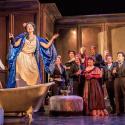
In Billy Budd, as in Peter Grimes, Britten’s tragic agent is the sea. But whereas in Grimes the sea is purely the mechanism behind events on land, in Budd it is all around, an image of life and our perilous voyage through mists and storms towards what Captain Vere (pictured below with Flint, William Thomas, and Redburn, Dingle Yandell) calls the land where our ship can anchor forever. The irrational sequence of 34 semibreve chords that grope their way though Vere’s mind as he goes to somehow break the news to Billy of his unjust condemnation are only the most brilliant example of Britten’s ability to match music to situation in the most precise and powerful fashion. Throughout, this is a score that, like it or not, breathes the harrowing grimness of its libretto without remission and without apology.
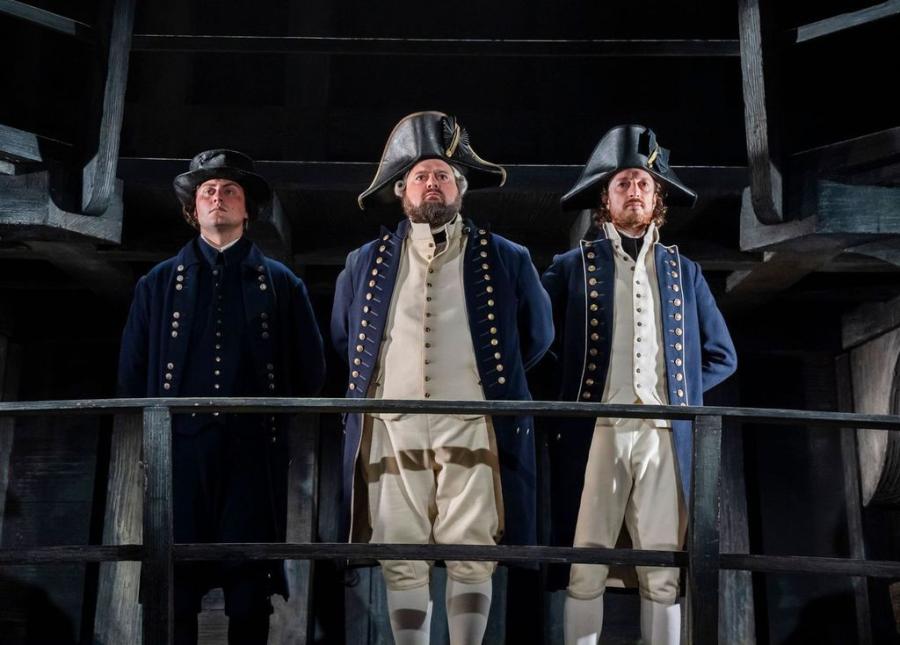
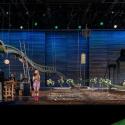
There’s little scope here for parallel (or oblique) directorial concepts, and Grandage embraced the work on its own graphic terms, accepting its imagery and context without embroidery: the agony and injustice of life on a 74-gun man-of-war in the French wars of the late 1790s. Ian Rutherford’s revival in no way relaxes the intensity of the original. Christopher Oram's set lands us not so much on as inside Vere’s ship, the Indomitable, with little or no view of any open sky. Life is not just hard; it’s brutal, remorseless, nearly meaningless: punishment without cause is routine, the snuffing out of the one light, the supremely open-natured Billy, ultimately inevitable.
All this is in the music, and Sunday’s opening under Nicholas Carter held nothing back. The playing by the London Philharmonic Orchestra was wholly superb, realising the abrasive force of Britten’s highly discriminate scoring - sonority as a metaphor of conflict and the brooding darkness. And the choral and ensemble singing never faltered. This is music that stays in the mind as a totality into which the solo episodes merge, even though the work starts and finishes, in a kind of irony, with Vere’s solo reminiscences, lamenting - after all - his ineffectuality.
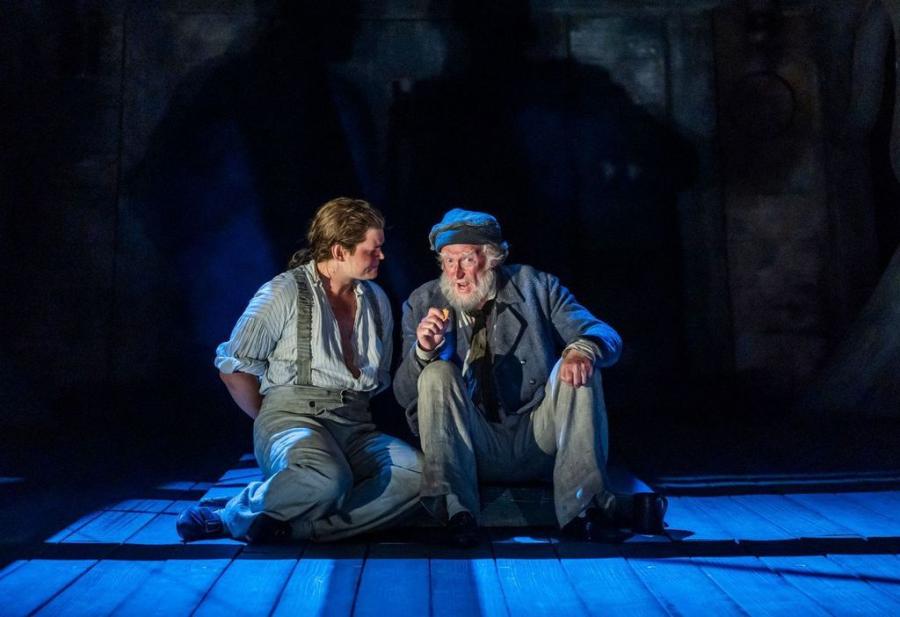
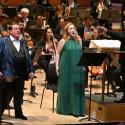
Allan Clayton’s Vere is beautifully sung and skilfully pitched. His is the tragedy of the philosopher, the dialectician, faced with a life or death choice, and his shambling prologue and epilogue express his failure as much as his too easy vision of redemption. Also marvellously exact is the young baritone Thomas Mole’s Billy (pictured above with Dansker, Clive Bayley), unattached, without regrets, trust and energy on two legs, ready for anything, even disappointment, even death. The character can seem improbable, but Mole brings it off, with just enough inwardness to ward off vacuity, and the voice is fine, clear, suitably natural.
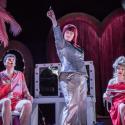
Always more problematic is the villain of the piece, Claggart, the Iago-like Master-at-Arms. Sam Carl (pictured below with Daniel Norman's Squeak), with his richly resonant bass tones, gives a chilling portrait of this self-styled agent of annihilation, but doesn’t altogether offset the image of the pantomime demon.
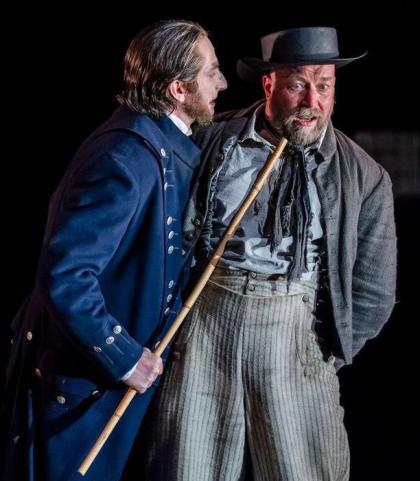
If anything, Claggart’s evil needs softening, complicating, not exaggerating. But the fault is perhaps Britten’s. By giving Claggart no saving grace of any kind, he encourages the demon-king aspect; and his music is of positively Verdian venom, sung here with relish by Sam Carl.
But Billy Budd is equally a work of vital small roles, a real company opera. There are almost too many to name, but all are excellent: Clive Bayley’s Dansker, Samuel Dale-Johnson’s Donald, Laurence Kilsby as the poor Novice, flogged for tripping over then frightened into suborning Billy. Also the officers, Dingle Yandell, Daniel Okulitch and William Thomas - forced by Vere’s silence into condemning Billy to the yardarm. These and several others are the reality of life, against which the exceptional has no defence.