Poor Oberon! An opera scorned so long as weird and silly,
A mash-up of outlandish tales all chucked in willy-nilly.
Now brave Sir Mark (the Elder one) rides out to save its name.
On Albert Hall’s broad field, will he win immortal fame
And glorify the final work of Carl Maria Von Weber –
Or leave the Prommers fretting over so much wasted labour?
OK, I’ll stop there. Timothy Knapman’s new narration for Oberon replaces the original dialogue by James Robinson Planché – universally dismissed as a calamitous botch – with a narration in corny, witty jingling heptameters that irresistibly bore into your brain. Slyly delivered by Tamsin Greig as she wandered far and wide around the stage, with plenty of comic pauses to relish, it anchored this Proms version in the pantomime tradition to which the first staging of the opera at Covent Garden in 1826 no doubt belonged.
Originated by the Monteverdi Choir and Orchestre Révolutionnaire et Romantique, and enthusiastically championed by Mark Elder, the much-mocked (but, musically, much-enjoyed), Oberon now had a a bicentenary chance to cast its spell again. It turned out that this preposterous crash of A Midsummer Night’s Dream into the Thousand and One Nights and medieval chivalric romance – derived from Christopher Martin Wieland’s 1780 poem – elicited from the dying Weber what those Covent Garden punters of 1826 might have thought of, if not exactly called, one absolute banger after another.
The action (Bordeaux to Baghdad and Tunis, via Oberon’s fairyland) is a ludicrous farrago. In contrast the music delivers one dose of enchantment after another. There’s a post-shipwreck sequence at the start of the second part (the Proms adaptation compresses three acts into two) when the French knight Huon’s rapt Handelian prayer (“Ruler of this awful hour, spare, oh spare, this tender flower”) yields to the terrific proto-Wagnerian cantata of the heroine Reiza’s invocation of “Ocean, thou mighty monster”. Then a couple of mezzo mermaids swim by and warble deliciously in a duet about “How pleasant it is to float in the sea”. Why? Search me, but it’s an utter and complete delight.
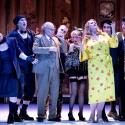
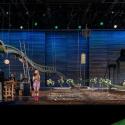
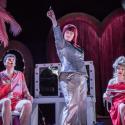
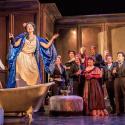
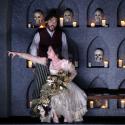
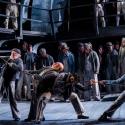
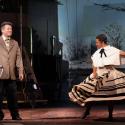
Anyone who heard Oberon in the right, up-for-anything spirit last night would have had a whale of a time. True, the semi-staging by director Emma Doherty had its creaky am-dram moments as the Monteverdi Choir bustled from Oberon’s fairy court to the Baghdad palaces of Haroun al Rachid, stormy Mediterranean shores and gardens in Tunis. Authenticity? Does not apply. Consistency? Who cares. But in general Doherty deployed her spaces and forces cleverly, from spotlit intimate episodes up beside the organ to farcical ramblings down in the arena.
As for the “plot”, better go into Knapman mode and get this over with:
Titania and Oberon have had a spat again.
Are men or women most disloyal? The Fairy King can gain
The upper hand by showing her a loving, steadfast pair.
So via his magic teleport he sends Huon by air
To win the heart of fair Reiza in faraway Baghdad
And seize her from the tyranny of dread Sultan, her dad.
But this Entführung’s no done deal as Puck whips up a squall
That dumps the pair (plus squire and maid) in Tunis, and in thrall
To one more shifty sheikh – an Orientalist’s wet dream.
The smart servants will save the day. They hatch a cunning scheme.
Their rescue plan: just find and toot the occult horn (no laughter!)
And Oberon will whisk us back to happy-ever-after.
Ludicrous intrigue, lovely music. How to square the circle? The performance, to my ears, took a little time to settle into a tone that balanced fun and fervour without skidding too far in the direction of Gilbert-and-Sullivan high jinks. Nicky Spence’s fairy monarch never faltered: vulgar, tetchy but commanding, a capricious panto ogre with a soft side. If John Findon’s big-boned voice as Huon initially overdid the Heldentenor pose, and veered towards parody, he nailed a thrilling solemnity in that hymn and credible exultation in his final ode to joy.
Jennifer Davis gave early proof of her quality in the ravishing guitar-accompanied lament over her betrothal to an oaf, and in her “Ocean” showpiece channelled all of this music’s startling grandeur – as if The Flying Dutchman had suddenly sailed into The Pirates of Penzance. Before her liberation in Tunis, her aria “Mourn Thou, poor heart” plunged us into an authentic gorgeous melancholy, only for fairy-tale twists to smash the spell. Such comically violent mood-swings buffet this piece at every turn.
If anything, the servant couple– Yannick Debus as Huon’s sidekick Sherasmin, and Rachael Wilson’s attendant Fatima – upstaged their employers in polish and charm. Debus and Wilson’s East-West duet about the rivers that nurtured them proved a vocal highlight of the night, and Wilson’s own laments as “A lonely Arab maid” landed with impeccable tone and poise. J’Nai Bridges’s green-cloaked Puck steeped her lines on audible mischief and merriment. That mermaid duo – Jessica Cale and Charlotte Bowden – surfaced with one more treasure from a score improbably packed with real gems that glitter amid the panto paste.
Elder, a true champion of this much-patronised alloy of the sublime and the ridiculous, ensured that the period instruments of the ORR sounded skittish, light, swift and agile. In his hands the music’s humour avoided facetiousness, and its tender lyricism steered clear of mawkishness. Horns and trombones hinted at rusticity while never losing their refinement. Woodwinds captured all the dancing, breathy enchantment of a work that matches or tops Mendelssohn’s own Dream for elfin wit, and the spread-out strings projected a sense of amplitude without heaviness.
Often required to be sombre and monumental, the Monteverdi singers grabbed the chance to enjoy themselves with unflagging gusto and grace. Does Weber’s fairy folly earn a place in every hall? The jury’s out on that. But still – good times were had by all.
More classical reviews on theartsdesk