

Can the 1916 Prologue of Strauss and Hofmannsthal added to a revised version of a 1912 opera-within-a-play setting the backstage shenanigans to music ever fail? Yes, alas. It fell horribly flat last night despite some radiant singing. The love story of deserted Ariadne finally being persuaded by young Bacchus is harder to make live and breathe, but it has in the past - notably and most movingly at Garsington in 2023 - and again it didn't achieve anything like its full humanity here, despite so many glorious sounds from stage and pit, fully backed by the supportive conducting of Robin Ticciati.
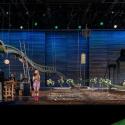
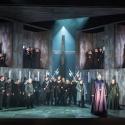
Trying to fathom Pelly's logic, or fantasy, was especially hard in an unfunny first half. The audience laughed at the supertitle translations of the wittily set text, but onstage humour was only of the bluntest. Massimo Troncanetti's set discards multiple dressing room doors and replaces them with one big ornate entrance, moving from left to right of the stage during the course of the action. Characters rarely interact, acting out puppet gestures which robs them of their palpable human feelings. Biggest casualty in this respect is the wonderful Samantha Hankey's Composer - not so much an overheated, gifted adolescent as a worn-out, jerky psychopath in the making.
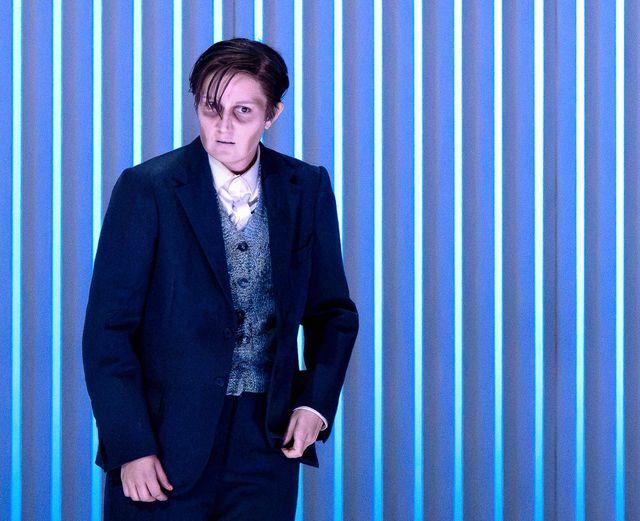
Even though Hankey sings his inspirations with full refulgence, and though Ticciati paces ideally with all details within the 38 piece orchestra coming through, you aren't really moved by his plight. Michael Kraus as his mentor the Music Master is unusually sonorous, but doesn't move quicky enough in repartee with the Major Domo (William Relton, delivering the usual shtick) of the "richest man in Vienna" who eventually decides that the lad's Opera Seria should be performed simultaneously with the "vulgar entertainment" of the fickle Zerbinetta and her suitors.
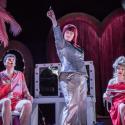
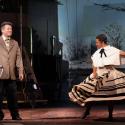
Does the real Zerbinetta have a tender side; is there ambiguity in her opening-up to the Composer? Not here. Aline Wunderlin is vocally ideal, game for all the titupping and finger-waggling she has to deliver so repetitively in Pelly's limited opportunities for her, and her big aria in the middle of the opera proper is perfect. You almost think she's going to deliver a real human being as she rages against the desert islands she's found herself on with monster men, but the recit recedes into the all too common playing to the audience (I can't forget Jennifer France giving us the full, troubled humanity for Scottish Opera/Opera Holland Park and at Garsington).
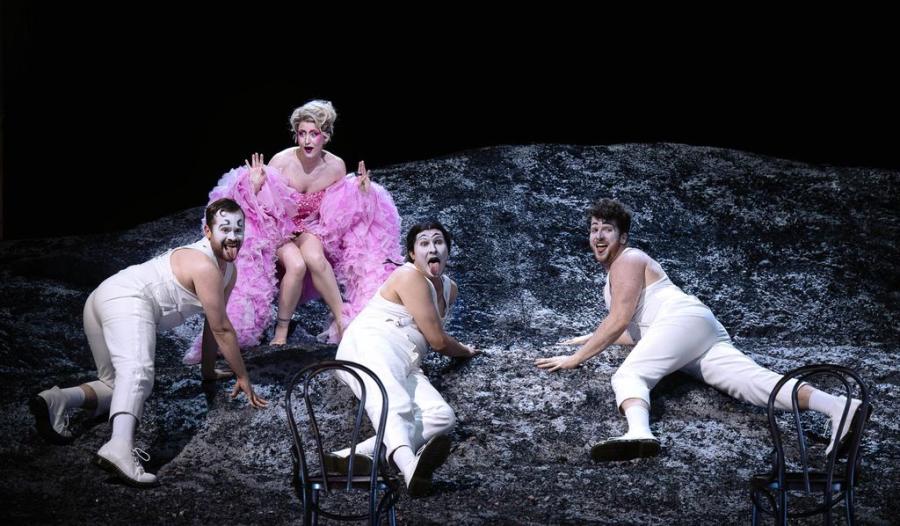
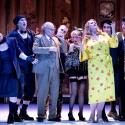
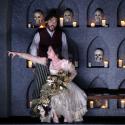
The other big problem is that the troupe makes little attempt to interact, however gauchely, with the deserted Ariadne and mugs to the crowd in front of them. Vocally, again, the four stooges - Mikhail Timoshenko, Liam Bonthrone, Liam James Carai and Casper Singh (three of them pictured above with Wunderlin) - are excellent, and even sexy, but the bottom-wiggling and tongue-poking get wearisome after a while.
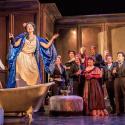
The nymphs of Naxos - Anna Denisova, Ekaterina Chayka Rubinstein and Eirin Rognerud - create gorgeous vocal patterns but look physically exhausted to match the object of their sympathy. Rachel Willis-Sørensen, having given us an ideally plucky Prima Donna in the Prologue, is made up and dressed (costumes by Pelly) to look like Elektra at the gates of the Mycenae Palace.
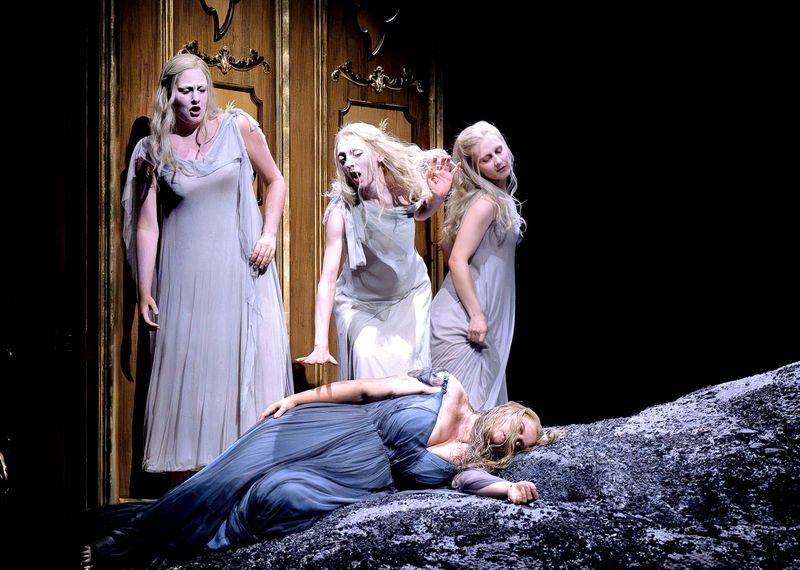
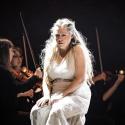
Sure, Theseus' desertion has taken its toll on her and she wants to die, but the soprano radiance above the stave at which this soprano so excels belies the misery. Willis-Sørensen gives it her all, but the production pulls her down, especially as she, too, has nothing to give physically but limited hand-gestures. Ticciati actually goes too slow at times here (though don't blame the music for the number of slumped folk around me). The slag-heap/lava rock is difficult to negotiate too, though it looks good.
Will Bacchus save the day, dramatically speaking? We know how secure David Butt Philip is as a lyric-heroic tenor. But the final duet, so musically ravishing, turns into a park-and-bark scene (again, Young Woo Kim was so touching as a lost boy to Natalya Romaniw's grieving Ariadne at Garsington; this leaves us dry-eyed, despite the way in which Ticciati makes the chamber orchestra sound like a very full symphonic engine). This soprano and tenor are big voices more used to filling bigger spaces, and they weary the ear after a while, as the orange glow at the back does the eye after we realise it's not informing the end.
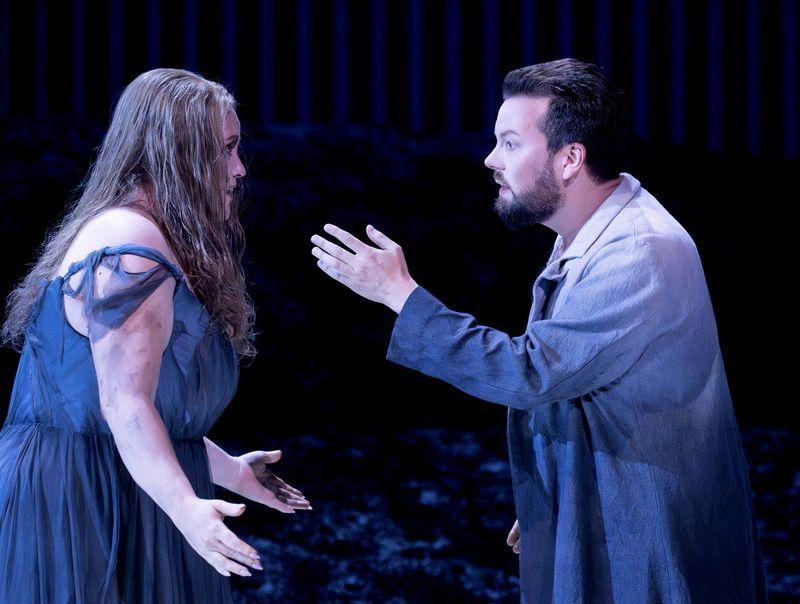
The final elements hammer nails into the production's coffin. As Bacchus gets the last vocal word, Ariadne turns back into Prima Donna and sulks (or so it looked). The Composer has hung around looking more rapt at his inspiration than we are; Zerbinetta hangs on too at the front of the stage and hopes he'll join her. He leaps into the void; she gets picked up (literally) by Harlekin.
The musical curtain of the revised opera, luminous to the last, can't take it; in the original, the harlequins all sing and spin off, and M. Jourdain - for an adaptation of Moliere's Le bourgeois gentilhomme was Hofmannsthal's original structure, the opera taking the place of the Lully-scored Ballet des Nations - gives the epilogue. You can't have it both ways, and Pelly ends as disappointingly as he began. The previous Glyndebourne Ariadne, directed by Katharina Thoma, had its problems, but also its humanity. This one doesn't. I'd happily listen to a radio broadcast, though, which you can do when a semi-staged version visits the Proms.

Add comment