

The first question is always: Don Carlos or Don Carki? Verdi’s opera was originally composed for Paris in 1867, in French, with the requisite five acts and the inevitable ballet. For Milan in 1884 he reduced this to four acts, dropping the whole of the first act and the ballet, and making substantial revisions to what remained, as well as of course translating the libretto into Italian. There were many tinkerings in between.
Jo Davies’s production, made for the Hampshire Grange Park Opera a decade ago and now revived for the second time at the Surrey Grange Park, opts (somewhat unfashionably) for the 1884 version, a choice that carries both advantages and disadvantages. The loss of the whole first act between Carlos and his betrothed, then abruptly unbetrothed, Elisabeth de Valois to some extent thins out their later psychology, and it also loses one or two musical connections; on the other hand, the Italian language is generally easier on the voices.
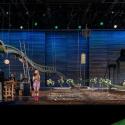
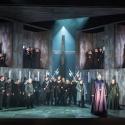
But of course the crucial point for this revival, as before, is how to fit such a grand and intermittently spectacular opera on to so small a stage. It’s true that Verdi’s interest in the public arena was mainly its effect on the personal lives of his dramatis personae. But you do still need the public arena. Davies’s solution to this knotty problem is essentially to ignore it. For the most part she tyre-levers the action into what looks like the foyer of a smart parador hotel (designer Leslie Travers) - polished 'timber' walls and batten lights with a tree behind glass, all subtly lit by Anna Watson - opening it out in somewhat token fashion for the monastery and auto-da-fé.
On this basis she can run together several of Verdi’s intimate ensemble scenes, but it also entails two or three lengthy scene changes at awkward moments, all of which slightly upsets the rhythm of the drama. Visually the effect is somewhat drab: costumes black and brown, white, ironically, only for the quasi satanic figures of the Grand Inquisitor and his acolytes at the auto-da-fé.
Finally, what to do about the ending? Verdi has Carlos saved from the Inquisition by being dragged into his grandfather Charles V’s tomb by its supposed occupant. Jo Davies, forgivably, rejects this nonsense, but instead has the Grand Inquisitor hardly less improbably personally cut Carlos’s throat, which I suppose is some echo of the ending of Schiller’s play, where Philip II hands his son over to the Inquisitor for, presumably, torture and the rest.
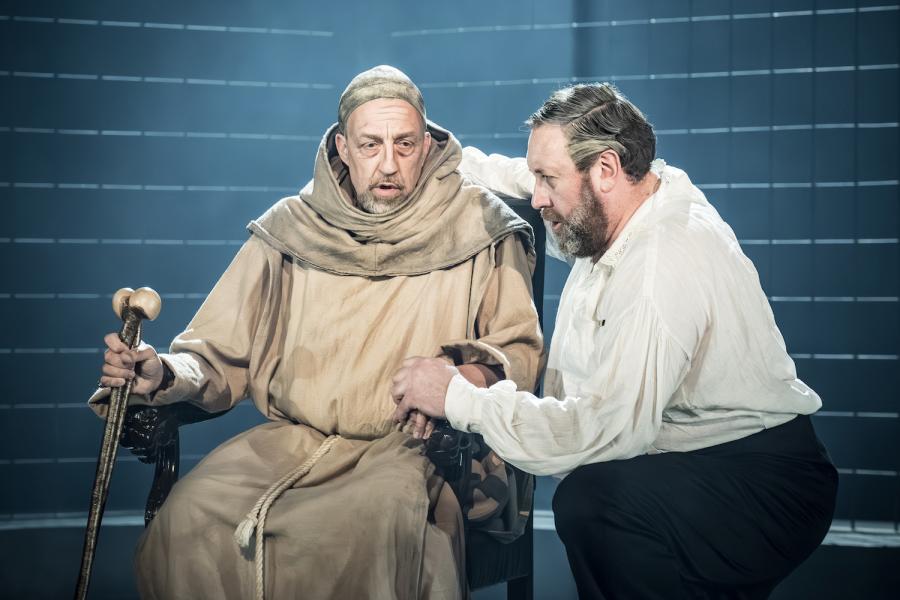
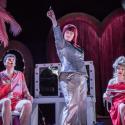
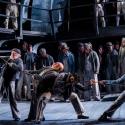
But if the staging has its limitations and its quirks, they are to a large extent redeemed by the performance. Already in 1867 Verdi was composing those superb personal confrontations that elevate his work above all other Italian opera, and the 1884 revision enriches them still further. Matthew Rose is a superb presence as Philip II, tormented by the powerlessness of power against feeling; his monologue just before his meeting with the Grand Inquisitor, not much altered from 1867, is one of the high points, and the confrontation with Julian Close’s sinister, decrepit Inquisitor (pictured above left) keeps up the tension.
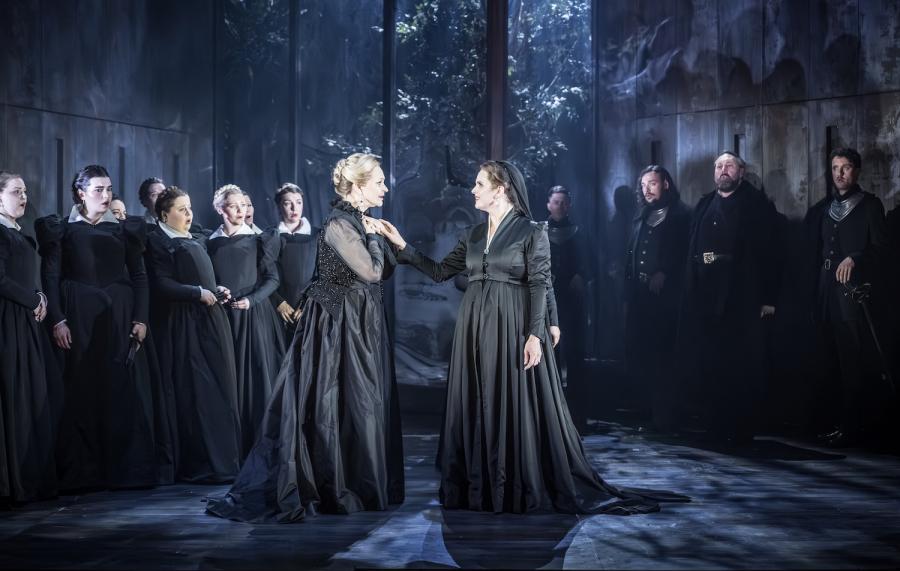
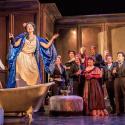
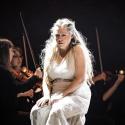
But Don Carlo is rich in such conflicts, inner and outer. Elin Pritchard’s Elisabeth, though deprived of her emotionally decisive first act, is finely paced towards her great final act aria of renunciation, delivered with outstanding control and lovely tone. Ruxandra Donose convinces as the deeply troubled Eboli (pictured with Pritchard), brilliantly extravert in the Veil Song, almost touching in her great scena “O don fatale”, where she chooses to blame her treachery on her good looks. Michel de Souza is a suitably incisive, largely unconflicted Rodrigo, a noble character whose uprightness can have a disconcertingly pragmatic appearance.
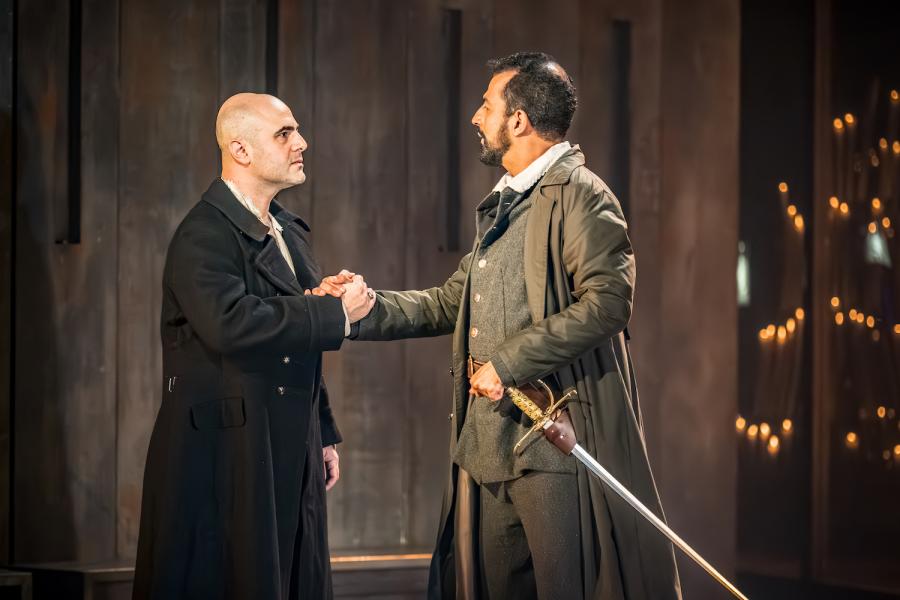
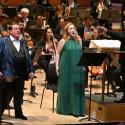
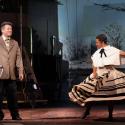
The one casting that fails here for me is the Georgian tenor Otar Jorjikia (pictured above left with Michel de Souza) in the title role. Though his voice is powerful, his singing lacks refinement and his acting is wooden. He is, moreover, a somewhat old-looking Carlos. This might matter less with a less stiff presentation. As it is, it weakens the emotional core of the drama, which is that Elisabeth, having thought she was marrying a young prince, has ended up with an elderly tyrant.
Gianluca Marciano, who conducted the production when it was new, has the style at his fingertips. Everything is well-balanced and paced, and there is a lot of outstanding playing by the English National Opera Orchestra, the brass especially. The chorus work is likewise excellent. The reduction in scale inevitably affects the grandeur of Verdi’s orchestral canvas but in no way spoils the detail.

Add comment