

Any conductor undertaking a journey through Mahler's symphonies - and Vladimir Jurowski's with the London Philharmonic Orchestra has been among the deepest - needs to give us the composer's last thoughts, not just the first movement (which, along with the short "Purgatorio" at the centre of the symphony, was all that Mahler fully scored). Or so I thought every time I heard Deryck Cooke's restrained but not anaemic performing version. Last night I wished Jurowski had left it at the opening odyssey, as perfect as I've ever heard it, and not espoused fellow Russian Rudolf Barshai's "completion".
Although Jurowski, as quoted in the excellent programme note by Stephen Johnson, thinks that this version "brings Mahler more into the proximity of Shostakovich and perhaps Britten", I beg to differ: Shostakovich at his most thickly-scored, possibly, but never Britten, whose relatively lean textures seem to me more often evoked by Cooke's bonier, not "milder" (pace the conductor), edition.
It's not that Barshai interferes with "creative" ideas of his own, like Clinton Carpenter (way too invasive). The main problem is what the Russian does with the two scherzos: the first stripped of its joy in life, with Jurowski offering a plausible mania in the coda as alternative to the radiance evoked by Cooke, the second too congested to suggest Mahler's self-described dance with the devil, if you can equate that with a skeletal Brother Death.
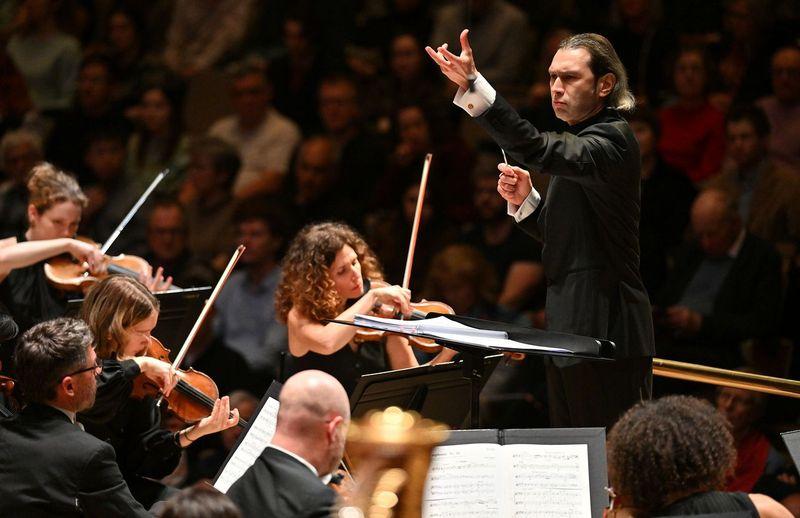
Barshai's percussion section brings in the guitar from the Seventh Symphony's bittersweet serenade, fine, and Shostakovich wood-block rattles, not so much; there are also way too many timpani rolls. But the most troubling aspect is the too-constant use of mass brass; it was fascinating to see how Mahler holds back the trumpets in the first movement until the apocalyptic wave, and while the scherzos' moods are quite different, the "less" of Cooke is still more.
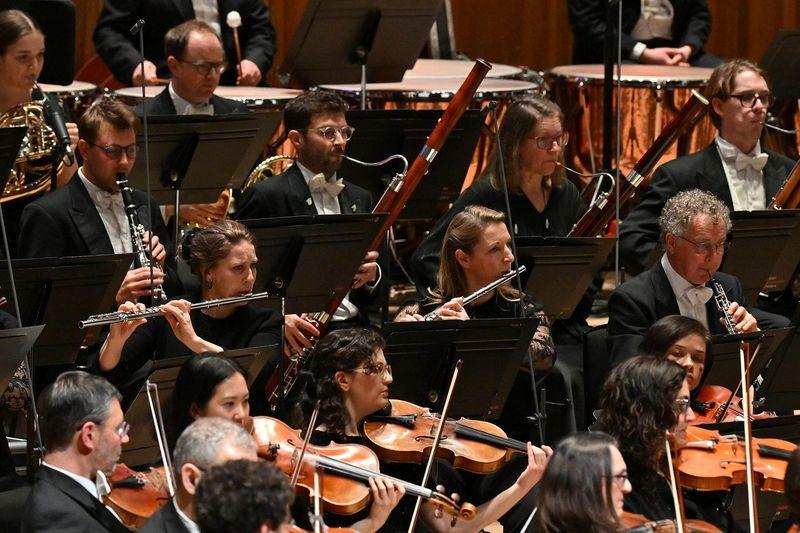
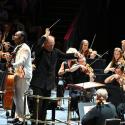
The searing essence of the finale felt reduced too: no-one could deliver the flute song with greater eloquence than Juliette Bausor (pictured below in the middle of her equally superb woodwind colleagues), but the string takeover felt too cramped, overly sentimental (true, this paean to restored love of Alma teeters on the edge, but usually moves too much for one to worry).
This, oddly, may not have been Barshai's fault but Jurowski's: ultimately disappointing since he had gauged the inwardness, the move towards climaxes, so superbly in the opening movement. So it was hard to join the standing ovation at the end, despite huge admiration for the orchestra and its stars of the evening - Bausor, first trumpet (not Paul Benniston as advertised) and first horn Annemarie Federle. After Wednesday's blistering success, this one didn't work for me. Fortunately, this month also sees the CD release of the extraordinary live Mahler 9 from this same team, and that shouldn't be missed.



Comments
Jurowski Mahler 10