To watch Martin Hayes play the Irish fiddle is like watching a man possessed by his music. As his bow flickers across the strings the infectious energy of it spills into the air, through his limbs, and eventually out into the whistling, whooping crowd.
Through the course of his career, Hayes – most famous for founding the Irish-American supergroup The Gloaming – has joined forces with musicians ranging from Paul Simon to Yo-Yo Ma, and played everywhere from small pubs to Obama’s Whitehouse. At Koko last night, with his ensemble The Common Ground, his virtuoso repertoire of Irish traditional music spliced with jazz, avant-garde classical, and shimmers of rock filled the venue with an exuberance that made us feel like sycamore leaves spinning in the wind.
The evening – which marked the 234th crowd-funded classical gig (or “noisenight”) for the pioneering Through the Noise – began with the lilting, mournful melody of Wild Geese, an Irish tune that dates back to the 17th century. The title honours the thousands of Irish soldiers who fled to France and Spain after the 1691 Treaty of Limerick, which ended the war between the exiled James II and William of Orange and allowed safe passage for Catholics to the continent. At first it was the lyrical swell of Hayes’ violin that dominated, as Cormac McCarthy on the piano and Kyle Sanna on the guitar provided a gentle arpeggiated accompaniment that rippled beneath the melody like a clear stream over pebbles. As the piece progressed, Kate Ellis introduced more melodic lines on the cello while Brian Donnellan heightened the sense of melancholy with quavering notes on the concertina.
Without pause for breath, we were swept into a rendition of Lord Leitrim, which began with a soulful tune on the cello that was gradually superseded by a lively jig from the fiddle, weaving itself over the cello notes like lace. As the fiddle motif became louder and louder, the crowd started to whoop and clap, already intoxicated by Hayes’ playing. This led seamlessly into the blazingly energetic Port an Deorai, and on to the whirligig of My Mary Ann. When the first session ended with a madcap swirl through The Boys of Ballisodare it felt as if the energy could take the roof off.
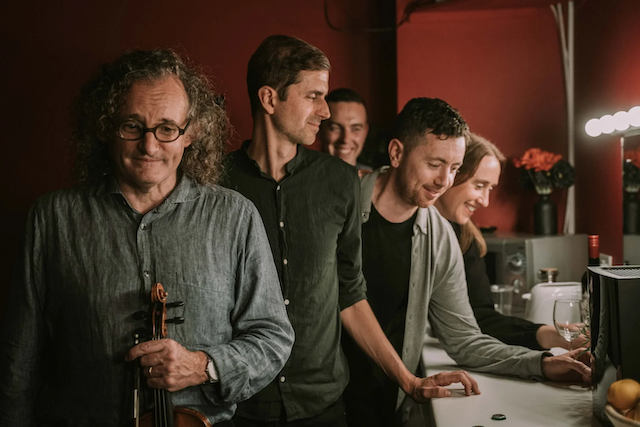
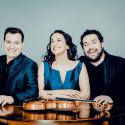
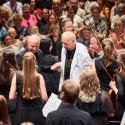
No small part of the thrill of watching Hayes (pictured above, front) play was that of seeing a performer who had put his ego to the side and completely surrendered to the music. In the Common Ground Ensemble, he had brought together musicians at the top of their game, whose collective experience embraced jazz improvisation, avant-garde classical, and new composition. What unfurled in front of us resembled a joy-filled musical laboratory, in which the musicians took it in turn to experiment before the rest of the ensemble joined in.
At some points it was Donnellan introducing new musical ideas and cadences either on his concertina or his bouzouki. At others it was McCarthy, either making the piano more percussive by dampening the strings with one hand or executing passages that shimmered like gold raindrops. There were times when Sanna made his guitar sound as ethereal as a harp, though he could also make it growl with the menace of a mythical dragon. In the meanwhile Ellis held her own, alternating between velvety lyricism, taut pizzicato, and mistily atmospheric harmonics.
There was a sense of dance and elation throughout but highlights of the evening included Music on the Wind, which began with Hayes’ swaying in time to Donnellan’s yearning concertina solo, before whipping the whole ensemble up into a devilish dancing frenzy. In the wistful poetry of Little Jennifer, Hayes and Ellis’s playing was so resonant it made Irish dancehalls and rolling green landscapes flash before your eyes.
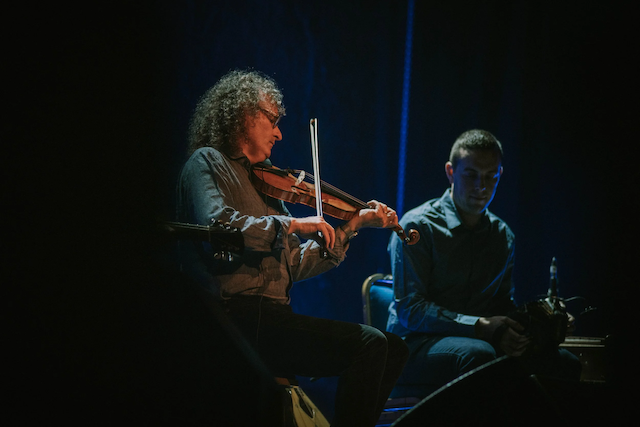
For the last part of the programme, the ensemble was joined by the American singer-songwriter Sam Amidon who among other achievements recently tutored Paul Mescal and Josh O’Connor to sing for the film The History of Sound. He started by singing his elegiac love-song Saro in a wheat-dust-filled voice, before moving onto the more jaunty Wedding Dress. His style meshed seamlessly with The Common Ground’s, though he brought a greater sense of reflectiveness along with his appreciation of the idiosyncrasies of everyday life. At the very end, he led the audience in the chorus of Time Has Made A Change In Me, an introspective reflection on mortality in which the voices of the crowd rose eloquently to the ceiling.
We weren’t quite ready to go though, and happily Hayes and The Common Ground were ready to oblige by delivering more energy and joy with their encore. A final outburst of giddy exuberance ensued, in which the dancing and whooping resumed, sending everyone out into the street with enough of a spring in their step to negotiate the unpredictable twists and turns of the Northern Line journey home.