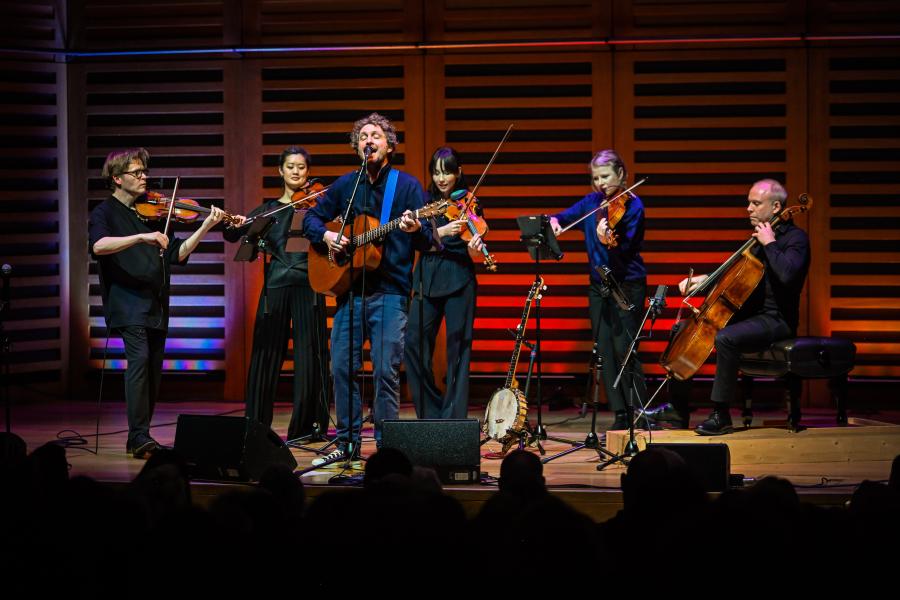
Last week I saw Tom Stoppard’s Arcadia, a play which behind its pyrotechnic wit affirms that sorrow and calamity can strike chaotically at the heart of any human idyll. At first glance, the programme presented at Kings Place by the ever-resourceful Finnish violinist Pekka Kuusisto, with Vermont-born folk singer-songwriter Sam Amidon and a quartet from the Norwegian Chamber Orchestra, looked rich in time-honoured pastoral pleasures.
The launch concert for Kuusisto and Amidon’s new album Willows, on the Platoon label, it featured a string quartet arrangement (by Martin Gerigk) of Vaughan Williams’s The Lark Ascending, a clutch of songs from American folk traditions by Amidon, in arrangements by Nico Muhly, and string pieces by contemporary American composers Caroline Shaw and Ellen Reid.
But “Et in Arcadia ego”: I, Death, am always there on your enchanted ground. Kuusisto’s wise-cracking presentation – sending the stand-up routine into the recital hall with deadpan charm – made it clear that devastating grief frames and unites this genre-hopping project. In 2022, he lost his brother, and fellow-musician, Jaakko. As he first recorded the Lark in that year, his mother died. The remaining items on the album date from 2025, when he lost his father.
Written on the eve of the Great War, and performed in its immediate aftermath, of course Vaughan Williams’s heavenward flight on the violin felt more than ever like an elegiac ascent from blood-soaked, pain-stained earth. Lyric mourning cast its heavy shadow too over Amidon’s quietly searing set, which included the New England “sacred harp” hymn “Kedron”, addressed to the crucified Christ: “Thou man of grief, remember me/ Thou never canst thyself forget/ Thy last exploring agony/ Thy fainting pangs and bloody sweat...”
So Kuusisto’s droll shtick contrasted piquantly, sometimes uneasily, with the colours of lamentation that painted the evening elsewhere. It still worked effectively, not least because the string pieces made for balance and relief: above all, Caroline Shaw’s Plan and Elevation. The horticultural and architectural spaces summoned by the movements of this quartet – “The Herbaceous Border”, “The Orangery” etc – and its origin, as a commission by Dumbarton Oaks, signal a Stravinskian neo-classicism, although Ravel and Mozart (Shaw’s frequent touchstones) also lie somewhere in the mix. Yet, maybe because of the context for this concert, I heard as well in the NCO members’ elegant playing some heartfelt, almost Beethovenian, cries and pleas across the string writing. It felt as if the Palladian villa had suddenly morphed into a creeper-clad Gothic mansion.
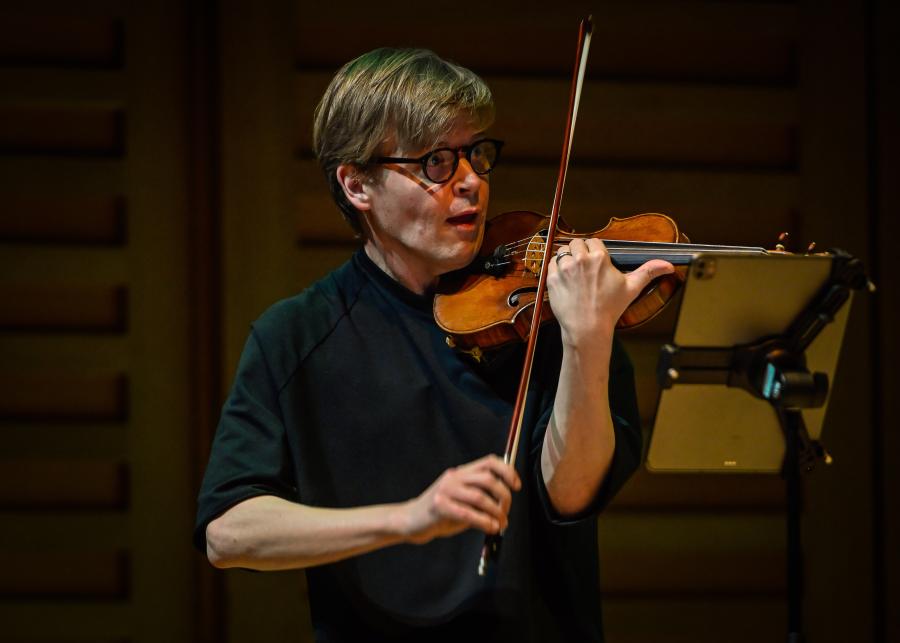
Kuusisto plays The Lark Ascending with a rapt, raw intensity. Of course, he shuns any Classics FM sentimentality or over-ripe lusciousness; but so do many other violinists. His tone, though, is notably grainy, soft, urgently physical, the pianissimos utterly involving, the timbre spectral and otherworldly thanks in part to sul tasto bowing around the fingerboard. If the solo part soared, it also blended with the earthier tones of the quartet: the smaller forces harmonised sky and soil, so that the transcendence here never felt like a pure escape.
Written for Kuusisto, in memorial for his brother Jaakko, Desiderium by Ellen Reid also grounds the solo violin in strenuous, sometimes frantic, figures. They rasp and pound in contrast with gentler passages of songbird exultation. This brief, fierce, scorching outburst of loss and celebration reminded me of the old tradition that makes the Chaconne from the D minor partita an elegy for Maria Barbara Bach.
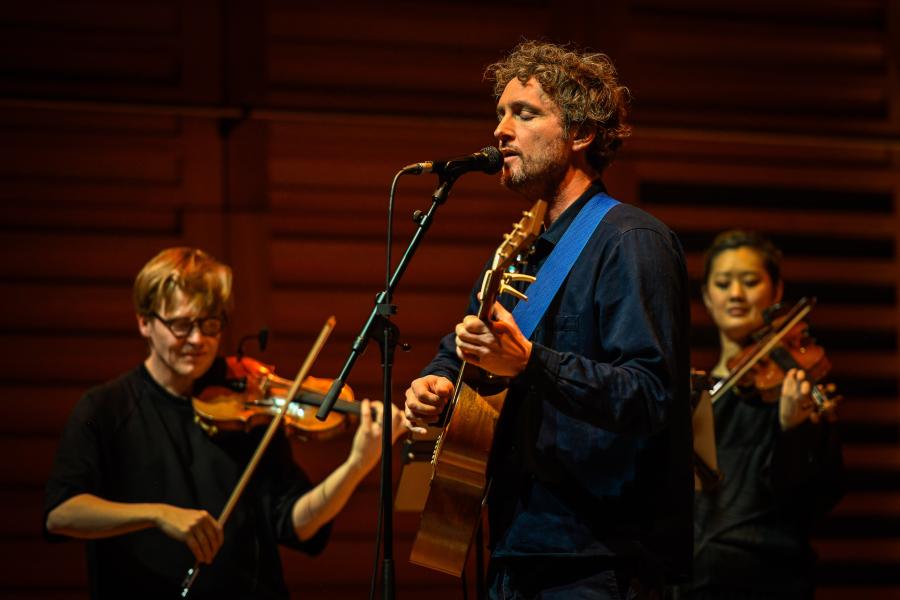
As for Amidon’s songs, he sings with subtlety, feeling and nuance. Muhly’s string parts added textural richness to impassioned words. RVW’s Lark even returned in Kuusisto’s ghostly instrumental finale to Amidon’s closing number, “Wedding Dress”. I worried, however, that the smooth evenness of Amidon’s delivery could downplay the shifts of mood and tone encompassed by the pieces. They stretch from the anguished piety of “Kedron” through the savage murder balled of “How come that blood” – with Amidon swapping guitar for banjo – and the African-American call-and-response rhythms of “Way, Go Lily”. The sinister story of “How come that blood”, by the way, turns out to be an Appalachian offshoot of the Child ballad “Edward” – also set by Schubert and Brahms.
Not every folk bard has to grate and growl like early Dylan (God knows, enough have made idiots of themselves with trying). Still, we experienced the odd effect of the “classical” violinist sometimes courting roughness or harshness as the “popular” singer brought a winning, even paradoxical, gentleness to rugged or violent material. Not always, however: the encore of “Weeping Mary”, another sacred-harp hymn, saw voice and strings exquisitely, movingly, matched. It capped a boundary-crossing evening of musical remembrance and reflection with a suitably poignant coda.