An English Violin Geneviève Laurenceau (violin), Orchestre de Picardie/David Niemann, with Jean-Frédéric Neuburg (piano) (NoMadMusic)
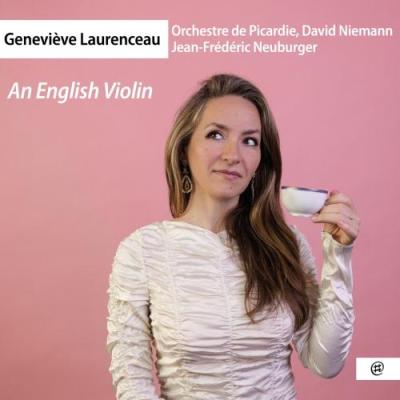
An English Violin, from French violinist Geneviève Laurenceau, consists of a superb and thoroughly recommendable new recording of the violin concerto from 1935 by English composer Guirne Creith (born Gladys Mary Cohen, 1907-1996), and a beautifully played selection of pieces for violin and piano: Elgar from the late Victorian era, Rebecca Clarke from the 1920s, right through to Walton compositions from after the Second World War.
Laurenceau is a fine musician who simply judges things well. She was concertmaster of the Orchestre du Capitole for a decade and can bring decisiveness and leadership. But there is also a very appealing lightness: Elgar’s “La Capricieuse” gets a glorious performance recalling the elegance of players of another era like Alfredo Campoli. Even more delicate is Rebecca Clarke’s delightfully filigree “Chinese Puzzle”. Laurenceau simply has more fun with it and takes faster than other recordings.
The Guirne Creith violin concerto is a remarkable and beautifully crafted work, stemming from a collaboration with Albert Sammons, who was a strong advocate of the composer. In March 1935, Creith wrote to the head of Music at the BBC, Dr Adrian Boult: “Mr Sammons has been most enthusiastic about the work and I certainly think it is by far the best thing I have so far written.” Creith’s family discovered the score of the piece after the composer – who at the time also had quite some profile as a pianist, and was to go on to do remarkable things under multiple pseudonyms: teach Lieder, inspire and mentor David Fanshawe, write and publish cookery books, and a whole load more – had died in 1996.
In this recording the work is beautifully paced, and this performance definitely outshines the premiere recording by Lorraine McAslan and the RSNO/Martin Yates (Dutton Epoch, 2009) – particularly in the slow movement which has pulse and momentum, rather than being overawed and slowed down by the work’s beauty. As well as a thoughtful note by the soloist, there is also an excellent liner note essay about Creith and the concerto by Katharine Copisarow. And what to make of the silliness of the album cover, in which the violinist poses brandishing a cup of tea (English, geddit)? Titter ye not, settle down and enjoy a surprisingly classy album which makes a strong case for each and every one of the works it presents. Seb Scotney
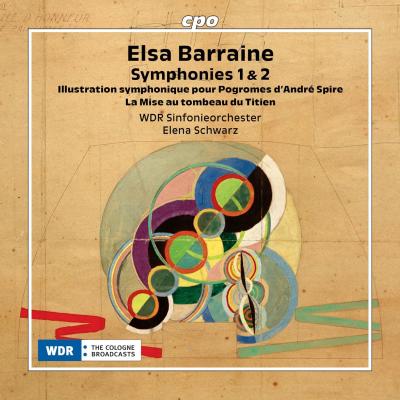
Elsa Barraine: Symphonies 1&2
Orchestre National de France/Cristian Macelaru (Warner)
WDR Sinfonieorchester/Elena Schwarz (CPO)
Elsa Barraine’s Symphony No. 2 is one of those "Where has this music been all my life?" sort of pieces and really should be better known. Born in 1910, Barraine was a child prodigy who gained entry to the Paris Conservatoire aged just nine, later enrolling in Paul Dukas’s composition class. A Prix de Rome prize winner in 1929, her musical career was interrupted during the Nazi occupation. Being of Jewish descent, Barraine lost her post as Head of Singing at the Orchestre national in 1941 and became active in the French Resistance, at one point forced to go into hiding. She later combined composing with teaching at her alma mater, dying in Strasbourg in 1999. Composed in 1938, the symphony’s three neoclassical movements last barely 17 minutes, Barraine mapping a journey from quizzical unease to exuberant rebirth with a sombre Marche Funèbre at its heart. Subtitled "Voïna" ("war" in Russian) it’s difficult not to hear the first movement’s jagged accents as reflecting Barraine’s unease about the political mood of late 1930s Europe, though a pithy finale does offer some relief. I defy anyone not to grin after hearing the symphony’s cheeky payoff. This is a deeply impressive symphony; if you’re fond, say, of mid-period Stravinsky, Martinu or even Walton, you’ll be hooked.
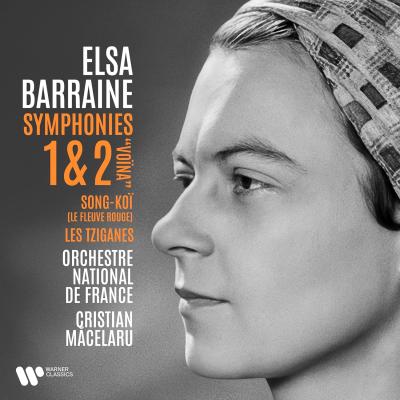
Symphony No. 1 (1931) was composed during Barraine’s spell at Rome’s Villa Medici. More expansive than its successor, this is another confident three-part work. The first movement’s “Vivace” section is thrilling stuff, and Barraine teases us into expecting an upbeat coda to her propulsive finale. Which we don’t get, the music instead losing momentum and slipping into the shadows. Both symphonies are finds – exciting, brilliantly orchestrated and full of character. That two new recordings have recently appeared is remarkable. Happily, both are excellent, well-played and superbly recorded. Cristian Macelaru, working with the orchestra which premiered both symphonies back in the day, is a little more relaxed than Elena Schwartz with the WDR Sinfonieorchester – for me, Schwarz’s versions have a tad more bite and excitement.
Both discs have interesting couplings. Schwarz gives us Barraine’s early Illustration symphonique pour Progromes d’ André Spire, a response to 1930s antisemitism, plus her postwar Musique funèbre pour la Mise au tombeau du Titien. Both are dark but compelling, pianist Alberto Carnevale Ricci imposing in the Tombeau. Macelaru includes two lighter but no less striking works. Song-Koï, Variations sur le Fleuve Rouge is fun, its eight sections brilliantly evoking a Vietnamese river’s journey from source to sea. Plus Barraine’s Les Tziganes, a short, exuberant romp inspired by Eastern European Roma culture. Two albums of seriously interesting music, then. Buy both.
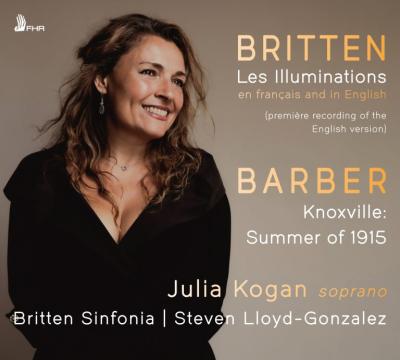
Britten: Les Illuminations (en français and in English), Barber: Knoxville: Summer of 1915 Julia Kogan (soprano), Britten Sinfonia/Steven Lloyd-Gonzales (First Hand Records)
Soprano Julia Kogan and Timothy Adès have form in my book, Kogan’s disc of melodies by French composer Isabelle Aboulker my album of the year back in 2019. That album included a second disc containing the songs in brilliant English translations by Adès. Here, we get Britten’s early song cycle Les Illuminations in both French and English versions. The nine Arthur Rimbaud poems selected by Britten are readily available in English, but these new translations fit the music, brilliantly so. Kogan’s crystalline diction means that the French originals are beautifully clear (sample the start of the fifth song, each syllable of “les chars d’argent et de cuivre” almost bell-like), but hearing the cycle in English is revelatory. Try “Parade”, with its “cruel procession of talentless poseurs” and “crafty fakers of places and persons” delivered with a near-improvisatory swagger, making the reprise of the cycle’s opening fanfare all the more arresting. You suspect that Britten would have approved.
The coupling is Samuel Barber’s delectable Knoxville: Summer of 1915. James Agee’s prose poem is a bittersweet evocation of rural America seen through the eyes of a young boy. The lack of surface incident, of drama, is what makes this work so lovable, though Barber’s music is alert to the text’s melancholy subtext, the sense that this bucolic summer evening is a one-off. Kogan’s subtle, understated singing is what this work needs, conductor Steven Lloyd-Gonzales drawing exquisite playing from the Britten Sinfonia. Full texts are included, the performances warmly recorded in London’s Henry Wood Hall.
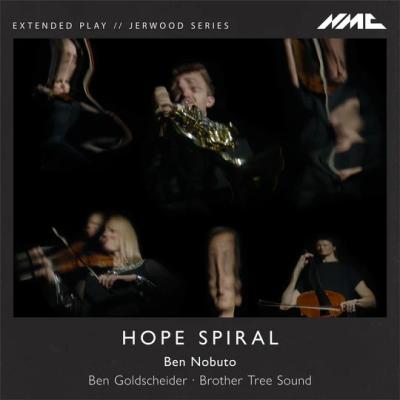
Ben Nobuto: Hope Spiral Ben Goldscheider, Brother Tree Sound (NMC)
Last September I reviewed the premiere of Ben Nobuto’s Hope Spiral, for horn, string quartet and electronics, as part of a programme by Ben Goldscheider and the Brother Tree Sound quartet. The following week these forces went into the studio to record the piece, which has now emerged as part of the NMC Extended Play series. This is a series of short releases supported by a film, in this case an arty and beautiful realisation in which the performers are seen first as if reflected in water, then behind gauzy curtains, and last in a kind of nightmarish disco. (It is on YouTube and worth a look.)
Hearing Hope Spiral live I revelled in its “exhilarating weirdness” and I have welcomed the chance to hear it a few more times. The music is inventive, making the most of its resources: not just the instruments, but the players vocalising in the first section, breathing in the second, voiceovers, sound effects, electronic beeps. Horn player Ben Goldscheider is heroic, moving from declarative low notes to skittering scales. The quartet start out striding together before the textures fragment and an unseen audience applauds wildly. Their playing is confident and bold and the production (by James Unwin) embeds them into the electronic surroundings.
Hope Spiral is fun in a way contemporary music mostly wasn’t when I was Ben Nobuto’s age. But it isn’t trivial or silly – there is a clear intention and artistic clarity behind the work – and the piece has a heft and earns its 17-minute duration. It plays with ideas of pulse, is referential in a postmodern way, it is technically extremely demanding – but all these things feel at the service of a composerly imagination. There is something in common with the music of Alex Paxton, in the hyperactivity, garishness and super-saturation. Maybe this is the start of a new “school” of British music: maximalism? Bernard Hughes
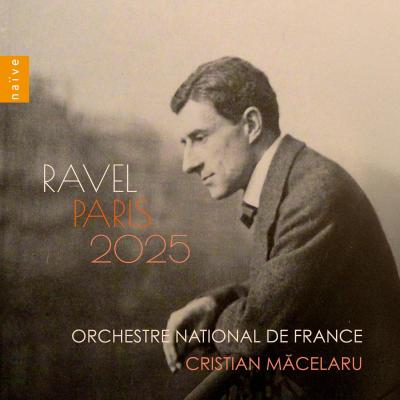
Ravel: Paris 2025 Orchestre National de France/ Cristian Macelaru (Naïve)
More Cristian Macelaru, in an enjoyable three-disc compilation of Ravel orchestral music which was released in the latter months of his anniversary year. One reason for investigating is a version of Le Tombeau de Couperin which follows the order of Ravel’s piano original, the “Fugue” and “Toccata” orchestrated by the French conductor David Molard Soriano. He’s not alone in having done this, an online search revealing versions arranged by Zoltán Kocsis and Kenneth Hesketh. Hesketh’s gleaming, percussive transcription is my favourite, his orchestration bright and brittle, but Soriano’s is pretty idiomatic – listen to the upward swoop at 3’19” in the “Toccata”, the bassoon writing looking ahead to the finale of the G major Piano Concerto. It’s followed by a sweet, affectionate reading of the complete Ma mère l'Oye ballet with Macelaru’s Parisian woodwinds rightly prominent in the mix, Ravel’s Jardin féerique glowing.
Une Barque sur l'océan is neatly done, Macelaru alert to the work’s darker overtones, and this Pavane pour une infante défunte features a superb horn solo. Alborada del gracioso is fun, the pathos of the central “Plus lent” nicely conveyed, and there’s a zingy account of the Rhapsodie espagnole with a decidedly slinky habenera. Macelaru’s Boléro isn’t as distinctive, the eerie bitonal section not sufficiently spooky for my liking, the modulation into E major less surprising than it should be. Still, La Valse’s closing pages are exciting, music which always reminds me of the final minutes of Stravinsky’s Rite. Disc 3 contains Ravel’s complete Daphnis et Chloé. Having a full-sized choir on hand makes this one of the better modern accounts I’ve heard, the Chœur de Radio France letting rip when required. Macelaru’s solo winds impress, especially flautist Silvia Careddu, and listen those bassoons at the start of the “Danse grotesque de Dorcon”. The third tableau’s sunrise is something to savour, and the final bacchanal is hair-raising. Naïve’s slimline packaging is appealing, though the actual discs require some care to remove without damaging the sleeve.
Stravinsky: Muses Camerata Salzburg/Giovanni Guzzo (Channel Classics)
Symphonies in 3 Movements Orchestre National Bordeaux Aquitaine/Bar Avni (Alpha-Classics)
Here’s a pair of albums connected by the music of Stravinsky, who is – cards on the table – my favourite composer, with one of them featuring what is one of my very favourite pieces. This can be a double-edged sword, as I think the better a listener knows a piece, the harder they are to please. And in the case of Camerata Salzburg’s new recording of the Dumbarton Oaks concerto, I was pleased, but not ecstatic.
The album puts together three of his neoclassical pieces, the strings-only Apollon Musagète and Concerto in D, along with the extraordinary masterpiece that is Dumbarton Oaks. The Concerto in D is the latest, from 1946, and can feel a bit like Stravinsky on autopilot. The playing, though, is always scrupulous and refined, in a suitably Swiss way, for a piece sometimes known as the “Basle” Concerto. Apollon Musagète, which caused consternation when it was premiered in 1928, doesn’t sound revolutionary – it’s no Rite of Spring. But Stravinsky’s sudden swerve away from brittle music for winds, to luscious string textures nodding towards Tchaikovsky was a typical act of stylistic wrong-footing. Again, the playing is unimpeachable if slightly unexciting. I’ve always loved the “Variation d’Apollo”, which moves between sternness and a limpid dreaminess, and, in the finale, the players capture the music’s proud fragility.
This Dumbarton Oaks is, in a word, fine – but no more. The outer movements lack the bustling busyness that propels the best performances forward, although the middle movement has the requisite perkiness – with some lovely bassoon and flute playing – and there is more sense of momentum here. The final bars – which I find irresistible – have a genuine excitement, and I was struck by the unusual voicing of the final repeated chord. But Camerata Salzburg won’t be dislodging Christopher Hogwood and the St Paul Chamber Orchestra as my favourite recording of the work.
The other disc only has one Stravinsky on it, but I suspect it was the piece that the whole conceit of Symphonies in 3 Movements was based around (although the conductor, Bar Avni, makes the unlikely claim that it wasn’t till the programme was assembled that she noticed all the pieces were in three movements. Hmm.) The others are an odd mixture, and I’m not sure the sequence works as a whole, but the Stravinsky Symphony in Three Movements is truly excellent, and I am pleased to have been introduced to Charlotte Sohy’s Symphony in C-sharp minor. Although completed in 1917, this piece wasn’t premiered till 2019, and it certainly deserves to be heard. Belonging in the Romantic tradition of Franck rather than the contemporary language of Ravel or Stravinsky, Sohy’s symphony has an anguished lyricism, and Avni gives it room to breathe.
The second and third pieces are a four-minute bit of fluff by Milhaud, whose symphonic designation is clearly satirical, and a striking CPE Bach piece from the 1770s, part of his late stylistic flowering. The Bach is a brisk and welcome palate-cleanser before the Stravinsky, a wartime piece which was partly made of off-cuts from abandoned film projects. The Orchestre National Bordeaux Aquitaine tear into it with real urgency, and it has exactly the impetus I missed in Camerata Salzburg’s Dumbarton Oaks. The accents snap, the strings bite, the brass has real edge and the obbligato piano sparkles. It is very good. The slow movement is creepier than I’ve ever heard it before and the finale is both triumphant and yet ironically distanced from its own bombast. Although the playing throughout is good, Avni and her orchestra really come to life in the Stravinsky, and the album is worth hearing for this item alone. Bernard Hughes