Outside, this imagined world has collapsed, a few survivors of the flashes of two bombs scratching a living from a landscape that Mad Max would recognise from that howl of a first movie. Inside, matters are no less easy - and no less familiar. At least at first.
On the day when "preppers" are in the news after the government issues information on what to hoard in anticipation of a catastrophe, Ashton’s construction of a bunker to which he could retreat seems less the actions of an oddball and more the rational response to climate change, Russian threats and social breakdown. Really, you can take your pick from the four horseman cantering ever more near.
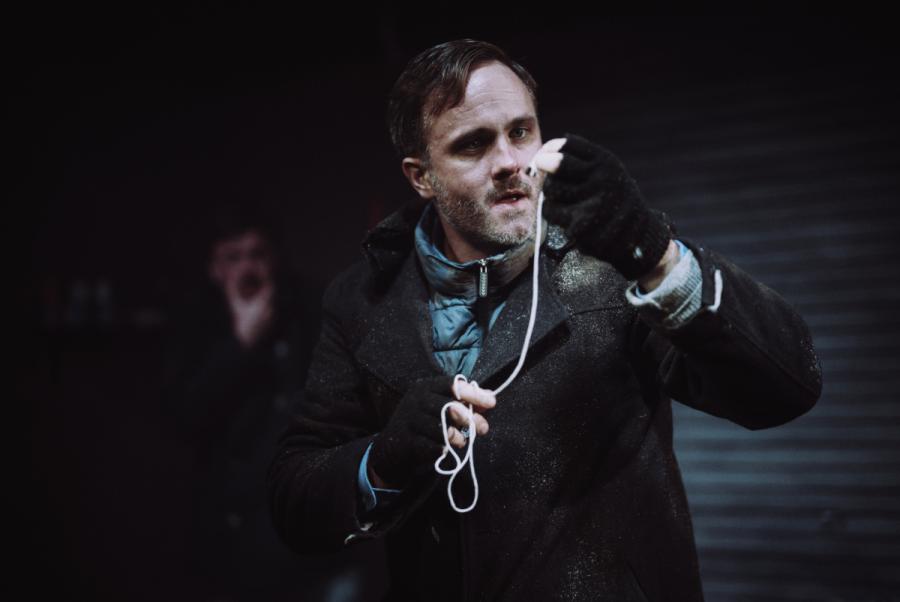
Behind a heavy duty shutter, amongst the ten kilo bags of rice and carefully counted water bottles, on a sparse set and wearing Vladimir and Estragon’s overcoats, two men are waiting, but for something more abstract than Godot. They’re waiting, Reece eagerly, Ashton reluctantly, for hope - or, at minimum, the sense that the tide is turning outside, the world recovering.
They also know that they need to push back a psychological tide too, the creeping obliteration of what went before as memory, personal and collective, fades. Ashton makes maps, venturing into the wastes to research the land and then painstakingly draw what he finds, understanding that Man’s ability to create a world through symbols is the first step to controlling it.
Reece, a porter, hence rather different to Ashton, a professor, enacts scenes from his past in which hope was central, Ashton playing along. He also holds on to the prospect of handing over his prized watch, the marker of time, a concept that has rather lost meaning, to his son, lost and presumed dead by everyone - except his father.
In the first act, the conversations and the reconstructed scenes play out between the pair, rubbing along, occasionally butting up against each other, but their relationship leavened by the bleak humour that men have always found to hold off despair. Reece takes on something of the parenting role he misses from befofretimes and Ashton acquiesces in it - a stable equilibrium. That changes when Presley, bearing a Chekhovian gun, bursts through the door to tip everything out of kilter.
Simon Stephens’ new play, in London after a run in Dublin, is an intensive two hours that could be even more intensive if director, Rex Ryan, were to cut 15 minutes from a first half that slightly outstays its welcome. It’s the kind of dystopian parable that requires strong performances to find the charm in the characters that eases the horrors we witness. And we need that because they're edging closer to home than at any time since 1961.
Ian Toner’s warmth and homely wisdom is critical to finding that vibe, giving us an everyman Reece who finds purpose in his relationship with the crumbling alpha male, Ashton. A smile, though sometimes watery, is never far from his lips, a light still flaring in his eyes, but the pain of family separation is only managed, not diminished.
In Ashton, Ross Gaynor shows a man clinging on, unsure whether his efforts to chart a lost world will have any impact at all for those who follow, but determined to do it as there’s nothing else better that comes to mind. In that way, he and Reece are archetypes of the men needed when the rain eventually comes - the thinker, wracked by doubt but strategic in his gathering of data the better to make decisions and the dreamer, attached emotionally to the past and present, a link between disparate men who have disparate needs.
And it is men, this play very much a male enterprise, examining what happens when an excess of masculinity - toxic the mot juste just now, but it's always been there - is given free rein. Like dispensing testosterone to armed militiamen.
That rage is most evident in Presley, Fionn Ó Loingsigh (pictured above) wildly oscillating between mad gun-toting ravings and the considered, cultivated conversation of the lawyer he once was, each masking the other. It’s notable that he is searching for his sister, who once represented a better future, before that was lost long before the apocalypse came. His mental issues exist outside the particulars of his circumstances.
Staged in the underground bunker that is the Jermyn Street Theatre, it’s something of a relief to find, on ascending to street level, that the world, for all its faults, is still there and that we’re not required to go back to be divvied out into Ashtons, Reeces and Presleys.
That we all, the men anyway, have a bit of each of them within us, is the rather sobering conclusion we take from a production that makes demands on its audience and does not shy away from forcing us to confront the atavistic impulses that sit beneath civilisation’s thin veneer of empathy.
I'm off to buy a bumper pack of wet wipes and a few sacks of rice.