Populist theatre really is a terrible flirt. You know the type of thing I mean: cheeky pursed lips, making eyes at the audience, strutting with a provocative wiggle. No need for subtle signals. No need for hidden depths. Okay, so here we are: Nadia Fall’s revival of Mike Leigh’s Abigail’s Party, the classic 1970s suburban wince-machine, finally arrives at the Harold Pinter Theatre in the West End, trailing the cheap perfume of crowd-pleasing populism, after first being seen at the Theatre Royal Stratford East two years ago, and touring since. One thing is certain: it’s enormously, and I mean enormously, enlivened by EastEnders’ Tamzin Outhwaite’s unforgettable performance as Beverly. Who’s she? Well read on.
First staged at the Hampstead Theatre in 1977, with Alison Steadman in the same role, it has been televised, and also revived countless times. This cartoon version gloriously repackages the play for Gen Z, Gen Y, and anyone else who can’t remember the decade of Heath, Wilson and Callaghan. Of the Three-Day Week, Northern Ireland State of Emergency and punk music. All of these, and similar milestones such the Oil Crisis of 1973 and the death of Elvis Presley in 1977, are shown in an info-graphic in a programme whose lack of substance is neatly matched by its exorbitant price. You don’t have to be a communist to raise an eyebrow at the more blatant side of West End money-making. But anyway, what’s the play about?
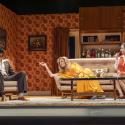
In the sitting room of their suburban home, Beverly and Laurence are hosting a drinks party for their neighbours. He’s a workaholic estate agent; she’s a housewife determined to put on a good show. First to arrive are Angela and Tony; the second is Susan, whose 15-year-old daughter Abigail is having a raucous house party nearby, but offstage. The class lines are precisely shown: because Laurence is successful, the house is large and there are plenty of drinks and nibbles. They are not the new rich, but they are upwardly mobile. By contrast, Tony is a computer operator (not a programmer) and Angela a nurse. They are also upwardly mobile, but their house is smaller. Last but certainly not least, Susan is upper-middle-class. Unlike the others, she has been living in the area for ages. She comes from older money, and is divorced.
Leigh’s comedy of manners is actually an excruciating account of social tensions, and should be as painful to watch as it is funny. None of the guests are really comfortable, and both Beverly and Laurence, well especially Beverly, are so determined to be hosts with the mosts that they bully the others relentlessly, to drink, to eat, to dance. This is brilliantly observed in the playwright’s text, which shows how overt cheerfulness and pleasantries are a mask for deeper status anxieties. Beverly boasts about her new kitchen (although it emerges that she rarely cooks and has never used her new rotisserie) and Laurence shows off his leather-bound collection of Dickens and Shakespeare (which he never reads). There is comedy Tony’s taciturn “Yeahs” and in Susan’s obvious discomfort at the vulgarity and inquisitiveness of Beverly and Angela.
Added to this, there are acutely perceptive examples of emotional embarrassment as Beverly, frustrated by the fact that Laurence works all hours, begins to flirt with Tony, who used to be a footballer and has a muscular body. Angela doesn’t take this very seriously, and as the evening progresses the huge amount of gin, pale ale and other alcoholic drinks fuels Beverly’s desires, to love, to dance, to live. One character vomits, but this doesn’t stop the drinks, or the flirting. Although feminism is mentioned, and the Permissive Society, what powers the show is the desire, to quote Beverly, to have fun: “Let’s all get pissed. Yeah!” – to which Angela replies, “Yeah. We can enjoy ourselves.”
The women in particular are sympathetically portrayed. The drama is infused with images of both female solidarity and female competition (oh, those passive-aggressive putdowns). Each of them is frustrated in their marriages, or experience of marriage, and each only too well aware of the dangers of male violence. At one point, Laurence brandishes a knife. The boys are bullies. And the indifference of men, summed up by Angela saying, apropos of women throwing up that men, “they’re not usually that sympathetic”, is a constant theme, as is having children: Susan has two, and had different experiences of childbirth, while Beverly hates the idea of giving birth. Angela, who works with children, looks forward to having a couple herself.
While both the women and the men manoeuvre to prove their points, resulting in some temporary shifting alliances, some frankly ghastly moments and a lot of comedy, the overall feeling is that suburban marriage, and suburban life, is boring. You can see why punk is arriving; you can recap the words of the Buzzcocks’ “Boredom” as you watch. And boredom comes hand-in-hand with misery. Despite her loud mouth, and desperation to show her husband and her neighbours that she knows how to have fun, Beverly is deeply unhappy. She’s a monster with an aching heart. Likewise, Tony and Angela are hardly a model couple. He bullies her, and she is even more gauche than Beverly. So when Tony begins to respond to Beverly’s foolish sexual overtures, the final outcome, signalled more than once with phrases like “You’re going to kill yourself”, is as inevitable as tragedy.
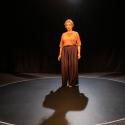
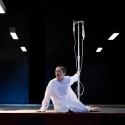
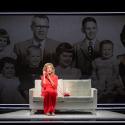
After a while, the pleasures of the play, with its overt vulgarity enhanced by Fall’s exuberant production, turns to weariness. Still, the retro features of the evening, such as Demis Roussos, cheese and pineapple on sticks, rape jokes, suggestive names such as Clittingham Avenue, absurd pronunciation of words like “Beaujolais” and “kebab”, are a mix of delight and exasperation. Fall’s Donna Summer-themed curtain-raisers to the two acts are vividly lit and signal the OTT style of the whole production. Similarly, Peter McKintosh’s set, as so often with this play, is too rich, too tasteful despite its attempt to satirize 1970s kitsch, and gives the impression more of a show house than a lived-in home.
The chief attraction, of course, is Outhwaite’s Beverly. Looking like a Greek goddess, splendidly dressed, and a vision of light and life during the curtain-raisers, she dominates the show. Whether swaying her hips, imposing drinks and ciggies on her guests, or grabbing her crutch as she pisses herself laughing, this is an amazing performance of exaggerated characterization and flamboyant entertainment. It’s fabuloso — trouble is, no one ever behaves like this. But never mind: by now, you’re laughing too much to notice. By contrast to this golden-shod drama queen, Kevin Bishop’s Laurence is a quieter study of, yes, rather quiet desperation. But Fall’s best casting decision is have actors Omar Malik and Lauren Patel play Tony and Angela as an Asian couple, thus giving an extra resonance to the casual racism of the others. Most convincing of all is Pandora Colin’s polite but very pained Susan.
The main problem with turbocharging the caricature aspects of this takedown of suburban illusions is that the wild laughs dehumanize the characters, with little room left for subtlety or sympathy. If you like your comedy to be raucous, this is the show for you; if not, then maybe just watch the BBC version of the original.