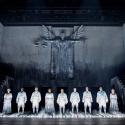
Well, this is uncannily topical, thought I, as the opening number, “Where Is the Justice?” took me back to Jurisprudence seminars and caught plenty of the newspapers screaming headlines that very morning, decrying the government's early release scheme.
Unlike Mr Burnham, Light, a bright schoolboy but one still prone to seeing the world as comprising only good and evil, unshaded by complexity, gains the means to do something about it. Courtesy of a bored shinigami (a Japanese death demon) he comes across a notebook that, merely by writing a victim’s name therein, ensures that death follows in less than a minute.
Soon, high on his own supply, he’s offing violent criminals, he’s acquired the serial killer’s must-have accessory - a media nickname, Kira - and he’s a hero to the many who prefer vigilante justice to the rule of law. But the police are after him, calling in the mysterious L, Japan's greatest detective - think Sherlock Holmes crossed with Kurt Cobain - and Light/Kira discovers that he’s not such a master of the universe after all.
If that sounds like a teenage boy’s version of a teenage girl’s fantasy of becoming a princess (roll in the pop superstar pixie-chick girlfriend Light attracts too), and that might explain the original manga’s huge success, spreading across media from movies to games and everything in-between.
Except, musical theatre - outside Japan and Korea that is - but 11 years on from its premiere in East Asia and a couple of years after a concert performance in the West End, Death Note is at the Barbican for a limited run. It's probably aiming to get the brothers of the sisters who have been packing out the thematically not dissimilar Wicked a few stops round the Circle Line for years. As Vladimir Propp explained a century ago, all stories are fundamentally the same.
The other point of comparison is Game of Thrones: The Mad King up at Stratford Upon Avon. Both shows are technically dazzling, supremely confident that their big budgets are well spent and, for many in the house, enjoy an IP recognition that provides an oven-ready fanbase that furnishes plenty of bums for seats. Both have significant issues with the storytelling and pacing and lack the wit and charm required to balance off the spectacle - at least for newbies to the characters.
Much of Death Note is, for all those faults, hugely entertaining, particularly for a younger demographic who will see versions of low level adolescent neuroses on stage and, as is the case for Dear Evan Hansen, will gain that glorious glow of understanding that they are not alone. To be fair, it’s not much different to the feeling us older theatregoers get watching Chekhov or Ibsen, so why not?
Xander Pang sings beautifully as Light, our antihero, whom you’re expecting to, err, eventually see the light, but never does, as arrogant and immature at the end of his journey as he is at the start. There are plenty of smart kids today stuck in arrested development by the power they enjoy - some very, very wealthy indeed - but they can be irritating to be around. Light is one such.
I was rather hoping that the Ariane Grande figure, Misa Misa, would give me a character more nuanced, more generally empathetic but no. She’s as psychotic as her boyfriend, but Stephanie Zaharis is the best of a very talented cast of singers and nails her “We All Need A Hero” like she’s at Madison Square Garden.
The charm, such as it is, comes from Telly Leung’s Ryuk, the shinigami whom only Light can see and who has the bantz to put the kid in his place. If you’re thinking that we’ve already got one too many of those guys in London with Beetlejuice already smartmouthing about death on Shaftesbury Avenue, I'll confess agreement.
His fellow demon, Rem, gets the 11 o’clock number “When Love Comes” and Grace Mouat gives it all she’s got with Frank Wildhorn’s best song in an impressive if sometimes samey score, but it’s lost a bit in a rushed ending. Writer, Ivan Menchell, despite the two and a half hours plus running time, hasn’t put enough into Rem’s character development for us to understand the depth of her relationship with Misa, to appreciate why she is breaking hard and fast rules and why she is accepting of her sacrifice. The song has too much work to do, director, Stephen Whitson’s, pacing all at sea as we hurtle towards a Pucciniesque denouement.
The boys in the house do get a kind of hero, though one not without a streak of mean ruthlessness too, in Colin Ryan’s L. To be fair, I might have been more impressed with the neurodivergent detective had I not seen Joshua James give a very similar take in Sherlock at Regent's Park back in May. Ryan certainly hits his straps with his big number, “The Way Things Are” the music, under Jason Howland, bailing out the show again.
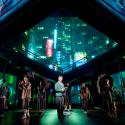
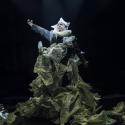
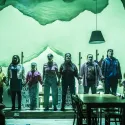
This is a big production though, Jon Bausor’s sets integrating spectacularly with Akhila Krishnan’s Bladerunner-inspired video backdrops creating a rainy, alienating Tokyo. It's not difficult to imagine some of Haruki Murakami's sad people behind the glass and steel. In some ways, it’s an MT extravaganza for those who might not like MT's jazz hands reputation.
That’s never a bad pitch, but for those of us who do like Musical Theatre, it’s a curiously distant experience, very much worthy of admiration, but falling well short of securing our love.
Oh, £15 for the programme! Really?