QFWFQ, Summerhall ★★★★
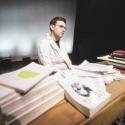
At first glance, an iconic post-modern novel (or, perhaps more accurately, "novel") by Italo Calvino might not seem like the most obvious starting point for a searing condemnation of Zionism and Israeli atrocities in Gaza. But Los Angeles-based performance artist and writer Gregory Nussen finds a convincing if perhaps unlikely path between the two in the slippery, witty solo show QFWFQ (named after the protagonist in another of Calvino’s works, The Cosmicomics).
And if you don’t know Calvino’s 1979 If on a Winter’s Night a Traveller, then it probably suffices to say that it’s a thoroughly entertaining if ultimately aggravating novel about the act of reading a novel, and a perpetual search for what that novel actually is. Nussen’s slide sideways into a theatrical adaptation feels entirely natural: alongside their ticks, quips and knowing winks to the audience, they're perpetually frustrated in their attempts to perform the show, and forced to swerve into gleefully unrelated anecdotes about discovering a strange Helsinki church, or how Keith Jarrett ended up performing his legendary Köln Concert, or any number of arcane eastern European tales besides.
The masterstroke in Nussen’s adaptation, however, is in stepping back from the teetering tower of unreliable fictions and unstable narrators that they’ve created to examine their own Jewish-American upbringing, including barely concealed Zionist summer camps, and formative visits to Auschwitz and Israel. Nussen’s underlying questions about what tales are told and who gets to tell them – as well as how they can then be used to justify future actions – is as inevitable as it is timely.
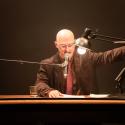
Nussen is a droll narrator, slipping between contrasting versions of themselves, stumbling over apparently unexpected problems, and apparently making the whole thing up as they goes along (Jarrett-style, in fact), despite Hannah Pilkes’s clearly assured direction. Nussen is such a captivating presence, in fact, that it’s easy to follow their lead – even if that ultimately leads to some dark and difficult places.
QFWFQ is a show that’s genuinely popular (extra dates – that Fringe holy grail – have just been added because of demand for tickets), genuinely clever and genuinely challenging too. Nussen balances with disarming nimbleness between those three pillars, and does it with enormous charm and uncanny insight.
Come Back Home, Summerhall ★★★
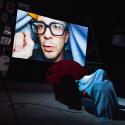
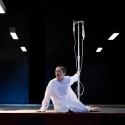
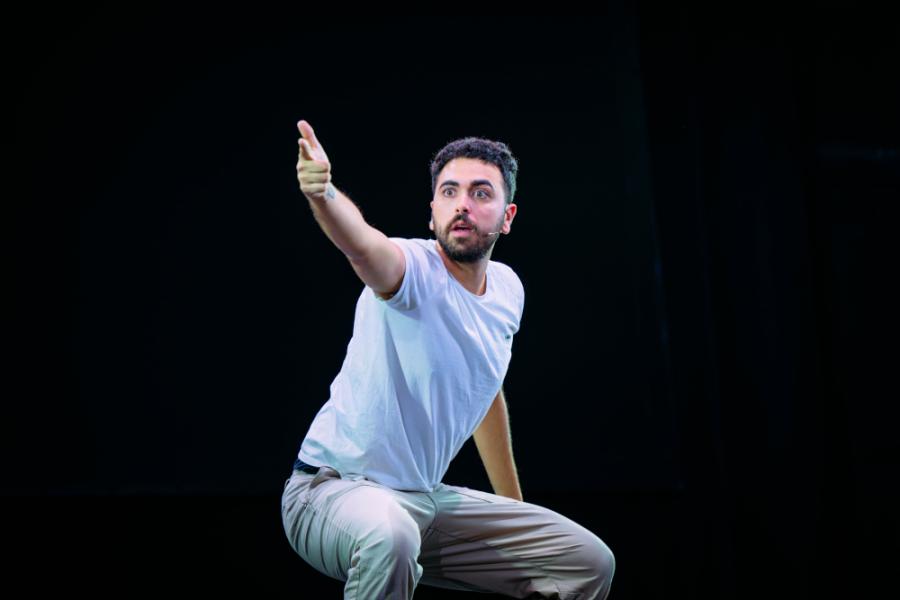
If Gregory Nussen leaves little doubt as to his views on Zionism, Palestine and the decimation of Gaza, then Palestinian multi-disciplinary artist Fadi Murad (pictured above, image by Mihaela Bodlovic) takes a far more oblique perspective on his homeland in his beautiful but sometimes elusive Come Back Home.
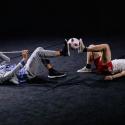
It’s a deeply personal piece, blending atmospheric video, quirky poetry, sometimes clownish physical theatre and an underlying sense of longing, a feeling that seems to pervade Murad’s thoughtful, unhurried creation, and which becomes increasingly inescapable as the show gradually unfolds almost like a dream. Central to that feeling – perhaps – is the death of Murad’s mother when he was just nine years old, which he reflects on, even unearthing a video of his childhood self singing a heartbreakingly out-of-tune version of Tears for Fears’ "Mad World" at her memorial. This unflinching self-exposure – also present in a deeply embarrassing personal accident he reveals early on – serves to suggest vulnerability and fallibility, casting what develops into an atmosphere of melancholy and poignancy across Murad’s idiosyncratic creation.
In many ways, though, Come Back Home feels more like an installation or performance art than a piece of theatre, one in which water returns again and again as a resonant theme, but an idea that it’s also hard to pin down to a specific meaning. In its own terms, Come Back Home is a touching and quietly powerful work, and Murad is adept at drawing you in, posing questions, offering tantalising morsels. A few more connecting threads between its constituent elements, or a few clearer articulations of themes and ideas, would inevitably serve to shed a brighter light on what Murad has to say. As it stands, however, it’s a deeply poetic, delicate but somewhat elusive hour of vivid if fleeting imagery and gentle reflection.