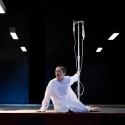
Max Olesker: Making the Cut ★★★★
Pleasance Dome
Most Fringe fans will know Max Olesker as one half of sketch duo Max and Ivan, but this is his Fringe debut as a solo performer. In it he tells how he, a man who had grown up in a liberal Jewish household, had to convert to Judaism in order to be with the woman he loved.
It’s a terrific tale, well told. Olesker uses just a few stage props – a table and chairs, and a simple white cloth – to tell the story, as they become a dinner table or a courtroom, or a prayer shawl or a Jewish wedding canopy (a chuppah). Like all good stories, Olesker tells us, it begins with a Jagerbomb. (For the uninitiated, count yourselves lucky.)
He and Eliana met at the Edinburgh Fringe a few years ago, where they were both performing. “I liked the Jewish jokes,” she said of his show. He quickly replied: “It’s OK, I’m allowed.”
But, as he was soon to discover as they fell in love, her Orthodox faith would not allow her to marry this secular, uncircumcised Jewish man.
What follows is a witty, wry run-down of the trials and tribulations of becoming a Jew to the satisfaction of Beth Din (a sort of Jewish Supreme Court). It's funny and touching by turns in a hour that covers love and loss, longing and belonging, family and the weight of history. And yes, Olesker does detail what making the cut entailed.
Adam Riches: The Captain ★★★★
Summerhall
Have you ever heard of Frederick Beckwith? Or Captain Matthew Webb – he of the title in Adam Riches' tale? No? Don’t worry, settle in for an hour of storytelling about Webb, the first man to swim the English Channel unaided, in 1875.
The show – evocatively performed in Summerhall’s Victorian anatomy lecture theatre, complete with a dummy body under a sheet on the slab – is part lecture, part storytelling. Riches is swimming coach Beckwith, who coached Webb in Lambeth Baths in London – “the four-sided sea” – and who backed the then crazy idea for Webb to swim the 21 miles between England and France. (Actually it become 39 on the day due to terrible conditions.)
Riches builds the narrative expertly, mixing comedy and historical fact, and involving the audience in the action by instructing us in the four basic swimming strokes – front crawl, backstroke, butterfly and breaststroke – and adding Beckwith's own, the side stroke.
Webb’s was a heroic endeavour as he battled jellyfish, strong currents, exhaustion and sickness – not to mention those who would try to steal his thunder.
Adams writes a date on the chalkboard in the theatre at the start. As the show reaches its climax, we realise the significance of July 24th 1883 in a story that examines fame and the competitive spirit, and how even heroes are sometimes quickly forgotten.