A febrile energy powers Timothy Sheader’s production of Jesus Christ Superstar, which arrives in the West End with an edgy vibe that powerfully conveys the idea of Jesus as a dangerous revolutionary. At the age of 56, the musical isn’t showing its age remotely, with its vigorous, unashamedly complex rhythms and persuasive interrogation of the Bible marking it as a resounding classic even for Lloyd Webber agnostics like this critic.
You could argue that Eurovision star Sam Ryder was made for the role, a former carpenter with an impressive beard and a lion’s mane of hair, who after years of struggling found his own transcendent following with his hit Space Man. Yet there’s nothing entitled about his performance – on the contrary, he displays a modesty and restraint which implies that his Jesus is initially overwhelmed by the adulation he inspires.
Despite the huge success of his 2016 production of Jesus Christ Superstar at Regent’s Park Open Air Theatre, Sheader has insisted that this is no “rinse and repeat”. While there are many recognisable elements from that production – not least Tyrone Huntley reprising his award-winning performance as Judas – this digs deeper into the spirit of the iconic concept album that was released in 1970, with Deep Purple’s Ian Gillan as Jesus.
Lucy Martin’s dynamic design evokes a world in transit, with a scaffolding structure that spreads across the stage and beyond so that it covers the Palladium’s gilded boxes, and a tilted gangway in the shape of a crucifix. Raised levels on the scaffolding provide platforms for the actors, the great sweep of classical and rock musicians, and, right at the bottom, selected audience members who watch the action as if they were in a mosh pit.
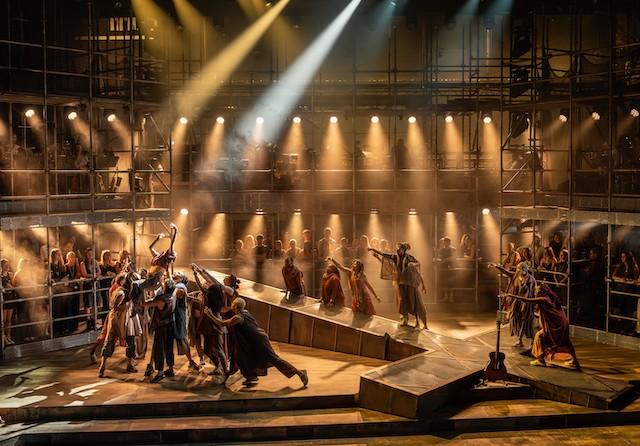
This is in many ways a story about Jesus’s impact on the mob, so the group dynamic is intrinsic to why the authorities saw him to be so threatening. Drew McOnie’s frenetic, hot-blooded choreography really makes us feel the delirium of his followers, from the spine-tingling moment when they run down the theatre aisles and onto the stage at the start to their outrage in the run-up to the crucifixion.
There are whoops and screams when Ryder first emerges from the crowd at the start, yet though he is physically commanding throughout, it takes him a little while to seem comfortable in his role. This seems like nothing that won’t improve with the show’s run, however, and when he goes full throttle – as in the song "Gethsemane" – he is genuinely thrilling.
The performer who stands out throughout is Desmonda Cathabel as Mary Magdalene, who has a voice like liquid gold and a powerful, empathetic presence. Bob Harms is a magnificent Caiaphas, plunging to his bottom C# with ease, and Jesse Tyler Ferguson (the first in a series of celebrity Herods for this production) infuses the role with all the requisite poisoned bitchiness.
To reinterpret the story of the charismatic dude from Nazareth who preached love and forgiveness, defying an empire run on efficiency and violence, tuned in perfectly with the hippy era in which it was written. This production goes big on the psychedelia, with streams of glitter heightening crucial dramatic moments, whether it’s Mary Magdalene washing Jesus with scented oil, or his casting down of the moneymakers in the temple.
Yet the star, all these years on, remains the musical itself. As a clergyman’s daughter growing up in Sussex, my childhood memories of this are of the shock waves it sent through the theological college where I lived, combined with the excitement of seeing the story retold in such words and music. Now that it no longer shocks, what strikes you is Lloyd Webber’s brilliant conceptual range – not a sentence I find myself writing often – as he innovates in styles ranging from gospel, hard rock, jazz, and funk through to folk, and contemporary classical. Tom Deering’s dynamic musical direction injects it with its full adrenaline fury.
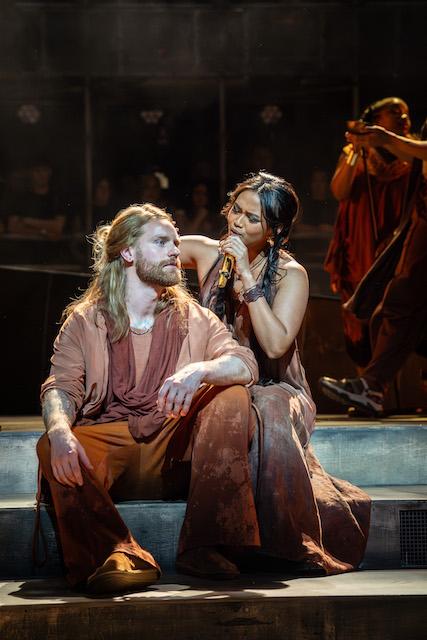
Rice’s lyrics remain intelligently provocative too and still feel edgily political. Judas sings fearfully of the Romans as an “occupying force”, and when Mary Magdalene (pictured above right) sings the apparently sentimental “I don’t know how to love him” she’s patently referring to the fact that Jesus is the latest of many lovers. The decision not to feature the resurrection anchors it firmly as a story of political insurgency gone wrong – even Christ’s crucifix is ultimately made of scaffolding. Yet the music makes it transcendent.
On press night it felt like everything needed to warm up a bit more – surely, apart from anything else, those lucky punters standing on the stage should be encouraged to dance, as indeed should the rest of the audience members. But all the ingredients are there for a rip-roaring run which in good enough time will bring the rafters down.