Language is a weapon in the RSC’s vigorous adaptation of Cyrano de Bergerac – we feel viscerally that wordplay is just one letter away from swordplay, and verbal discord can result in death. Co-adaptor Debris Stevenson cut her teeth on the Grime poetry scene, and brings a raw, abrasive energy to this love story for word nerds that transforms poets into warriors as Cyrano strives for the survival of the wittiest.
Jamie Lloyd’s production of Martin Crimp’s rap battle-style Cyrano de Bergerac seven years ago felt definitive, yet this Cyrano more than holds its own. It’s proof once more of the enduring fascination of Edmond Rostand’s 1897 play about a man forced to woo the woman he loves for a rival who’s superior to him in looks and inferior in brainpower. To date it’s been adapted by writers including Anthony Burgess, Steve Martin, and Edwin Morgan – who produced a rollicking, rambunctious version in Scots verse. Lead actors have included Ralph Richardson, Gerard Depardieu and – last year – Virginia Gay in an entertaining gender-swapped retelling at the Park Theatre.
Here, director Simon Evans – who also co-adapted the text – rips down the barrier between the audience and the stage from the start, with actors darting in and out of the auditorium, addressing us as if we were citizens of 17th century Paris. A sense of raucous irreverence prevails as Chris Nayak’s oily Montfleury – an actor “still dazzling as Romeo after more than four decades in the role” – inches his way onto the stage before discharging a sequence of thudding rhyming couplets.
In this rewrite, language is entwined into each individual like their DNA. Stevenson has assigned all the main characters with a distinct vocabulary range and rhythm that defines their status, savvy and sex appeal. When Adrian Lester’s spiky, swaggering Cyrano emerges onstage it’s clear immediately that he’s the apex predator in this linguistic ecosystem, as he verbally dismembers Montfleury before taking on Matt Mordak’s Valvert in a verbal duel about his own nose. As Valvert struggles to produce anything but basic obscenities, Cyrano offers a menu of insults ranging from the fairytale, “Look Papa Gepetto I’m a real boy!” to the epigrammatic, “Can we please discuss the elephant in the room?”
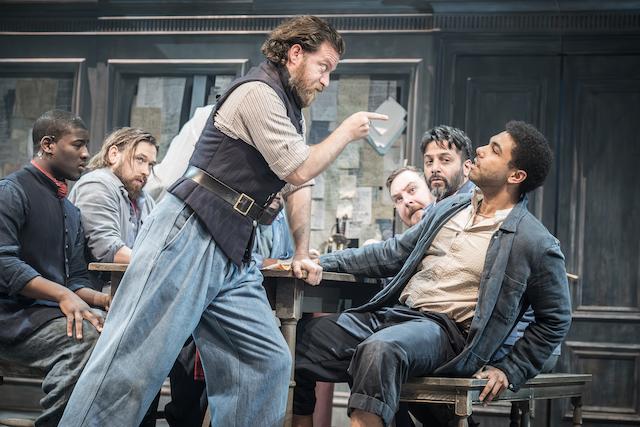
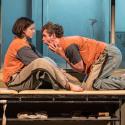
The strength of Lester’s performance is in the way he makes us feel the smouldering sadness beneath the verbal fireworks. His unrequited love for Roxane consumes him – you sense the depth of his pain along with the contempt he feels for Levi Brown’s naïve Christian (pictured above, right) when he realises that the younger man is the object of Roxane’s affections. As Roxane, Susannah Fielding – well known for her perma-smiled exasperation as Steve Coogan’s presenting partner Jennie on This Time With Alan Partridge – is given more agency than previous versions of her character. Here she’s no innocent but a widow from an unhappy marriage, whose intellectual curiosity extends to a sparky, intimate delight in the word games they both play.
Brown’s Christian, portrayed as a provincial Brummie, is a fascinating creation. While he’s the butt of many of the play’s jokes, there’s a poetic authenticity to his attitude that ultimately elevates him to the same level as Cyrano and Roxane. The humiliating moment when he realises that Cyrano has been using him to express his own love for Roxane is the same moment that he realises that they are both trapped by their verbal cleverness. When Cyrano confesses “I have hidden behind words my whole life,” suddenly the comedy tilts towards tragedy.
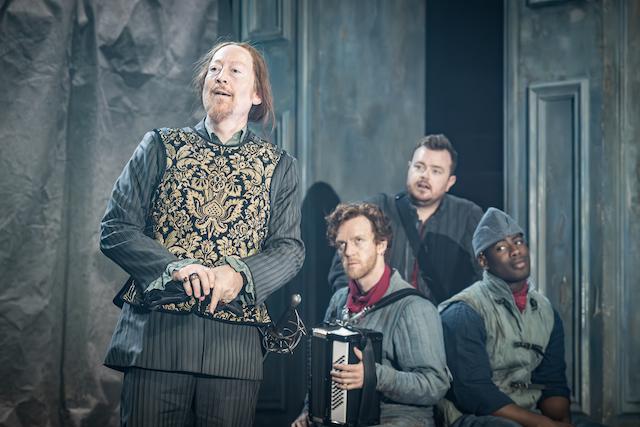
Grace Smart’s atmospheric set transports us back to the noise and theatricality of 17th century France. Whether we’re bystanders to Parisian brawls, or witnesses to the ravages of the Thirty Years War, every visual note rings true. Never more so than in the final scene where Cyrano visits Roxane at the nunnery where she has sought sanctuary following Christian’s death. As Lester and Fielding wrestle magnificently with the agonising vision of what might have been, dead leaves cascade from the tree silhouetted starkly above them.
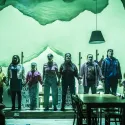
Highlights from the boisterous cast include Scott Handy’s Comte de Guiche (pictured above, left), who musters a dustily heartfelt dignity even as Roxane rejects his advances: “He mistakes my disinterest for mystery,” she spits in disdain. Greer Dale Foulkes is hilarious as Roxane’s man-mad companion Abigail – specially written in for this production – who transforms from transparent flirt to censorious nun. The musical ensemble, led by Josh Sneesby, becomes a slyly humorous part of the action, as they accompany Cyrano everywhere he goes – even to the battlefield. Music may not be the food of love here, but it’s certainly a highly enjoyable aperitif.
The action is framed by flashbacks to Cyrano as a little boy living in the countryside, at the time when he first knew and began to love Roxane. It’s a risky device – handled wrongly it could have been sentimental – but here it adds a genuine poignancy. For beyond being a story about words, what is this but a meditation on the invisible armour all adults wear to conceal their vulnerabilities? As Cyrano’s fate shows, the danger comes when they abandon their inner child, and allow that armour to eclipse their true selves.