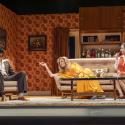
Hot from its successful run at the Old Vic, Carrie Cracknell’s Olivier-nominated revival of Tom Stoppard’s 1993 masterpiece has made a particularly sweet landing in the West End. For opening night was accompanied by the news that the play’s venue, the Duke of York’s, is to be renamed the Tom Stoppard Theatre.
The honour is well-deserved. Stoppard, who died last November, is one of the true greats of British theatre; and it’s well-timed with this play, which has its second revival here, 17 years after the first, and is one of his very best.
Arcadia contains everything that made Stoppard such a distinctive playwright, that inimitable weave of ideas, wit, romance and theatrical playfulness. And it’s such a rich, complex piece, that even seeing the same production within the space of a few months, with a partially amended cast and a different setting, can elicit new discoveries and thoughts. And, given most of us don’t possess a fraction of the Stoppardian bandwidth, there is a great deal to grapple with.
In reviewing another recent revival, of Michael Frayn’s Copenhagen, I commented on the broad similarities between these two masterworks, the marriages of intense, often dense intellectual debate and human drama, wrapped in mystery. Returning to Arcadia, one difference is heightened: while the scientists in Copenhagen are wrestling literally with life or death – their decisions leading a path towards the atomic bomb – Arcadia’s characters are engaged, really, with the simple pleasure of learning.
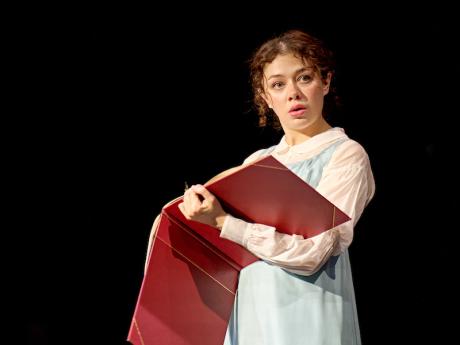
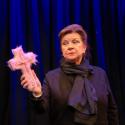
So, in the early 19th century section of of Stoppard’s play, the teenage genius Thomasina Coverly (Isis Harmsworth, pictured left) is riffing her way towards chaos theory, 150 years before it was formally discovered, while her tutor Septimus Hodge (Seamus Dillane) skilfully throws in some thoughts about literature and dancing along the way; in the present day, the academics Hannah Jarvis (Nikki Amuka-Bird) and Bernard Nightingale (Oliver Chris) are each involved in historical detective work that will inform a philosophical battle between the Enlightenment and the Romantic.
The connective tissue is the setting, Sidley Park, a country house in Derbyshire; Thomasina is a daughter of the house in 1809, Hannah and Bernard guests of the Coverly’s in the present. Hannah is seeking to discover the identity of a hermit who lived for years in the gothic hermitage on the grounds, Bernard to prove that it was a duel while a guest of the house that led Lord Byron to mysteriously flee England for Lisbon; the answers for both reside in Thomasina and Septimus’s story.
Stoppard tip toes between genuine romance and sexual farce, and learning displayed both as sincere quest for knowledge and, in the case of Bernard, crass ambition, all the while weaving webs of conjecture and consequence. There’s also a tonne of delicious comedy, courtesy chiefly of Septimus, a hugely decent man who nevertheless has to do a lot of ducking and diving to evade the consequences of a spontaneous tryst in the gazebo with another guest.
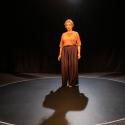
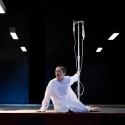
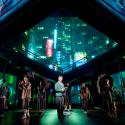
Cracknell marshals it all extremely well, leaving the audience at once exhilarated, moved and happily exhausted by the effort of keeping up with it all. The director is aided hugely by her cast, as well as Alex Eales’s gorgeous set design, whose glowing globes and intersecting rings hovering above the revolving stage offer an ever-present sense of both the natural universe, and the deeper one of the mind.
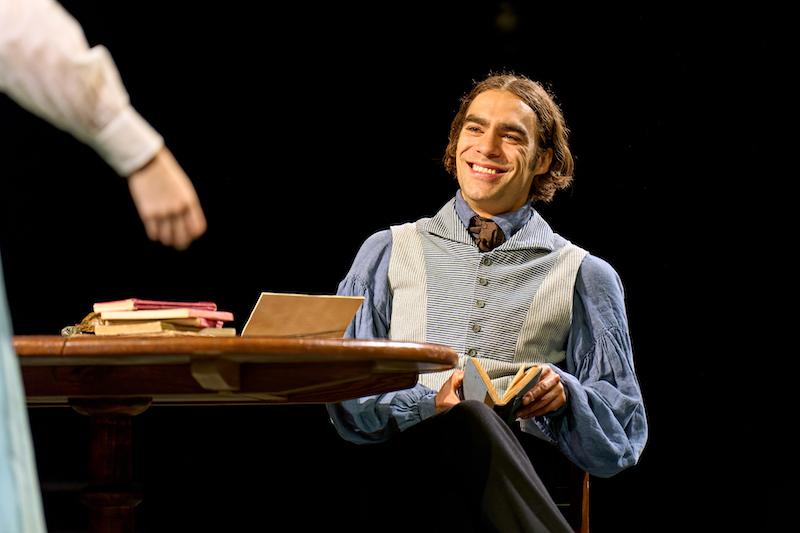
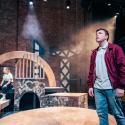
The return of Dillane (pictured right) and Harmsworth at the bittersweet heart of the play is a blessing. They beautifully capture the relationship between a teacher who recognises that his young charge is intellectually and imaginatively head and shoulders above everyone around her, and nurtures that gift, and a girl who spends most of the play standing on a table, book in hand, reaching for the stars.
Angus Cooper also returns, as one of Thomasina’s descendants, Valentin Coverly, a mathematical biologist with an interest in grouse, and he does wonders with the arguably thankless task of dispensing much of the plays scientific theorising. But Cooper also has the most Stoppardian of quips: “It’s the best possible time to be alive, when almost everything you thought you knew is wrong.”
Of the newcomers, Yolanda Kettle is a suitably commanding Lady Croom, and her principal scene with Dillane, when the teacher and his employer posit a possible attraction, is one of the night’s best.
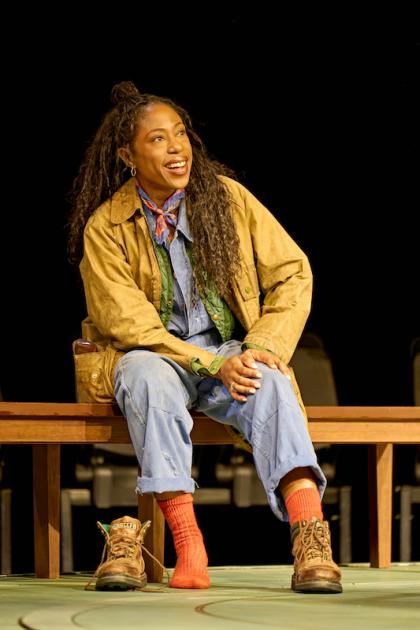
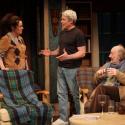
Nikki Amuka-Bird (pictured left) and Oliver Chris offer a better central pairing than the Old Vic iteration: her Hannah is livelier and more enjoyably amused at the appalling behaviour of her fellow academic, and clearly never intending to heed his charmless seductions; and Chris, who is brilliant at buffoons, makes one of Stoppard’s ugliest characters at least a little tolerable, for a while, before his failings simply can’t be ignored.
Nightingale is arrogant, patronising, duplicitous, extremely sexist and wholly self-serving. And this is the only area where the now 33-year-old play doesn’t feel as fresh as a daisy. Viewing Bernard through today’s different standard, it’s hard to believe that Hannah or the Coverlys would endure the man for a second, his knowledge notwithstanding. And the resulting gulf in delight between the two storylines suggests a tiny crack in the play’s otherwise perfect veneer.
A quibble, though, set against the many pleasures of a wonderful play and production, whose effect is summed up by an exchange between Hannah and Valentin. “It’s all trivial,” she says, “your grouse, my hermit, Bernard's Byron. Comparing what we're looking for misses the point. It's wanting to know that makes us matter. Otherwise, we're going out the way we came in.”
Tom Stoppard certainly didn’t go out the way he came in; and he ensures that anyone who sees his plays won’t, either.