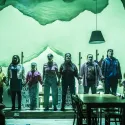
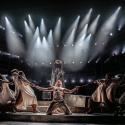
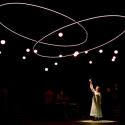
Scottie Fitzgerald, the sole offspring of F Scott Fitzgerald and Zelda, swigs from a hip flask where she shouldn’t (she inherited the transgression gene). She’s in the room that harbours her parents’ cluttered archive, and soon she conjures their ghosts who tell us the story of their lives.
Or, more accurately, some of the story of their lives, continuing a trend in biopics (Bradley Cooper’s Maestro is an example) in which we’re either assumed to know the works or to accept that the artistic achievement is less interesting than the marital strife that fuels it. Inter alia, such narratives come with a side order of rescuing the wife from the role that damns with faintest of praise, The Muse.
There’s certainly a case for saying that the writer of The Great Gatsby and Tender is the Night needs no introduction, but, as we find out later, Zelda’s novel, Save Me the Waltz, and her surviving paintings have been reassessed positively in recent years. It’s a shame that we hear and see so little of that, condemned from her own mouth almost as soon as she appears on stage, as being best known for suffering from a mental illness. She could say "reduced to a mental illness" and it would hardly be an understatement.
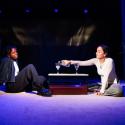
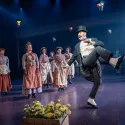
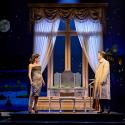
Zelda (played on press night by Amy Parker, standing in for the indisposed Hannah Corneau, who also wrote the music and lyrics) is a mercurial teenager, the belle of a small town just outside Montgomery, Alabama. She catches the eye of a soldier posted nearby (she was good at catching eyes) and the aspirant writer and Princeton dropout was instantly besotted. Soon they were the outrageous toast of New York’s 1920s party scene, young, beautiful and successful, one night’s sex and champers and rock’n’Charleston merging into the next, barely slowing after the arrival of their daughter, Scottie.
It was all such a high that the only way was down, with debts piling up and the thirst for ever more novel company and experiences taking them back and forth across the Atlantic. The writing dried up, Zelda became embittered at the lack of recognition afforded to her contributions to her husband’s stories and both took lovers. His drinking gripped him; her psychosis gripped her. Both were gone before the age of 48, living fast, dying young.
Scottie is our narrator, from the age of five a witness to the mayhem, old before her time. I was pleased to learn that she lived out a successful and fulfilling life, albeit touched by tragedy of her own. Aside from a coda in which she extols her mother’s painting of her nursery ceiling, she doesn’t talk much about the joy of the art created around her; the musical is really about the misery of a traumatic marriage, a decision by book writer, Mona Mansour, that tips these most remarkably vivid of individuals into generic washouts.
That focus reflects in songs that appear to be stuck in one mood. So many start with a plaintive piano introduction before the excellent band carry the singers towards an outpouring of disappointment. They’re sung very well, but each number’s emotional tone is much the same as the one before and the one after. The best of the score, “Built To Last” and “Call It Love”, stand on their own feet as show tunes, but the 17 songs are too samey, the peaks and troughs of a fully realised score replaced by a slow shallow descent into despondency.
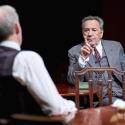
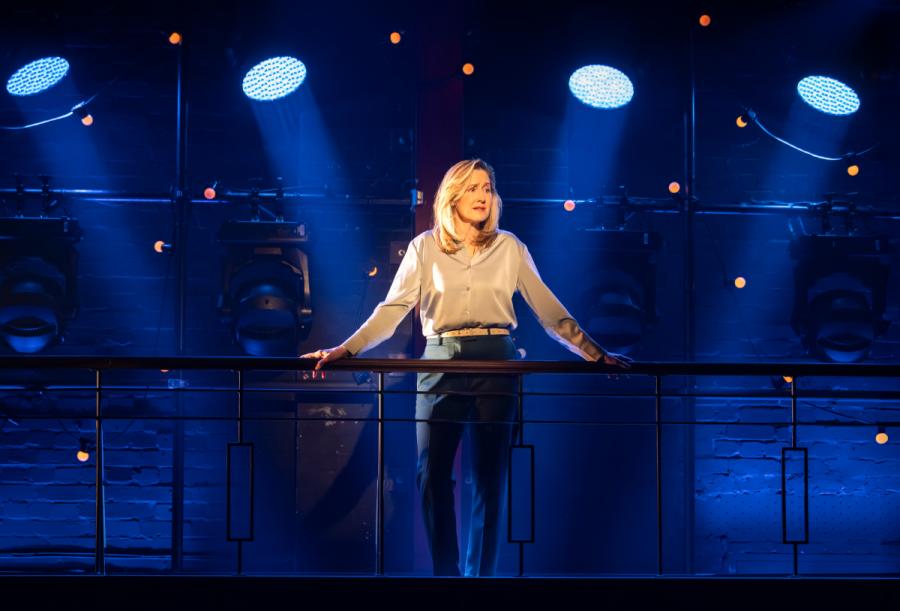
David Hunter, as F Scott, rocks a cable knit sweater and a pair of Oxford Bags like a Yankee Sebastian Flyte, but he’s an alcoholic shit and, absent any exploration of his genius, not much more than that. Lauren Ward (pictured above) lends Scottie a world-weary respect for her parents, understanding more as an adult narrator about what must have been a very tough childhood, angry about her mother’s fate, accepting of her own.
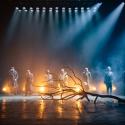
Amy Parker did a very fine job as Zelda on press night, stepping up from the ensemble. We see the charm, the sexy confidence, the justifiable bitterness spiralling to the appalling death, incarcerated in a medical facility after brutal “treatment” afforded to such spiky women, tied up in her room as a blaze took hold. That prompts a fiery condemnation of such practices from the stage that imports a lot of gender politics hitherto only obliquely referenced, so feeling a little out of place. Tagged on it may be, but such fury is entirely apposite when powerful insecure men still silence intelligent challenging women, these days with phrases like "Quiet, piggy". Then, as now, those who do not speak out against such abhorrent behaviour are tacitly acquiescing in it.
Despite much that is laudable in conception, the musical is a misfire, not taking us into the Fitzgerald’s marriage nor into their work, the detail required to locate poor Zelda’s health issues within their time and place left unexplored. Great musical theatre songs can rescue an ill-focused book, but there just aren’t enough to raise a show that has a marvellous story to tell, but not the tools to tell it.