

In prehistoric Britain, life was full of Hs. It was hard. It was horribly hard. It was hardly happy. And, according to Jack Nicholls, whose debut play has a typically noisy Royal Court title, The Shitheads, it was also hilarious and heartless. Performed in the venue’s upstairs studio space, this tale of life some tens of thousands of years ago is co-directed by David Byrne, the venue’s artistic director, and Aneesha Srinivasan. But although they take the opportunity of the Court’s 70th anniversary to nod to its heritage of horrid horrors by staging a story full of hideous and hateful events, the result strikes me as incoherent and disjointed.
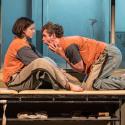
Yet the show begins with a terrific prehistoric elk hunt. On the small bare stage, a huge animal puppet roars into view, the animal badly wounded but still dangerous, with its enormous antlers still a real threat to the two early humans determined to kill it. They are strangers, Clare – who lives in a cave with her father Adrian and sister Lisa – and Greg, more nomadic, with a wife Danielle and their baby. As these two finish off the elk, it emerges that Clare sees Greg as one of the tribe of Shitheads, a social group who are underdeveloped, unable to dream or imagine the future. When she returns to her family with elk meat, she is soon followed by Danielle and her baby. This woman is more clever than the average shithead, and she wants to know what’s happened to her man.
Nicholls imagines the cave dwellers, who are good at talking and killing, as alert to the power of what Clare calls “dreams; thoughts; stories”. This tribe believes it’s imbued with magic. They have wall paintings. If you eat the brains of shitheads, argues Adrian, “their stories become our stories”, but actually his daughter discovers that the cannibalism remains purely physical. And as the sinister crack in their cave gets wider, it looks like the sky, water and ground are becoming increasingly inhospitable, driving the rival shithead tribe to move south to warmer climes. And this climate change is shown as apocalyptic, able to change everything. But not before most of the humans have slaughtered each other in an inevitably brute orgy of violence.
Of course it’s hard to miss the metaphorical intention here, with one set of humans seeing the others as, er, Other, as unwanted migrants, although the shitheads turn out to be as eloquently verbal as the cave dwellers. Sadly, the chance to explore an imagined primitive language as David Harrower did in his classic Knives in Hens is missed, and the vibe here is more The Twits or The Flintstones than Edward Bond, although there are some desultory echoes here of 1990s Royal Court stalwarts such as Sarah Kane and Martin McDonagh. Disappointingly, Nicholls’s exploration of family, tribe and climate change says very little about the human condition.
In fact, there is a thoroughly pessimistic sense of humanity’s propensity for violence, vaguely reminiscent of the most reactionary ideas of the 1960s, which saw aggression as the basic driver of human evolution. Instead of embracing the feminist insight that some so-called primitive societies might be matriarchies, and that female solidarity might be a better survival strategy than toxic masculinity, the play viciously articulates a deeply unpleasant sense that violence is essential to survival. Especially when allied with guile. While lacking the visual poetry of Stanley Kubrick’s “Dawn of Man” (sic) sequence in 2001: A Space Odyssey, The Shitheads nevertheless seems to endorse the idea that might is always right.
I would certainly have preferred a less blood-soaked account of human origins, or even of the human future after an apocalyptic event (be it climate change or nuclear war), yet the good thing about this show is the energy of some of the writing, which occasionally has dream-like musings, mainly by Adrian, and some strong child-like exchanges, mainly from Lisa. Too often, however the production style here wants to give the audience some laughs, rather than face the ghastly truth of this imagined world. On the other hand, it has to be said that Finn Caldwell and Scarlet Wilderink’s puppets are, in the case of the elk, exceptionally thrilling, and, in the case of baby, perfectly charming.
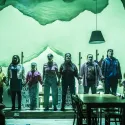
Likewise, Anna Reid’s design beautifully mixes fur-and-bones hangings with a suburban lamp stand, Victorian chair and Sports Direct mug, suggesting that the distant past is also our present. And the cast is completely committed to realizing the production’s vision: Jacoba Williams (Clare), Peter Clements (Adrian), Annabel Smith (Lisa), Ami Tredrea (Danielle) and Jonny Khan (Greg). But the overall image of violent brutality reflects less the origins of our species and more our current nihilism and despair. But if playwrights, to adopt a phrase, use their imaginations only to interpret our world in various ways, isn’t it the point that we need to change it?
Comments
Shitheads - why so violent - really?