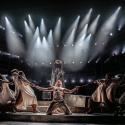
Backstories of famous writers are fascinating: where did they come from? What were their inspirations? What obstacles did they overcome? Alexi Kaye Campbell’s new historical family drama, Bird Grove, looks at the early years of Mary Ann Evans, long before she became a novelist who published under the name of George Eliot. Yes, time to dust down your copies of Middlemarch, Mill on the Floss, Daniel Deronda and so on. Produced on Hampstead Theatre’s main stage, the play stars Elizabeth Dulau, best known as Kleya Marki in the Disney+ Star Wars series Andor, alongside Owen Teale, Ser Alliser Thorne in Game of Thrones.
It’s Christmas 1841, and Mary Ann (Dulau) is 22 years old, living with her father Robert Evans (Teale), in Bird Grove, a Georgian country house near Coventry. Retired from estate management, Robert – and his son Issac, Mary Ann’s older brother – would like her to marry, and the plot starts with the arrival of a hilariously unsuitable suitor, Horace. As this silly stiff-natured sop gets short thrift from the rest of the assembled company, which includes Maria – Mary Ann’s former governess – plus visiting friends Charles and Cara Bray, a notoriously freethinking couple, and Lafontaine, a French mesmerist, the intellectual and moral battle lines are set out.
Mary Ann is a confident, highly educated young woman, currently reading up on geology as part of her curiosity about the truth of scripture. Although she believes in God, and in the vital importance of Jesus, she is open to criticism of the Bible, especially its more mythical aspects. (The science of geology makes nonsense of the idea that the world was created in seven days.) Her intellectual ambition is stimulated by the nonconformist Brays, but shocks both her brother Isaac and his friend Horace. They think that women should stay uneducated, to be instructed by the men in their life, and just believe whatever the church says.
Robert, who is now a widower and actively participates in local Anglican church services, supports his daughter in her rejection of Horace, but disagrees with her and the Brays about religion. He suspects that criticism of the Bible stories will lead to schism and disunity in the community, and one of the strengths of Campbell’s play is that he takes this conservatism seriously. And, after all, Robert does love his daughter, even if he expresses this by wanting to control her. When, later on, she decides that she can no longer go to church because of the hypocrisy of conforming to rituals she no longer believes in, both her father and the devout Maria are shocked and angered.
Moreover, Mary Ann’s desire to be independent, to make up her own mind, is influenced by Cara’s argument that hitherto “the stories that shape our lives”, as women, “have been written by a small pool of men”. But although she desires the complete freedom to study and to write, she also remains emotionally close to her father. When she rebels against him, one result is “the prison of guilt”, and – as history shows – she does spend most of her 20s looking after him when he gets sick. For most middle-class women, as her novels were to show only too well, the life choices available in Victorian England were limited, and limiting. What’s warmhearted about this play is that it shows both sides of the emotional coin: parental generosity as well as domination.
The conflict over religion, with real belief in Christianity’s essence pitted against its dogma and Anglican forms, reminds us that the 1840s were a time when non-conformism challenged the Establishment and its ancient privileges. But the well-written Bird Grove also shows how the young Mary Ann is influenced by German philosophy, especially David Friedrich Strauss’s The Life of Jesus, Critically Examined, of 1836. The tension between middle-class respectability and the new ideas about science and critical thinking come across well here, and without condescension. The piece also suggests the limits of early feminism: it’s hard to be independent if you don’t have your own income.
That said, Bird Grove is more enjoyable in its tightly written, and often humorous, often ironic, first half than in its second, which does meander a bit. As the playwright searches for an ending, he taps a bit too much into a Chekhovian sensibility, and the final scenes feel much weaker and unfocused. There’s a long will-reading scene, whose essence could have been conveyed in a different way, and the final appearance of Dorothea (hardly a spoiler as this character from Middlemarch is in the cast list) feels a bit too on-the-nose. And yet there are also memorable moments which beautifully illustrate the importance of books and the cruelty of male family members.
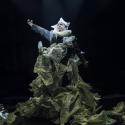
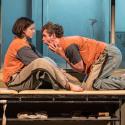
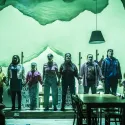
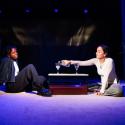
And there’s a lot to enjoy in Anna Ledwich’s measured production, elegantly and modernistically designed by Sarah Beaton. Both Dulau and Teale deliver detailed and convincing performances, entirely credible and convincing in their mutual love and affection, and in their conflicts, although I would have liked to find something I dislike in this rather idealised portrait of Mary Ann. As for the other, rather underwritten characters, Tom Espiner and Rebecca Scroggs are entertaining as the Brays, and Jolyon Coy and Sarah Woodward do good work with the equally small parts of Isaac and Maria. Much fun comes from Jonnie Broadbent’s Horace and James Staddon’s Lafontaine. This is a rather serious, heartfelt and thoughtful, if slightly overlong, account of family tensions and a young Victorian woman’s coming of age.