Arthur Miller is constantly being revived on London stages, and constantly remains relevant. However, his most popular plays are those from early in his career – All My Sons, The Crucible, A View from the Bridge, The Price even – but what about his later flowering? To fill this gap, the Young Vic is now staging Broken Glass, the playwright’s 1994 drama about Jewish identity, marriage and psychology. Directed by Fiddler on the Roof maestro Jordan Fein, this revival is more timely than ever, given the rising menace of anti-Semitism across the world. But is the show any good?
Set in Brooklyn, in 1938, the story focuses on the Jewish-American Gellburg couple, Sylvia and Phillip, who works in a high-profile real estate firm. When Sylvia reads newspaper reports about the Nazi attacks on Jews in Germany, during the Kristallnacht (Night of Broken Glass), she develops a medically inexplicable paralysis from the waist down. While workaholic Philip is baffled by this, their doctor, Harry Hyman, analyses a different cause: her profound frustration with her impotent, self-hating husband who is trying desperately to assimilate while ignoring evidence of anti-Semitism not only in Europe, but also in his own daily life. And, as ever, the best way to heal is to confront the truth head on.
Miller typically mixes profound psychological insight with provocative ideas. His portrait of Philip, the Jewish man who insists that his surname, Gellburg, has nothing to do with “Goldberg”, is vividly contradictory. Although, on the one hand, he is proud to be the first Jewish man ever to be employed by his company, and equally proud of his son going into the army instead of the more usual occupations of medicine or law, he is also acutely conscious, while simultaneously in denial, of the micro- and macro-aggressions he experiences. Gentiles, like his WASP boss, Stanton Case, won’t shake his hand. And he is constantly being told about what “you people” should do. Or not do.
All this anti-Semitism is instantly recognisable. By contrast, Sylvia – a former bookkeeper who gave up her job to be a housewife – is a stranger case, although equally complex. Less obsessed with assimilation, she feels the violent humiliation and harassment of the Jews in Germany both in mind and in body. Although her sister Harriet can’t understand why she should care about people on another continent, Sylvia feels their pain as her pain. Or does she? Dr Hyman, no expert in psychology but willing to help, develops a diagnosis which reveals the exact marital misery that both Sylvia and Philip have been enduring. As they begin to understand that to talk is to change, something begins to shift.
But Hyman, or Harry, is not a selfless do-gooder. Although he’s a popular doctor, he has a reputation as a ladies’ man, so much so that his wife Margaret, a Gentile, is constantly suspicious of his desire to meet attractive women patients. And she’s not completely wrong either. Harry is motivated both by the challenge to cure the incurable, and by a sexual impulse which is, to put it mildly, unethical. Today, this doc would be sued! Yet, he does succeed – up to a point. With him, Sylvia discovers the courage to find her own voice, to speak her truth, but at the same time she also experiences the more questionable attraction that comes from their intimacy.
Miller equates Philip’s rather toxic authoritarianism with, on the one hand, a fragile masculinity, and, on the other, with the dictatorial impulses of the Nazis. This husband understandably cannot easily tell the truth about his sexual problems, but at the same time his oppressive domestic behaviour, and his constant denial of his Jewish identity, seems to equate him with the march of fascism across the globe. If Sylvia feels Nazi hatred in both Germany and in New York, he comes across, symbolically at least, as complicit in this oppression. Until, that is, the play’s final climax, when Philip realises how, in Harry’s words, Sylvia is “connected to some truth that other people are blind to”. And both foresee the Holocaust.
Broken Glass gives a deeply nuanced picture of Jewish identity, with Miller looking back at 1930s Brooklyn from a compassionate standpoint some 60 years later. The main characters – Sylvia, Philip and Harry – are each complex and different. Harry is the confident and suave professional, secular and rationalist, with an intellectual connection to European Jewry. His telling insight is his belief that “we get sick in twos and threes and fours, not alone as individuals”. He is more open than Philip, who is uncomfortable in his identity, seeing Jewishness as a disadvantage that has to be managed, even blaming German Jews for their persecution. Finally, Sylvia is empathetic and traumatised, internalising the suffering of European Jews. Her desperate cry is: “Where is Roosevelt? Where is England? We’ve got to do something before they murder us all!”
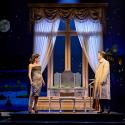
Miller’s play offers no easy redemption, and no answers to the complex psychology of diaspora and identity. He is clear-eyed about the problems of marriage and of the difficulties of women finding satisfaction, and agency, in 1930s society. Fein’s often intense production, designed by Rosanna Vize, has a puce-red carpeted thrust stage which is a bit too long for the play, much of which is close up and intimate. Some redundant clocks compare New York time with Berlin (and China), and the set includes Sylvia’s bed as well as benches, many of which are covered with piles of newspapers, some old, others contemporary. A goldfish swims around a bowl.
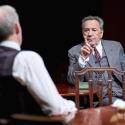
Much of this is a distraction from the acting, which is excellent. Haunted by photos of elderly Jews forced to clean German pavements with toothbrushes, Pearl Chanda’s Sylvia journeys from puzzled disquiet through emotional neediness to full-blown horror. She is well matched by American actor Eli Gelb’s dramatically conflicted Philip and Alex Waldmann’s more suave Harry. In the minor roles, Nancy Carroll (Margaret), Juliet Cowan (Harriet) and Nigel Whitmey (Stanton Case) are all convincing. Fein leaves the house lights on for much of the show, so the audience can examine each other, questioning perhaps our own silences, our own complicity in distant events. But his directing also has a tendency, especially at the climax, of underlining the play’s meaning a bit too loudly: Broken Glass really doesn’t need this exaggerated approach.