

Richard Strauss, who conducted this orchestra and programme to an audience of 7000 in the Royal Albert Hall on 19 October 1947 aged 83, would have shared our mixed feelings about the curious phenomenon that is Santtu-Matias Rouvali, the now-80-year-old Philharmonia's Principal Conductor. Not for Strauss Santtu's expansive, sometimes sluggish approach to his most popular symphonic-poem calling card, Don Juan. And in the 1940s he was quicker, too, with his mostly tongue-in-cheek, brilliantly worked saga of 24 hours in the life of the Strauss family, Symphonia Domestica. But he would have appreciated Santtu's love for the work, and definitely have commended the partnership with the fleet, crystal-clear virtuoso pianism of Benjamin Grosvenor in the still-underrated Burleske.
The worst, to get that out of the way first, was all Strauss's fault. His "First Waltz Sequence" from Der Rosenkavalier, made in 1945, is a horror: a cut and mangled Prelude - no horn-whooping orgasm, and why mush up the aftermath? - hideous transitions and developments which sound like they were made by a total amateur. Although Santtu does conduct the unsatisfactory Suite made by someone else (jury is out on who exactly), with its music-minus-two-and-three for the Presentation of the Rose and the Trio, he can't have enjoyed having to take on this. Fortunately he changed the 1947 order so he could get it out of the way before Domestica.
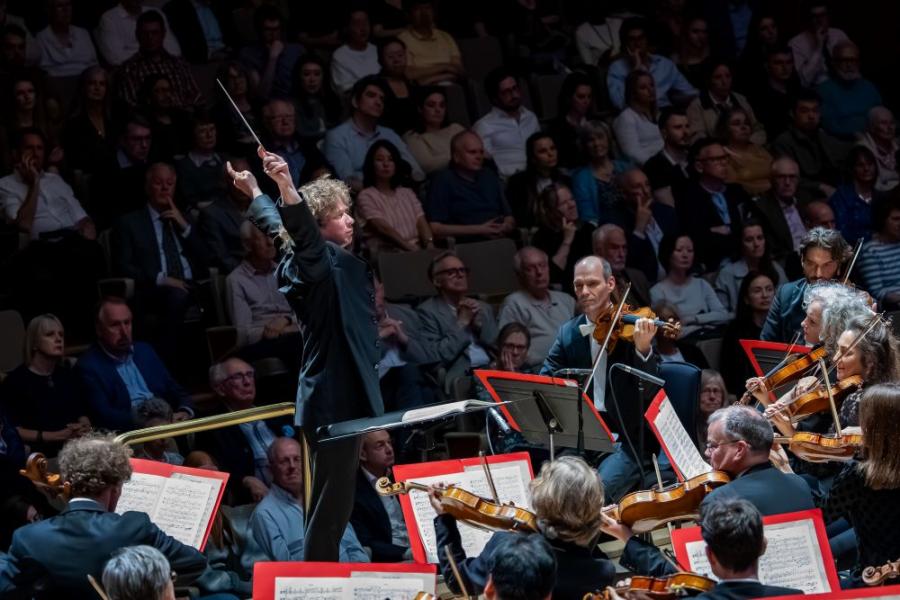
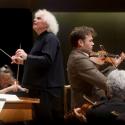
And what a performance that was. I first heard Santtu (pictured above by Marc Gascoigne/Philharmonia with players) conduct it at Gothenburg's Point Festival in 2019, and his love for the work has clearly grown - for a start, the rapid extension of the happy ending, more horn-whooping this time, but not of the lovemaking variety (mum and dad outdo Wagner's Venusberg earlier), has a genuine exuberance now. The conductor's favoured spaciousness allowed every symphonic metamorphosis to shine through. And there are thousands of them, once the odd format has laid out a multitude of themes for Papa, Mama and Baby (the young Franz Strauss, or "Bubi", represented by a simple theme on an unusual instrument, Bach's beloved oboe d'amore, beautifully played by James Hulme).
Symphonia Domestica is also the work where Strauss comes closest to the childlike Mahler of the Fourth Symphony's opening movement and his zig-zagging, "old-fashioned" children in the scherzo of the Sixth. The woodwind writing in the first sequence to truly gather steam, the Scherzo - "Bubi" at play - is Strauss's most elaborate after Don Quixote, and the Philharmonia section handled it exquisitely. Maybe the Lullaby which echose Mendelssohn and pre-empts one of the Marschallin's monologues - Der Rosenkavalier came eight years later in 1911 - was a bit too slow, but Rouvali had full control of the sweep and contrasts in the long Adagio, from another woodwind idyll to Debussyan dreamworld fantasies before the glock strikes 7am. The double-fugue quarrel was clear and exciting, first trumpet not splitting any of the top Cs at the climax (I heard Jason Evans, I presume, practising the phrase in the warm-up before the Garsington Rosenkavalier on Saturday). And yes, there was true love in the extended warmth of the ever-burgeoning finale. For some reason we'd been put in a box just above the orchestra, but that allowed one to admire Santtu's conducting technique. Everything he shows, he gets from the players.
The cause for concern at the beginning of the concert was completely dispelled here. Santtu doesn't favour heady charges in Don Juan - he had a hard act to follow in Jakub Hrůša's supreme performance with the Philharmonia - though while his first (sex) scene was too indolent, the true love here of the exquisite oboe solo in the second allowed Timothy Rundle to enjoy the space. Horns came in splendidly with the coup of the work's late-arriving heroism, but its high noon before the fall was oddly done: Santtu pressed them here, only to slow down for the full-orchestral response.
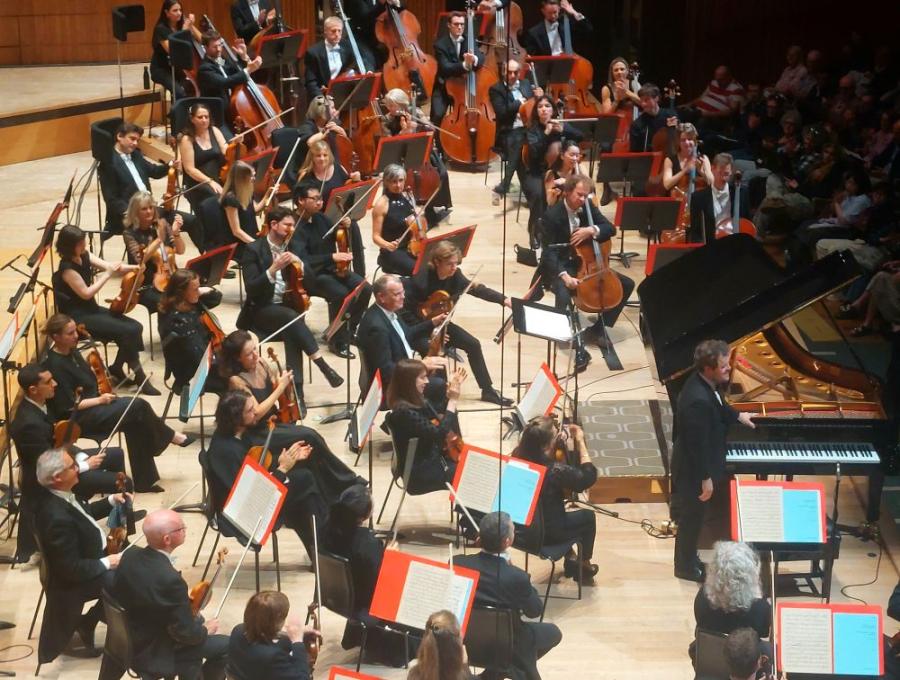
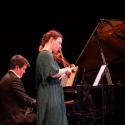
There was no slack in the Burleske. It starts and ends with timpani (the patterning-out of the main theme ideally tone-coloured by Ziv Stein), bracketing impish wit, thunderous Lisztian virtuosity and Brahmsian nostalgia, every note registering with exemplary clarity in Grosvenor's meticulous but also exciting performance (the pianist pictured above with Philharmonia players). His encore worked exquisitely: the song "Morgen" with the vocal line perfectly suggested. It would have been too much to hope for Grainger's Rosenkavalier Ramble, a paraphrase on the final duet which does a much better job than Strauss himself in that horrible waltz mishmash. But Burleske and Symphonia Domestica amply compensated.





Add comment