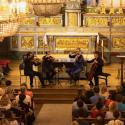
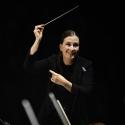
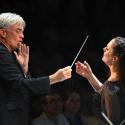
The Royal Northern College of Music put four of its brightest hopes on show in last night’s big end-of-year concert at the Bridgewater Hall – a composer, a conductor, a solo pianist… and everyone else in its symphony orchestra and chorus.
To that please add the conductor, Clemens Schuldt, whose exuberance and affinity with the young musicians made the performance a thing of distinction and emotional impact on a level rarely reached in even the most experienced hands.
Schuldt began his programme with a short piece that had “conductor’s choice” written all over it – Ophélie, by Mel Bonis. Having discovered the French composer, a contemporary of Debussy and Pierné, only recently (as he told the audience), she was now one of his favourites, he said. The music sounds as if it’s as much about the famous Millais painting as anything else, with liquid figurations and medievalistic harp sonorities over double bass pizzicati evoking the tragic end of Shakespeare’s doomed lovelorn damsel. It was beautifully played, with warmly rounded surges of tone and rocking rhythms to commemorate her watery demise. (If you’re thinking of hard-done-to women to memorialize, incidentally, spare a thought for Lizzie Siddal, who nearly died after posing in a cold bath-tub for hours on end, for Millais to get his “authenticity”.)
Another woman to meet a watery end, according to legend, was Lorelei, after whom a treacherous rock in the Rhine is named – and known from Heine’s poem and its many musical settings. Her story is the inspiration for a recent composition by Emily Dunbar which followed. Dunbar’s Lorelei uses electronics embedded in traditional orchestral textures, with a large orchestra, and is relatively tonal in style, with homage perhaps to Vaughan Williams and Mendelssohn in its writing. But the electronica add not only sound effects such as you might get with a TV nature film (watery swishing quite early on, after the wind soli and choir, and strings, that open the score), but also some looping and echo effects using the orchestral sounds themselves. It all builds to a magnificent climax and vigorous tutti with major triad harmonies – not necessarily the shipwreck I had been anticipating – before its final gestures and echoes. (The new work was conducted with great skill and care by Jasper Lecon, who is pursuing a MMu in the skill at the RNCM and has a lively career already in hand in Germany and Switzerland as well as the UK.)
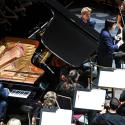
The solo pianist for the evening was Liana Storey, first prize winner in the RNCM’s Concerto Competition last year and now working as a postgraduate with Graham Scott and others there. Her assignment was Rachmaninov’s Rhapsody on a Theme of Paganini, and it was a fine showcase for her gifts. She has all the virtuoso fire and brilliance at her disposal that the piece needs, and also a limpid, gentler tone quality to bring (as heard notably in the opening theme and again in the chords of Variation 22). Of course the grand Romantic tune of Variation 18 is the one that everyone is waiting for, and she gave it a glorious cantabile unveiling and meditative feeling.
Clemens Schuldt, having kept rhythmic precision to the fore while freeing up the pace and allowing emotion to show in much of the preceding music, kept textures beautifully clear and drew luscious strings tone for that big tune as well, making the most of the firmness of the double bass lines and the lovely sound of the RNCM’s horn section in the rest of the work.
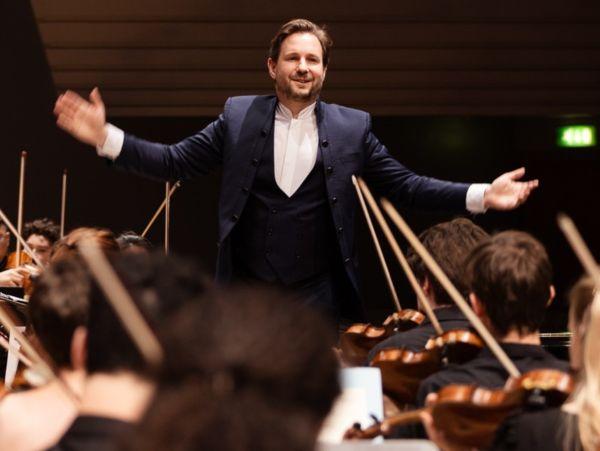
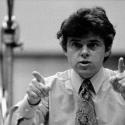
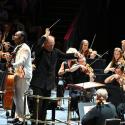
The programme was completed with Tchaikovsky’s Sixth Symphony, the “Pathétique” – for me the Romantic symphony par excellence, dramatic, charming, heroic and tragic by turns. Clemens Schuldt (pictured above) brought touches of imagination and individuality to it, with an emphatic ending to the first movement introduction’s phrase and a passionate edge to its main theme, while the second subject tunes were beautifully enunciated, with just a touch of portamento in the strings, and the coda’s rhythmic tread a clear and solemn one. The 5/4 movement’s melody was swaying and eloquent form, in turn, cellos, wind and later violins, paced perfectly and precise in its ending. The march-scherzo was not quite so happy at first, but he held back the tendency to rush it, keeping to a steady tempo that proved just right by the end (and asking the strings to keep their ensemble by listening once the pace was set).
Both those inner movements got their rounds of applause, which at least shows a kind of listener impartiality. The notable thing about Schuldt’s “Pathétique” finale – conducted stickless – was that it really was a finale, weighty enough to take all the built-up energy that had been felt before it, passionate in playing from strings and horns, with an impressive change of pace for the central section and a haunting, controlled last page.
The official programme of the concert was preceded by a short pre-concert, in the main hall, by the RNCM Symphony Chorus, conducted by Stuart Overington. These are the younger students of the college, all of whom contribute by singing, whatever their speciality interests, and in the Russian programme based around Tchaikovsky’s Liturgy of St John Chrysostom (“St John the golden-tongued”), some of which was heard along with music by Chesnokov, Stojanovic and (notably) Rachmaninov. They did themselves proud.