The parade of stage musicals borne from films continues with Pride, which takes the open-hearted, small-scale 2014 movie of the same name and brings it to the stage with many of the film's creatives (director Matthew Warchus and writer Stephen Beresford) along for the ride. The unbridled appeal to the emotions will be familiar to those who know Billy Elliot and Kinky Boots, two other musicals sourced in sweet indie English films that acquired a full-throttle theatrical life of their own. (Like Billy Elliot, this show, too, reserves musical pride of place for a song devoted to solidarity, albeit in a different context.)
And if the National Theatre's sellout iteration of Pride, presented in conjunction with P&P Productions, isn't big on nuance, that's unlikely to matter to those drawn by its amalgam of history lesson, rallying cry, and appeal for tolerance and inclusion - that last component far more necessary now than anyone could have predicted 12 years ago.
P&P here stands for "pits and perverts" and references the unexpected commingling that took place during the 1984-5 miners' strike when those on the picket line in smalltown Wales found London allies in the newly coined acronym LGSM - Lesbians and Gays Support the Miners. Would the mining town of Onllywn and the Dulais Valley lodge take to the flamboyance of these newfound activists in their midst? Cue a comedy of both coalition and collision set against the grievous backdrop of AIDS - "a new and deadly disease," we're told, and there's a song paying tribute to those lost to it - and a tabloid press hungry to stir up divisiveness at every turn. (Plus ça change etc.) Pride was in evidence, as was prejudice.
Our guide of sorts is 24-year-old Mark Aston (Jhon Lumsden), a prominent gay spokesman from the period who was among those of his generation to have found a London refuge at Gay's The Word bookshop near Russell Square, itself run by a Welshman, Gethin (Christopher Jenkins), who, we soon learn, hasn't spoken to his mum for 17 years. Others in their midst include Gethin's poshly spoken, out-there partner Jonathan (Samuel Barnett, sporting the most wonderful wig imaginable) and the indrawn Bromley (Lewis Cornay), who is the stage show's equivalent to the invented character of George Mackay's Joe in the movie. (The shift in narrative emphasis makes impactful sense: Mark's primacy centre-stage ramps up the devastation at the finish when we learn of his death in 1987, age 26.)
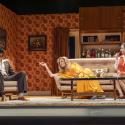
The show proceeds to toggle between these urbanites (pictured below) - Courtney Stapleton's Steph, the representative lesbian, included - and a Welsh assemblage who inhabit another sphere altogether, at least up to a point: "I'm from Swansea, not the Galapagos," insists Maureen (Caroline Sheen), a Welsh termagant whose bigotry exists at one extreme on a spectrum occupied at the other end by the language-loving Cliff (Darren Lawrence), Bill Nighy's role onscreen. We hear from Siân James (Sarah Pugh), the miner's wife who went on to be an MP, and from the resident pin-up, Reggie (Jordan Shaw), because, well, you can't have a show called Pride without the requisite eye candy.
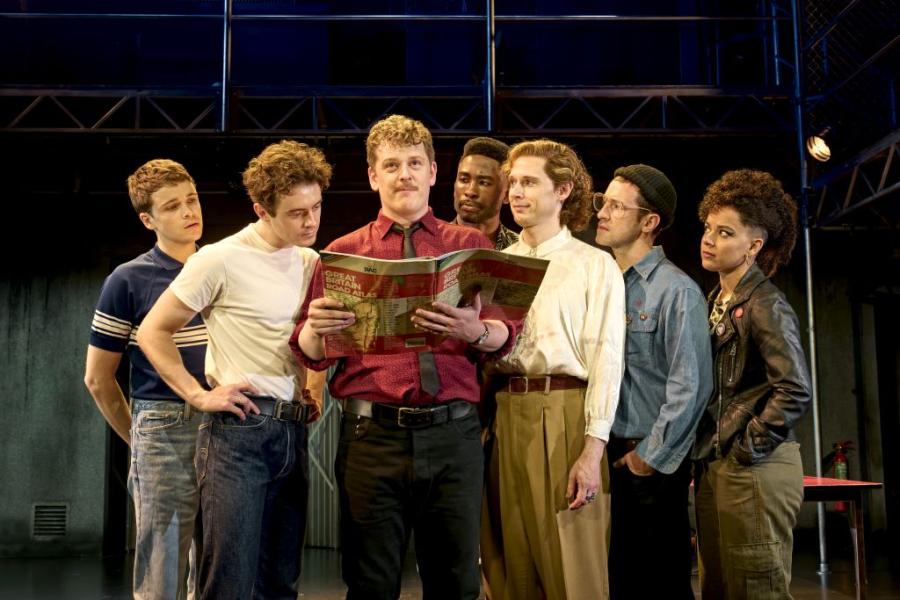
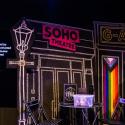
All the while, the musical navigates various stories and points-of-view alongside song and dance, exuberant set pieces - there's a fan dance from choreographer Lizzi Gee that calls to mind director Warchus's Broadway revival of Follies, which I saw three times - and a tonal pendulum that shifts from celebration to devastation and back again. Bunny Christie's design shifts locations as deftly as it does documentary verisimilitude: we're in the realm of fantasy one minute, very much rooted in real events the next.
The score brings together three musical notables in Tony winner Christopher Nightingale (A Christmas Carol), Josh Cohen, and DJ Walde, alongside iconic music heard on the way to and from our seats and, for the first act curtain, the ravishing "Bread and Roses", which lifts political sloganeering to the realm of the transcendent.
It's somewhat disconcerting, in contrast with what has come pre-interval, to kick off the second act with a showstopper for Barnett's take-no-prisoners thesp, Jonathan Blake, that seems to belong to a different production altogether - or at least to the same one as Bromley's belated hymn to self-assertion, "I'm Into Guys", this reluctant bloomer's own answer, I suppose, to "It's Raining Men". One wonders whether the score might acquire more internal consistency of its own if Pride is to continue onwards, as presumably it will. In a show about identity, you yearn for music that leaves its own immediately identifiable imprint.
Other cavils exist: in contrast with the film, the Welsh contingent feels somewhat shortchanged, and the musical's book feels comparatively bald-faced set against a movie that didn't need to press the feel-good pedal so fully to the metal: "This is a triumph" is followed soon after by "we're making history here", lest we hadn't noticed. And maybe it's because I've just been scooping up shows on Broadway that the vocals here aren't always as strong as one might wish for. Material this emotive needs a full-on attack from actor-singers who must fulfil both halves of that job description.
Still, there's no denying the depth of affection that underscores this show as it did the film, and one couldn't ask for a better keeper of the anthemic flame than Warchus, whose Matilda remains, in my view, the great British musical of my years in London. Wherever Pride continues next - and its journey from Cardiff and now to the National surely marks just a beginning - all one might wish for is a tad more art to complement this musical's unabashed abundance of heart.
- Pride at the National Theatre / Dorfman to 12 Sept
- More theatre reviews on theartsdesk