In a warehouse, Tube trains rumbling below, Noah, his sister Tamara and his (Gentile) girlfriend Maud, live in a disused space, a North London simulacrum of a kibbutz, but with drug dealers at the door, unhinged co-tenants wandering in and out and a Christmas tree in the corner.
Their father, Elliot, is visiting this kinda home for a kinda Christmas dinner which is also to be attended by Jack (now calling himself Aaron), Tamara’s kinda ex-bf, who moved to Tel Aviv for its skinny dipping and various other ‘Berlin of the East’ attractions. He brings a suitcase, but he and Tam have far more baggage than just that.
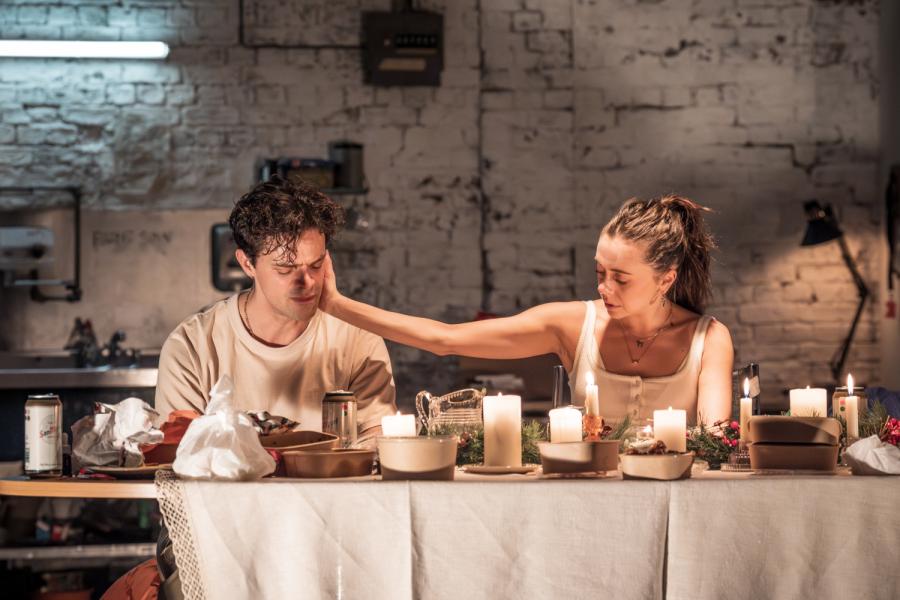
Nothing in this space is quite working. The family’s Jewish identities are strong, but fractured, individualised, incomplete. The dinner is a celebration, but also a reminder of their heritage of oppression, a shared past that is producing diametrically opposite responses to the issues of today. The pressure cooker atmosphere of December 25 is chiselling cracks in these relationships, the cleaves opening before our very eyes. The weight of metaphor hangs as heavily over the narrative as the industrial radiator that teeters above their heads, noisily and unpredictably firing up, making everyone ill at ease. Like an infinitely diluted representation of a Cossack pogrom.
Sam Grabiner’s second play, after his Olivier-winning debut, Boys on the Verge of Tears, is a state of the nation work, but about Judaism rather than England. That word is lengthily explained by Tamara as describing a religion of time since the first century AD (yes, two letters freighted with meaning) destruction of the Second Temple by the Romans, rather than one of place. More pithily, loudly and repeatedly, Elliot rebuts some of that argument with a more direct assertion to rights over land contested in Israel’s present day conflict. It’s the most direct reference to Gaza, but that misery, and the frequently ignored pleas to check the news, remind us that there’s both a place under siege in a localised war and a people under siege from globalised, violent antisemitism, from a beach in Sydney to a synagogue in Manchester.
In a near two hour, all-through, runtime, the tension is slowly cranked up, the bickering giving way to genuine malice and fear, as revelations, poor personal decisions and the mental scarring caused by not really belonging anywhere (even in one’s own family), accumulate inexorably, the heater intermittently clanging into life to make things worse.
Nigel Lindsay is at his best in the lighter first half of the play, the older man amusingly perplexed at the world of his offspring and, because of that generational gap, unlike them possessing a visceral sense of the Holocaust. Whether the extent of his pivot in the darker, disturbing second half squares with his earlier character, I’m not so sure. He’s certainly a lot less fun to watch.
Samuel Blenkin gives Noah a more consistent tone throughout, always uneasy, being slowly torn apart by having to navigate two cultures – he fits into neither – and a past and present that seem irreconcilable. Until the coda, Callie Cooke’s Maud appears to be little more than comic relief but the symbolism of that last scene vindicates her presence and lends a retrospective subtlety to her interpretation.
The two opposites, ex-lovers Tamara and Aaron (whom she calls Jack) prove the most compelling of the characters we meet. Jacob Fortune-Lloyd (pictured above with Bel Powley) is as smugly complacent about his dreamy life in Israel as Bel Powley, all darting eyes searching for offence, is uptight about her life in London. Both seem to hate and admire that in each other and it’s hardly a surprise when an element of mutual self-sabotage emerges in their interactions.
Director, James Macdonald, is juggling so many themes and churning personalities that I’m unconvinced that the required clarity of storytelling is distilled from the script’s whirlpool of ideas. That said, Grabiner does expect his audience to meet him at least halfway, as the best playwrights must, in that task. The writing brought me to the minds of this family, but not its hearts, still less its souls. I’m not sure I had the necessary perspective to see that far.
In a house that sat uneasily through a deliberately discomfiting production, there was a frisson abroad that made it clear that many did. Whether it was, in the words of David St Hubbins in the week in which the world lost the great Rob Reiner, “Too much fackin’ perspective...” is not for me to say. But I suspect it was indeed too much perspective for some, for whom the rawness of the play appeared sharp indeed.