Bayard Rustin is a fascinating but little-known figure in US history: a civil rights organiser who worked behind the scenes on both the Montgomery bus boycott and Martin Luther King’s 1963 March on Washington, as well as campaigning for pacifism (he was on the British anti-nuclear Aldermaston March in 1958) and gay rights. He was also an accomplished singer and lutenist, and advocate for Elizabethan song repertoire. An unlikely but intriguing combination, and one that was at the heart of yesterday’s Night Shift concert by personnel from the Orchestra of the Age of Enlightenment at the Blues Kitchen in Brixton.
The Night Shift is the OAE’s project to put classical music into pub venues – in this case a dimly-lit but welcoming wood-panelled room in south London, usually home to a different kind of music and, presumably, a different kind of clientele. But it was full for this event, essentially a lecture recital of songs with lute, plus items with violin, that were more or less connected to Rustin.
It was fronted by charismatic lutenist Sergio Bucheli, who was clearly bursting to tell us all about Rustin, from his struggles as a gay black man in mid-century America (which moved Bucheli to tears at one point) to his discovery of the lute while in prison as a conscientious objector. And hereby hung the drawback of the evening: Bucheli had so much to say that the chat-to-music ratio was off kilter and, interesting as all the biographical insight was, the spoken sections were overlong, and I just wanted more music.
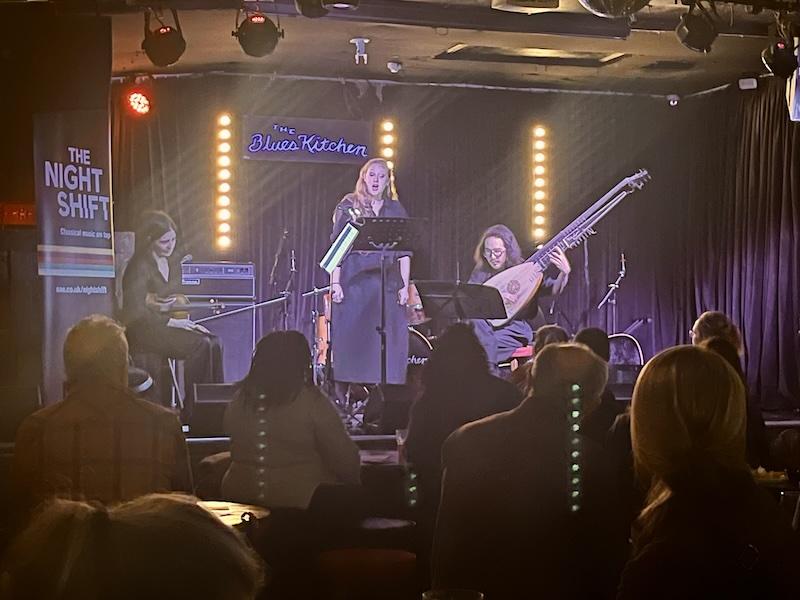
The music itself – heard in sets of three items between the talk – was excellent, from the rumbustious Purcell opener, Bucheli strumming his lute in the “blues-influenced” style of Rustin, to the touching closer, an aria from Handel’s Saul, the only item to feature all three players. I had not heard mezzo Bethany Horak-Hallett sing before, but hope to again soon. She switched seamlessly from the vigour of the Purcell to the ghostly melancholy of William Lawes, and delivered a stunning “Flow My Tears”, perhaps the greatest song ever written, utterly heartrending here. There was a neo-Elizabethan number of Rustin’s own composition and a “deep cut from the Rustin catalogue” in the form of William Cornysh’s “Ah, the sighs that come from my heart”. They were all sung with restrained poise, Bucheli finding a range of accompaniment textures from his chitarrone, including some lovely resonant bass notes.
Violinist Alice Evans’s contributions were less germane. Her Scottish folk tune in the second half was eloquently simple and the “Duke of Norfolk” fiddle-dance was very much at home in a pub setting. But her diversion into the music of violin pioneer Nicola Matteis took us away from the Rustin theme to little benefit.
I really enjoyed the Night Shift vibe – getting classical music out of its usual venues, although I’m not sure how many of the audience weren’t the usual OAE crowd, just in a different place. And while I was fascinated to hear about Rustin (and would recommend the Radio 3 Sunday Feature from 2024, available on BBC Sounds, to anyone who wants to learn more about this extraordinary man), a tighter script might have made for a better-balanced evening.