Perfectly at one in matching tone and response, this phenomenal duo who are both formidable solo personalities in their own right also took us through a range of colours and approaches in a cornucopia of masterpieces for both four hands at one piano and two instruments placed side by side, from Bach to Lutoslawski, Debussy to Tailleferre.
The first half was typical of their thoughtfulness. The grounding was in Bach, Bartlett providing the spiritual pulse at the start of the Sonatina from the cantata "Gottes Zeit ist die allerbeste Zeit" in Kurtág's transcription (you always know a true Bach interpreter the minute you hear one, and Bartlett's Bach/Busoni at the start of his debut CD immediately put him a cut above another pianist, overhyped in my opinion, who touches only the glassy surface).
The calm ruffled in the central section was restored in what we know as "Sheep may safely graze", transcribed by Leonard Duff, only to be blown sky-high in Schubert's Fantasie, despite its melancholy-smooth opening melody. Neither Batsashvili nor Bartlett sentimentalised anything here, keeping everything on the move, the playing clear-eyed throughout, and yet the end result was still deeply troubling.
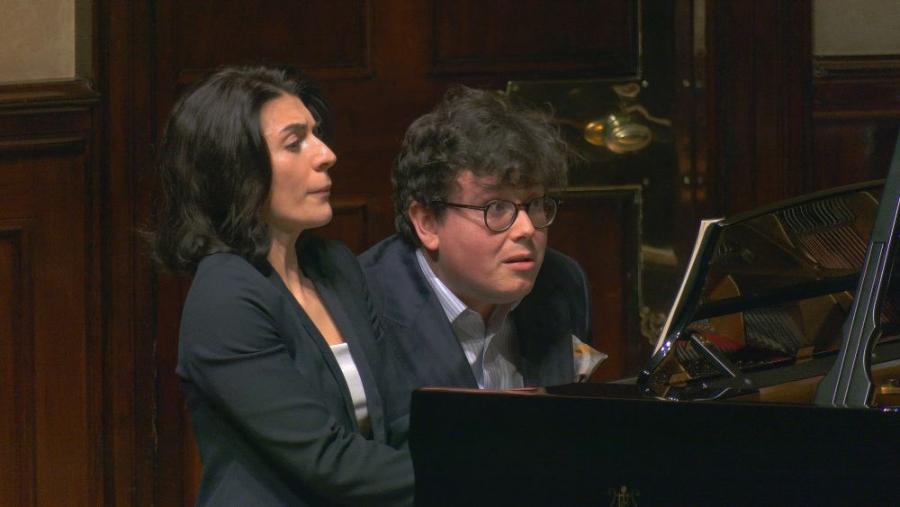
Inspired, then, to have Mozart's Sonata in D for two pianos as the joyous sequel. The ricochet exchanges may have been tonally indistinguishable, but each pianist brought an extra interpretative kick to so many of the phrases. Mozart's delight in extending an argument found roundings-off of perfect mirthful poise, which we also got after the interval at the end of each movement in Debussy's early but exquisite Petite Suite - more Massenet than Debussy, it always seems, but full of charm and melodic invention, ending with a "Ballet" that here had a hint of the music-hall strut about it, looking forward to "Minstrels" in the first book of Preludes.
Germaine Tailleferre's Valse Lente was over almost before it began, but its harmonic quirkiness was an ideal preface to Ravel's Rapsodie Espagnole. Here the two pianists brought down a gauzy scrim out of which violence and colour could explode - brilliantly so in the main dance of the final "Feria". How different the two-piano version sounds from the subsequent orchestration, each enlightening and magical on its own terms.
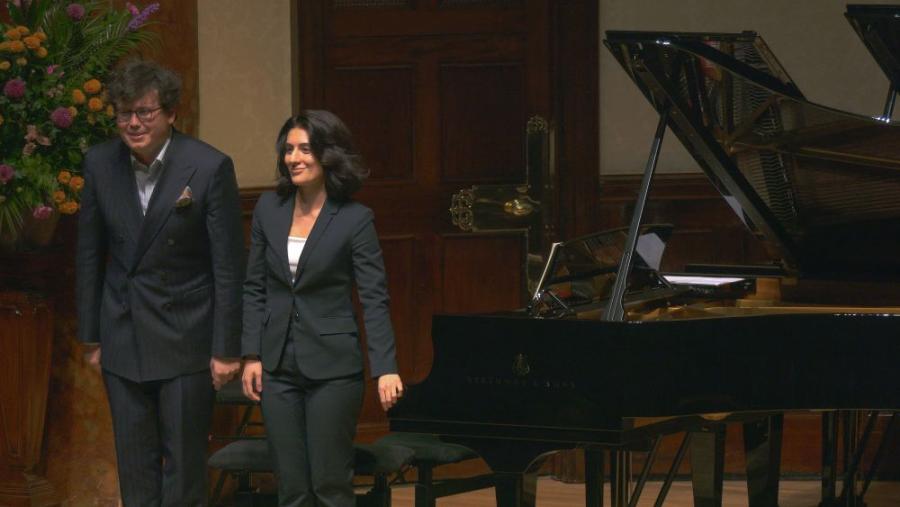
Lutosławski's Variations on a theme of Paganini - the same 24th Caprice engaged by Brahms and Rachmaninov, though not fully revealed here until near the end - predictably brought the house down, but still one wondered how on earth Batsashvili and Bartlett - or for that matter Lutosławski and Panufnik in 1941 - managed those torrents of notes: simply phenomenal. And for lowering the temperature by way of an encore, what could be better than the famous opening movement of Faure's Dolly Suite?