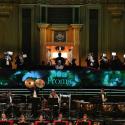
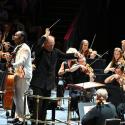
Pundits have always yoked architecture and Bruckner together, touting void and mass at the expense of the dynamic experience music ought to be. Abbado and his Lucerne Festival Orchestra favoured sinuous instability in the Fifth Symphony earlier this week, making the very foundations gyre and gimble. Relatively solid ground last night was due to a more sober conductor and Bruckner symphony: a mixed blessing. The grand design, in fact, came from Leif Ove Andsnes in Rachmaninov’s Third Piano Concerto, making overall sense of a work which has always seemed swooningly resistant to it.
If that meant throwing out the epic grandeur and misery favoured by the Russian school of orchestral pianism, so be it. Andsnes’s rock-solid technique was a marvel in itself, and deftly followed by Jiří Bělohlávek's velvet BBC army. It depended, apparently, on where you were sitting as to how well the balances came across: right at the back of the stalls, the piano sound pinged so insistently off the back wall that it felt as if the volume might never go below mezzo-forte, while another audience member seated some way back upstairs told me the soloist's fortissimos couldn’t be heard above the orchestra.
Such is Barbican concert life. What’s for sure is that Andsnes not only mastered the longer and more relentlessly chordal of Rachmaninov’s alternative cadenza-part-ones in the first movement – an option of which Horowitz once said, “It’s like an ending in itself, and it’s not good to end the concerto before it’s over” – but made the ensuing soft answer that turns away its wrath the lynchpin of the whole adventure, so that the movement could sink calmly to its temporary grave.
Bělohlávek’s straightforward engagement with Bruckner's Fourth Symphony made a suitable enough alternative to the still-glowing memory of Abbado in the Fifth
Least successful was the poker-faced turbulence of what sounded like a very overwrought Intermezzo, though its sudden bout of valse-tristing found Andsnes in top chamber-style partnership with the BBC Symphony woodwind. And the finale truly crowned the work, that central fantasy which so often used to get the chop making sense as a will-o-the-wisp pursuit through the forest of memory. The final cavalcade was both exhilarating and utterly in command, with a confidence that merited the ovation. Andsnes lowered temperatures graciously with a personable encore stroll through the Norwegian March of compatriot Grieg; Rachmaninov would have warmly approved.
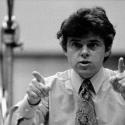
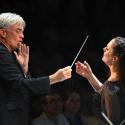
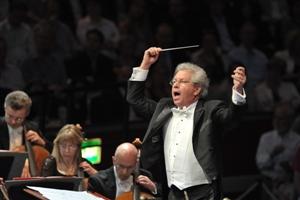 It was the Bruckner which took some adjustment. Throughout the first three movements of the Fourth Symphony, dubbed – as all the early ones might be - “Romantic”, Bělohlávek’s straightforward engagement (the conductor pictured right by Chris Christodoulou), his easy spaciousness for the mountain peaks and atmospheric command of the twilight zones, made a suitable enough alternative to the still-glowing memory of Abbado in the Fifth, even if one missed the sheer finesse of the world’s finest orchestral soloists (the collective BBC strings sounded in very good, echt-Austrian health, though).
The second-movement funeral march needs a little help, and got it; the violas shone in their disconsolate little meander and Bělohlávek lifted the whole by swinging through the first brighter processional in village-band style. But the finale has always seemed to me beyond redemption, especially last night with the miraculous solution of the Fifth still blazing in the brain; and here one really could have done with an injection of the Abbado/Lucerne hallucinogens. Instead Bělohlávek’s dogged sobriety made me want to bolt from the hall as Bruckner goes into two repeat modes too many, and with some of his dodgiest thematic material. A shame I left feeling almost as Mahler the conductor did about the piece, that the passing beauties don’t quite make up for some of the more tedious absurdities. Had composer and conductor been able to stop at the end of the big, horny Scherzo it would surely have been a different story.