“Welcome” reads a sign hidden behind a metal screen whose spider-web of bars is designed to keep out unwelcome visitors (pictured below: Welcome: Carib, 2005). Through the grille one can see an exhibition of paintings to which, despite the apparently friendly invitation, access is emphatically denied.
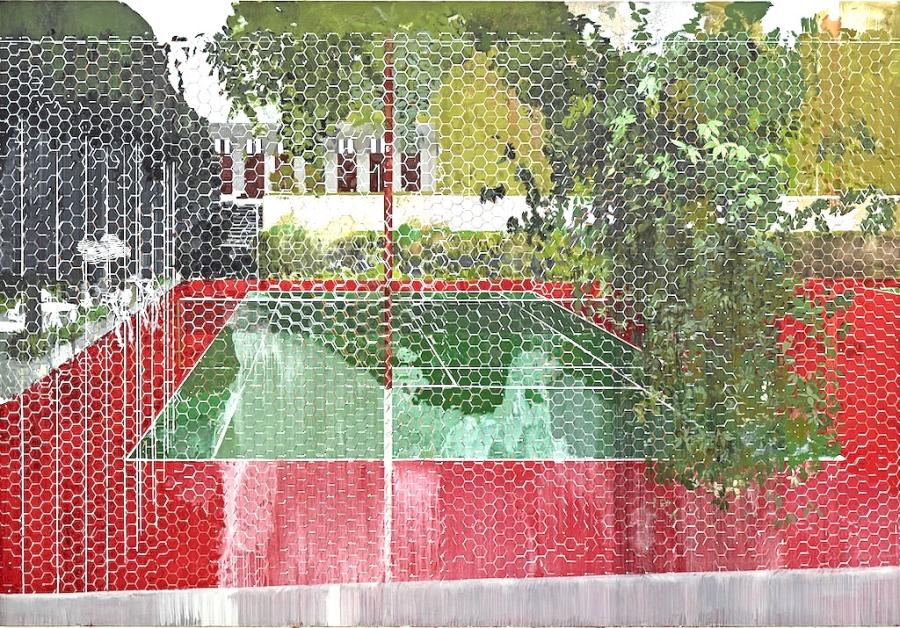
The Country Club is similarly protected by a high, chicken wire fence through which the tennis court and club house are tantalisingly visible (pictured below: Country Club: Chicken Wire, 2008). In these paintings, Hurvin Anderson treats both subjects with exquisite wit. The offending wire is rendered with subtle delicacy, while the visual pun of a “welcome” sign imprisoned behind bars speaks for itself.
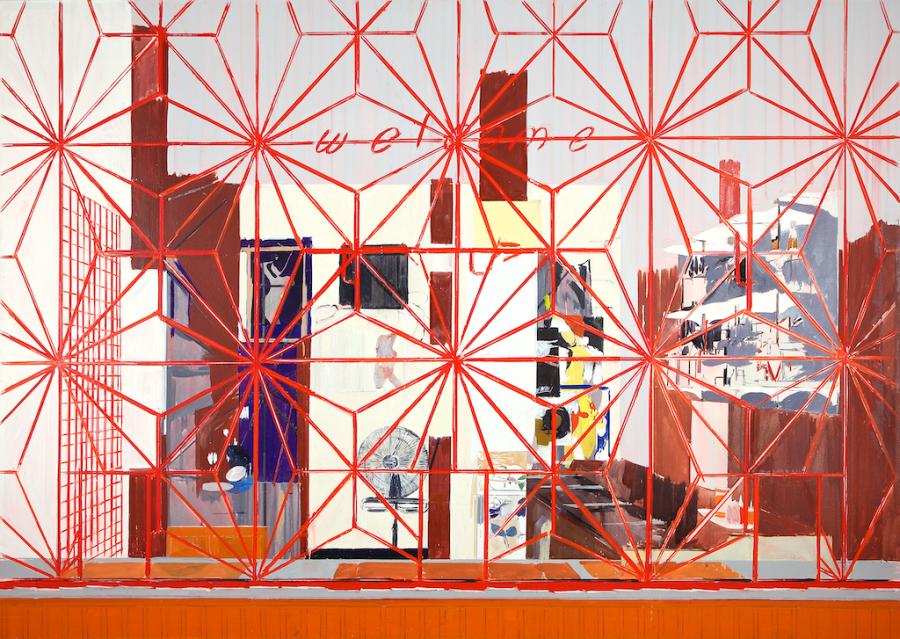
The paintings are of Port of Spain in Trinidad. While he was artist in residence there, in 2002 , Anderson was struck by the prevalence of security devices used to exclude those deemed undesirable. In numerous canvases which he describes as “painting myself into the fear and division evoked by security barriers”, he explores how the hierarchies of power and ownership are made visible. “If that’s how it feels making the painting, how does it feel living somewhere surrounded by these grilles? It’s a form of oppression”, he says.
It must have been a shock for his outsider status to be emphasised so clearly, since his parents came from Jamaica. They emigrated to Birmingham in 1961 and Hurvin was the first member of his family to be born in England. He has always felt like an outsider here, a state he describes as “being in one place and thinking about another”, so his visit to the Caribbean could have felt like some kind of home-coming.
The sense of displacement pervades much of his work, though. Painted in 1998, the year he graduated from the Royal College of art, Beaver Lake is a wonderful early portrait of his sister and her daughter in Canada, where they'd moved to. Cocooned against the cold, mother and daughter have been abstracted to the point where they become anonymous figures silhouetted against the icy expanse of the frozen lake. “The painting is like an extreme of an immigrant experience”, says Anderson. “The simpler it got… the more it looked like she was out in the cold, far from home.”
American Tan (Mrs S. Keita) 2013 is based on a photograph taken of another woman similarly far from home. A family friend, she is seen posing beside a large television set indicative of how well she is doing in exile. She makes her first appearance in Cabinet 1997 a painting of family photographs grouped together as a kind of shrine that includes a picture of Hurvin as a young boy with his father. Mrs Keita keeps on appearing over the years as if, with her floral dress, patent leather boots and determinedly positive stance, she is some kind of talisman for Anderson – a symbol both of displacement and courageous readjustment.
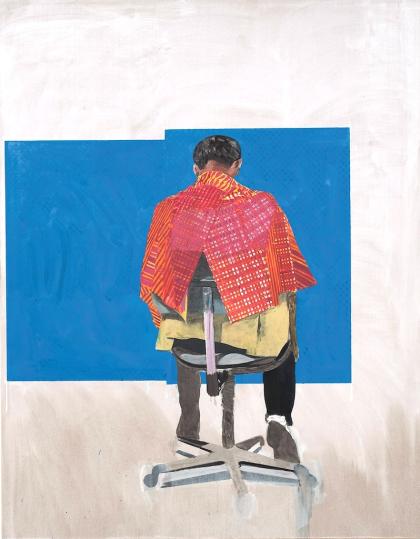
Set up in people’s homes, barber’s shops became cultural havens where immigrants could meet, gossip and have their hair cut. Over the decades, Anderson has revisited the subject time and time again, sometimes detailing salon clutter including a list of available styles with names such as flat top, hight top and skiffle, and sometimes reducing the familiar scenes to a set of completely abstract shapes. Peter’s Sitters II 2009 (pictured right) features a seated client draped in a towel, his head bowed ready for the scissors. Silhouetted against a blue rectangle, he is completely alone as though to emphasise his vulnerability and sense of isolation in the diaspora. It's a simple image, but it is as moving and as memorable as another iconic masterpiece – Edouard Manet’s Fifer 1886, of a young flute player isolated from the rest of his band.
Walking along the north coast of Trinidad, Anderson came across the ruins of numerous hotels, built to accommodate white tourists but long since abandoned and left to rot. Paintings such as Limestone Wall 2020 (pictured below) and Hawkshill Bay 2020 (main picture) show the man-made structures being overwhelmed by a riot of lush vegetation. It’s as though the island and its inhabitants were reclaiming their birthright from the colonisers who'd taken control of their country and made them feel unwelcome in their own back yard.
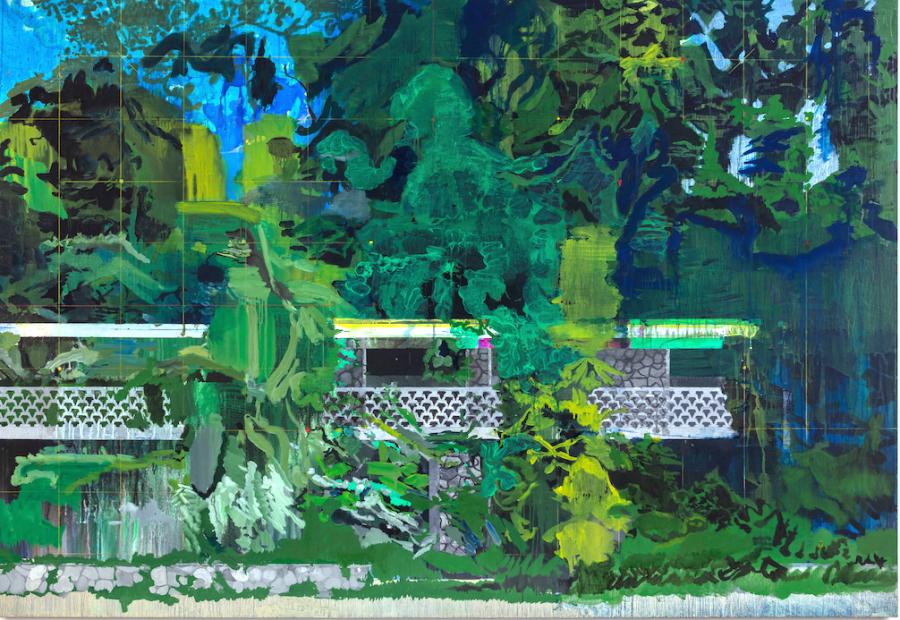
The vibrant colours of these tropical landscapes is in stark contrast to the dismal greys and browns of The Banqueting Palace. Made this year, the painting resurrects a memory of walking home from school through the dank streets of Handsworth beneath skeletal trees on a wet winter afternoon. Comparing this drab and comfortless landscape with the gorgeous blues, purples and greens of Wait a Moment 2019, a painting of a man resting quietly in the shade of trees that fringe a Caribbean beach overlooking a tranquil blue sea, it’s easy to read the picture as an image of longing – even if Trinidad is not such a paradise, after all.