Four storeys above Oxford Circus, the noise and bustle recedes to be replaced by a parallel universe of gleaming glass-fronted workspaces and discreet installations of modern art. The room where I am sitting looks towards the upper reaches of the grand neo-classical façade of the London Palladium, framed by a blue early evening spring sky. On the table in front of me, a chess board displays pieces representing landmarks from London and New York that include tastefully sculpted models of the London Eye and the Chrysler Building. On the wall next to the reception, a quote from Leonardo da Vinci reads, “Learn how to see. Realise that everything connects to everything else”.
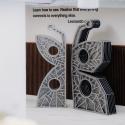
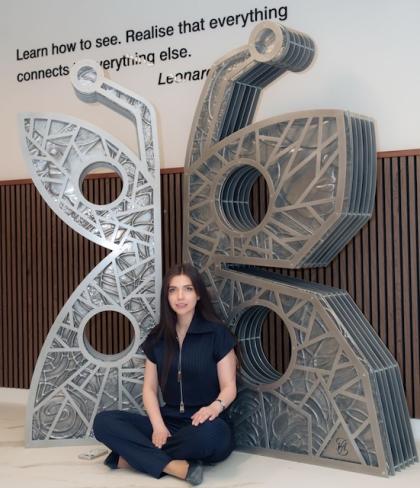
This is not a gallery, but the headquarters of Fasanara Capital, a hedge fund described in a recent article as a “Digital Finance Powerhouse of the Future”. Amid the quiet corporate hum, a crowd of people is starting to gather for the unveiling of the latest sculpture in a series by London-based artist, Aylal Heydarova. It’s a strikingly different atmosphere from the jostle of the brutalist World’s End estate in Chelsea where she created her first installation in the series. Like artists ranging from Dutch Golden Age painter Maria van Oosterwyck to Damien Hirst, she is obsessed by butterflies, in this case large sculptures that act both as an inspiration and a warning (main picture: Heydarova's most recent butterfly sculpture). While in her work they evoke transformation, resilience and renewal, they are also a reminder of the ongoing decline in species that she describes to me as “catastrophic”.
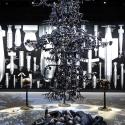
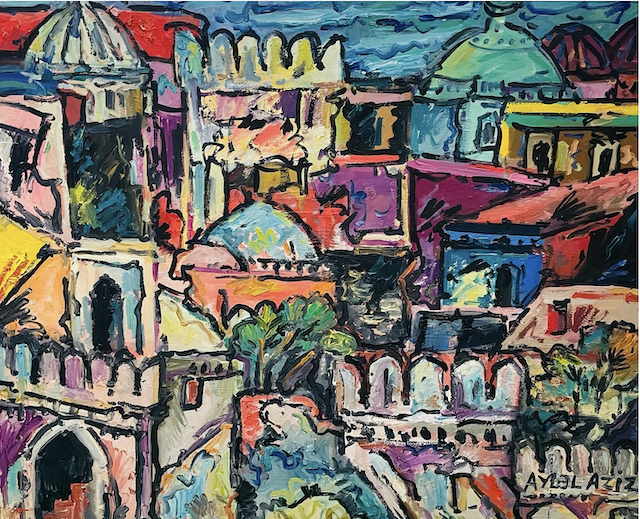
The Azerbaijani-born Heydarova began her #savingbutterflies project in 2024, working with the Wembley-based charity WE RESTART, which uses public art to promote social change and give a voice to disadvantaged communities. She started by collaborating with children from the World’s End and Lots Road community. “I was a painter at first,” she tells me when we meet at Fasanara, (her work Baku is pictured below) “but I decided I wanted to do public art, and sculpture felt like a powerful way of sharing my ideas”. Though she also realised that the combination of small children and sculpture presented other challenges, “I knew they would want to climb on it, so I had to design it so that it would be safe for them to do so”.
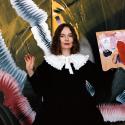
The wooden butterfly was built and painted in a two-week workshop, and then installed in the piazza in front of the World’s End estate for three months. After that it was moved to become one of the public art works in Wembley’s new Union Park. The success of the project led to her working a year later on a second butterfly with the children of asylum seekers living in Brent, a borough where famously more than 149 languages are spoken. This was accompanied by workshops for the children on practical steps to take to protect the environment. Heydarova (pictured below), herself a mother of three, declares, “I think the best way to explore climate change is through future generations”.
As we talk, it emerges that her motivation for creating public art has an intriguing background. In London, Heydarova is starting from scratch to make a name for herself, but her father, Arif Aziz, is regarded as one of Azerbaijan’s most important artists, whose work brings together traditional Azerbaijani themes and abstract elements. In Azerbaijan itself, he presided over a new generation of artists as Dean of the Azerbaijan State University of Culture and Art. In the meanwhile, his international reputation has led to everything from his acting as an Ambassador for Peace for his own country to having his work featured in German fashion designer Leonie Mergen’s collection at London Fashion Week in 2018.
While citing him as an influence – along with Georges Seurat and Gustav Klimt – Heydarova is clearly determined to make a name for herself on her own terms. She initially moved from Azerbaijan to the UK in order to study art at Leeds University. She presents as a very self-contained figure, with immaculate long dark hair and a sleeveless pinstriped trousersuit. Her English is fluent, and her conversation ranges easily from the anatomy of the butterfly to the influence of Zoroastrianism on Carl Jung.
Despite leaving her country behind, at Leeds she was inspired by Tom Cassidy, the Chair Professor in Design at the University, to draw on her national identity when developing her voice as an artist. “I made about 30 suggestions for my dissertation. After about two hours debating the topic, we finally settled on the mandala and Azerbaijani motifs. For me it was a breakthrough to realise how deep the connection was between these and Zoroastrianism, which has a history in Azerbaijan that goes back more than a millennium.”
Does she see her butterflies – which were also exhibited last year at World Art Dubai – as a continuation of the mandala tradition? She smiles. “Maybe subconsciously. But each one also brings together a range of influences and ideas.” Certainly the aesthetic of each one reflects a different agenda. The second butterfly that she created with the children of asylum seekers – which is also now displayed in Wembley Park – has its wings covered with brightly-coloured faces to reflect their multiple identities and cultures. The butterfly for Fasanara, by contrast, sculpted in an aluminium alloy, could be an etching on a manuscript in elegant silvers and metallic greys.
Has she got plans yet for her next installation? “No – but I hope we will have the opportunity to run more workshops. It would be good, too, to have more butterfly sculptures created with different communities in London. Children who are fixed to their screens are finding it increasingly difficult to understand the importance of emotions, empathy, and exploring the real world.” She smiles. “Even just the physical act of participation in a project like this is going to have an impact on them.”