A brand new sign in a contemporary font (Centra No.2 I am told) signals my arrival at the wooded grounds of Goodwood Art Foundation. This contrast, between cool, clean design and the timeless but perhaps parochial charms of the English countryside makes for a fascinating morning at this recently renamed and revamped sculpture park in rural West Sussex.
Beyond the art world, Goodwood has long been known for horse racing and motor racing. Now, thanks to a progressive landscape gardener, a modernist architect, an outreach programme and media support from Bloomberg Connects, it offers an art viewing experience removed from the revving of supercar engines, expensive hats and champagne (admittedly that remains a drink of choice for many in the art world as well).
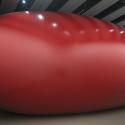
Bringing straight lines and plate glass to this natural setting, Goodwood has two gallery buildings, an upscale cafe, and 70 acres of carefully cultivated grounds, in which nestle works by more than half a dozen artists, so far. The woodland and the gallery programme change with the seasons. In keeping with winter, a time when many trees are bare and nature retreats, the Foundation has an exhibition called Erasure. These times are, after all, something of a winter for the planet. The forces of capitalism and greed are now more than a mere threat to biodiversity and diverse human cultures.
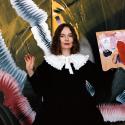
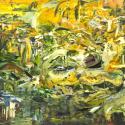
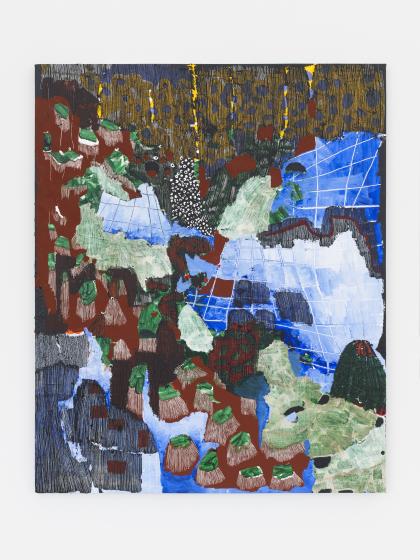
Though all three artists in this exhibition come from temperate climes, all three have cause to lament what is afoot in their homelands. Since two are from much-deforested Brazil and the third has Palestinian roots, how could this be any other way? Brazillian artists, Lais Amaral and Solange Pessoa, are put in dialogue with one another. Amaral paints; Pessoa sculpts. The paintings are large, heavily worked, generally abstract, with paint that spreads across each canvas and then is scraped away using combs and tweezers. It results in a signature look in which each work is densely layered and furrowed in finely scratched pale lines.
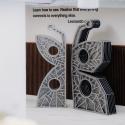
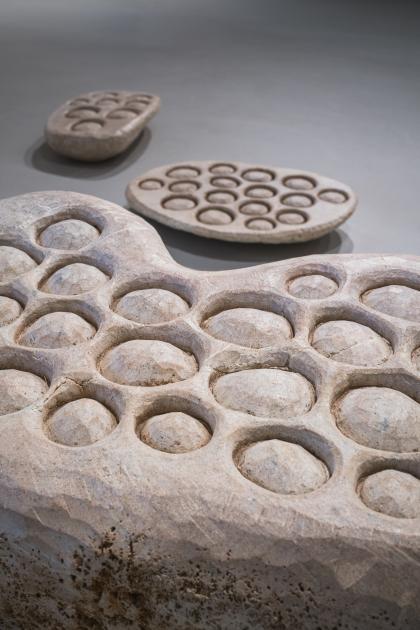
Pessoa offers no such complexity. Her floor-standing works – soapstone pebbles the size of foot pouffes – are smoothly carved with simple motifs recalling fossilised plantlife: fern leaves, spirals, branching stems. Both make tactile works but those of Pessoa are legitimately touchable. These stones are warm, reassuring, and energised. From wall to wall, the emphasis changes. (Pictured above left: Solange Pessoa, Nihil Novi Sub Sole, 2019-2021)
Amaral’s fine lines can ripple to suggest an undulating grid. The colourfield and contours can at times recall maps, charts, arcane diagrams. And despite inorganic colours, landscape is suggested time and time again, along with elements from science text books: frogspawn here, two abutting tectonic plates there. One detail might recall leopard skin; one combination of colours will evoke the infernal regions of one of our many earthly hells. (Pictured below right: Laís Amaral, Untitled (Gesto-Caminho series), 2022).
Pessoa’s 33 pedra-sabão invite you to crisscross the gallery and return to the magnetic paintings, but also occupy two spaces on their own: behind a screen at the back of the gallery and on a terrace which today is rain-soaked.
Sculptural process is as important as painterly practice; the artist takes clay maquettes to Mata dos Palmitos, a village in southeastern Brazil famed for its skilled stone carvers. In each medium, these are compelling works: contrasting the gravity of stone with the intricate possibilities of paint. But gallery notes are needed to link them to either pre-colonial times or threatened topographies and cultures in the Amazon. QR codes by each work connect you to a wealth of interpretation, admittedly, and keep the layout clean, but I feel that one or two succinct wall texts would have given these concerns a less diverting, more material hold on the attention.
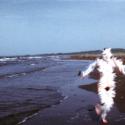
For me it was the third artist whose work most embodied cultural or ecological erosion. A single installation by Dana Awartani was on display in the nearby Pigott Gallery and, thanks to one of Goodwood’s very helpful and enthusiastic invigilators, it was immediately graspable, giving the visitor ample chance to reflect on the implications of a 22-minute film in which the artist sweeps up sand in a gloomy vestibule in Jeddah (Main picture: I Went Away and Forgot You, Dana Awartani, Courtesy the Artist and Lisson Gallery).
While sand is almost metonymic for the Middle East and certainly the Gulf States, this was no ordinary desert. Rather it was a carpet of colourful dyed grains applied using sieves and six layers of templating. The effect was a tiled floor, once reminiscent of Islamic architecture, but now out of favour given prevalent 20th century western styles.
Awartani has literalised this erasure. In the calm wooded setting, the film of calm repetitive labour induced a mood of quiet sorrow. By contrast the floorspace between the visitor bench and the projection screen was to be marvelled at: a full scale recreation of the tiling in the artist’s film. The minimal colours and geometric regularity of this smoothly precise sandy tiling were powerful in all respects: visually, conceptually and technically. There was a serenity about the contents of both galleries, as if they too were but clearings in the peaceful grounds. Not even the rain could dampen the pleasures of a wander round some of the hereditary Goodwood Estate, but Erasure was a recuperative space rather than a call to action.
- Erasure is at Goodwood Art Foundation until April 12 2026
- More visual arts reviews on theartsdesk