Rose Wylie’s paintings are a blast of fresh air. Direct, anarchic, exuberant and determinedly daft, they make a mockery of the self-importance that so often infects the art world.
Now in her nineties, she had to wait a long time before being able to spend time in the studio. Having studied at Folkestone and Dover School of Art, she married the artist Roy Oxlade, had three children with him and stopped painting in order to bring them up. In those days, it was normal practice for the man to be the Artist and the woman the Housekeeper while often also being his model, muse an assistant.
Then, as a mature student, she went to the Royal College of Art; she graduated in 1981 at the age of 47, when most people have already gained recognition or given up trying. Wylie wasn’t fazed, though. At the time women artists were largely ignored anyway, so she set about forging her own idiosyncratic path. “I’m used to being marginalised," she explained to critic Alastair Sooke. “I’m the seventh child. But I didn’t mind; it gave me a certain freedom. It made me make my own world.”
The years spent parenting had given her an opportunity to unlearn the unhelpful stuff she’d been taught as a young student. Irreverant Anatomy Drawing, 2017, for instance, pokes fun at the desire for anatomical correctness by featuring a pantomime horse with its various bones exposed and labelled.
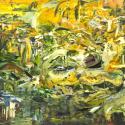
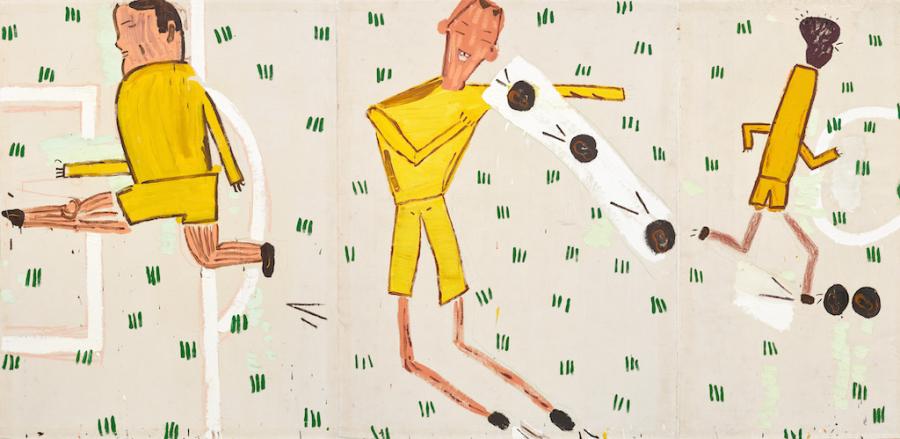
For although her paintings are figurative, she makes no attempt to depict things as they appear to the eye, preferring instead to reduce them to bare essentials and create images that are more emblematic – akin to the way things are stored in the mind, perhaps (pictured above: Yellow Strip, 2006, (detail) Oil on canvas, 186 × 670.7 cms Courtesy the artist and David Zwirner).
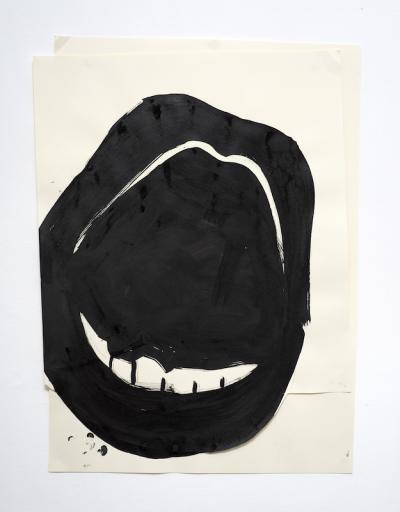
With space flattened, gravity ignored and people reduced to silhouettes, her paintings looks simple and child like; but don’t be fooled. The ink drawing Bottom Teeth, Self-Portrait, 2016, (pictured below right), for instance, is a highly sophisticated rendition of an open mouth. And as Picasso famously said: "It took me four years to paint like Raphael, but a lifetime to paint like a child…Every child is an artist. The problem is how to remain an artist once we grow up.” And I like to think of Wylie gaining inspiration from her kid's efforts.
She draws every day, jotting down things culled from a broad range of sources including newspapers, magazines, cinema, television and social media. “If it’s an exciting visual thing, I think, marvellous, I’m going to make a drawing of it,” she says. “I work from anything.That’s the whole point.” Then she forgets about them until they re-surface some time in the future, at which point she allows them free reign to interact on the canvas.
The technique reminds me of the nursery rhyme “Little Jack Horner sat in the corner/ Eating a Christmas pie/ He put in his thumb, And pulled out a plum/ And said, "What a good boy am I!” It’s as though, metaphorically, Wylie is sticking in her thumb, rummaging around in her unconscious and pulling out untold treasures.
Gazing at a painting like Bird, Lemur and Elephant, 2016, (main picture) is therefore like witnessing a “eureka” moment – full of surprise and innocent delight. To create this jumbo picture and its companion Spider, Frog and Bird, Wylie spread the oil paint on with her hands – a sensory experience whose visceral impact creates in one a gleeful sense of child-like wonder. It’s almost as if you are seeing things for the very first time.
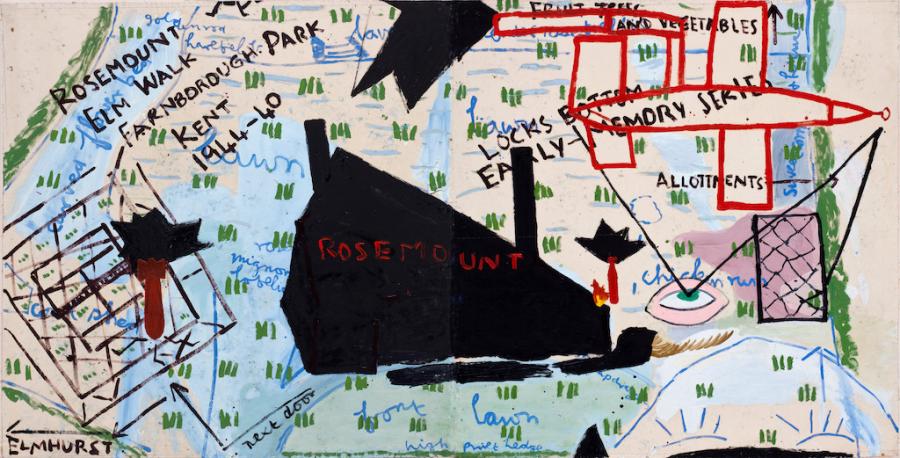
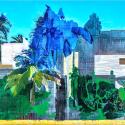
Usually, the more you know about an artist and their work, the richer one’s experience of it becomes. In Rose Wylie’s case, though, it’s better just to go with the flow and allow her to take you on a visual joy ride (pictured above: Rosemount (Coloured), 1999. Courtesy Vladimir Ovcharenko). The curators of the Royal Academy show have done their best to tame her rebellious spirit by making her paradoxical images seem sensible; but since her pictures deliberately bypass reason, rational explanations add little by way of understanding and serve only to spoil the fun.
According to Goya’s etching of 1799, The Sleep of Reason unleashes a torrent of fearful monsters. In Rose Wylie’s world, however, it generates curiosity, wit and wonder.