The National Theatre has a long record of starry revivals so this version of John Millington Synge’s The Playboy of the Western World, with a cast led by Nicola Coughlan (yes, from Derry Girls and Bridgerton), quickens the heartbeats of anticipation, although audience reaction won’t be anything like that of the play’s 1907 premiere. That Dublin production caused nationalist protests from a riotous public who felt insulted by the playwright’s realistic portrayal of the Irish peasantry as lonely drunks, and by its theme of patricide and its image of female underwear. Sinn Féin founder Arthur Griffith called the play offensive to Irish women, describing it as “a vile and inhuman story told in the foulest language we have ever listened to from a public platform”. Wow. So what’s this drama all about?
Well, the plot is simple: on the remote Western Ireland County Mayo coast, Pegeen Mike (Coughlan) is working in the pub owned by her father, Michael Flaherty, who is hanging out with his drinking buddies. Then Christy Mahon, a timid young stranger, stumbles into the pub and claims to have killed his father, an act which gives him the aura of a local hero. So much so that Pegeen, to the dismay of her fiancé Shawn, is strongly attracted to him, as is the older Widow Quin. When a group of young women arrive to see and idolize Christy, he increasingly becomes the heroic playboy they want him to be. That is, until his father unexpectedly shows up, injured but alive alright, and angry.
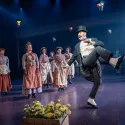
The Playboy of the Western World is about heroism and hero worship: Christy is at first tired and bedraggled, but he soon grows into the part that the villagers have created for him. At one point, he dances triumphantly across the bar floor, at another he kisses his own reflection in a mirror. He’s an ugly duckling who learns to swan around. But although he is liberated by female interest in him, stimulating him to boast and crow, he remains vulnerable to the truth, which is symbolized by the arrival of his father. If Bertold Brecht once argued that “Unhappy is the land that needs a hero”, Synge got there before him: he understood that Ireland’s need for nationalist heroes could end only in tragedy. As indeed it did in the blood sacrifice of the 1916 Easter Rising.
Yet Synge also realized that the best way to change your personality is to invent, to pretend, to act out, a made-up identity. And this is exactly what Christy does: by pretending to be the slayer of a tyrant, he actually does become a romantic figure. In this desire to free himself from his father, he has, of course, symbolically to kill him. But, as the play’s climax demonstrates, this Oedipal gesture results not in murder, but in role reversal: the slave takes the place of the master. The son becomes the parent. Life moves on. If Synge’s world view is both Freudian and satirical, his choice of Hiberno-English (using English words within an Irish language syntax) for the play’s dialogues allows him to mix flights of poetry with humorous remarks. His verbal magic is both beguiling and sometimes very funny.
The playwright’s vision of the much mythologized West of Ireland, which in the early 20th century was seen by nationalists as an innocent place uncontaminated by British colonial rule, likewise prefers reality to illusion. His picture of rural conditions emphases poverty, both material and of aspirations, with the influence of the Catholic church’s bigoted priests strong and oppressive. Drink seems to be the only solace, and loneliness has reached epidemic proportions among the young, whose prospects have been savagely curtailed. So Pegeen is conflicted between her instant love for Christy and her disillusion when his lies are exposed. Finally, she is the sad victim of the story.
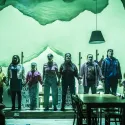
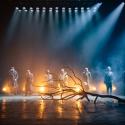
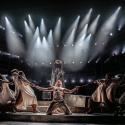
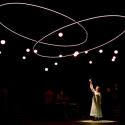
The problem with casting a superstar such as Coughlan at the National is that it raises the theatre’s expectation that it can sell out its large Lyttelton auditorium. I’m sure it will, but I also think that this large stage is really not right for this particular story. Quite frankly, Michael Flaherty’s bar should be like the cramped room of Conor McPherson’s The Weir (obviously influenced by Synge). Instead, here it is a huge space like a mega urban Wetherspoon’s. A massive barn. Hardly a place of poverty. To fill the acres of empty space, director Caitríona McLaughlin, who is head of Dublin’s Abbey Theatre, adds a fair amount of over-designed folkloric business, with keening funeral processions, masked mummers and goddess worshippers galore.
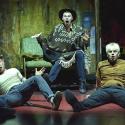
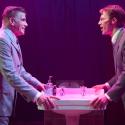
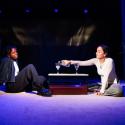
Added to these distractions are designer Katie Davenport’s elaborate costumes, some of which would not be out of place in an Oscar Wilde play, but here look much too lavish for an impoverished Irish backwater. Definitely not right for Synge. And neither is the acting completely convincing: Coughlan has a sunny vibe which negates the lonely misery of Pegeen, although her sharp tongued responses to Widow Quin, played with beautifully manipulative wit by fellow Derry Girl Siobhán McSweeney, are just right, and her final howl of desperation chills the blood. Éanna Hardwicke’s Christy is more convincing as the childlike milksop turned idol, though he lacks savagery, and he gets excellent support from Declan Conlon as his father. Lorcan Cranitch is hilarious as the drunk Michael and Marty Rea often gives Shawn a fine sense of the pathetic. But this production is too colorfully spectacular for this particular drama.