Some 16 or so years ago, I recall hearing what sounded like fireworks from my hotel room in Chișinău, the capital of Moldova. I was aware of the Russian-occupied, unrecognised state of Transnistria, but thought that it was very distant, It wasn’t – and I still think they were fireworks, but I can't be sure.
In Tbilisi, I heard stories of Russian tanks lined up just 40 kms or so from the Georgian capital; in Yerevan, Armenia and Baku, Azerbaijan, I was told quiet understated cases for both countries’ longstanding claims to Nagorno-Karabakh. That crash course in the poitical turmoil of the Caucasus told me that the lines on the map were more in pencil than in pen in that part of the world.
For a long time, the messy aftermath of the collapse of the Soviet Union was largely held out of sight and out of mind for those on the western side of the Iron Curtain – certainly events away from The Balkans. We preferred the images of kisses on the demolished wall, of peoples celebrating peaceful revolutions in streets wearing flowers in their hair, and a warm relaxation with the comforting thought of a Bear now caged and the peace dividend that followed.
Then, three years ago, the bubbling skirmishes and illegal occupations on Russia’s border with Ukraine blew up into a full invasion and, despite the best efforts of some and what appears much less than the best efforts of others, we are where we are, invaders repulsed but not defeated.
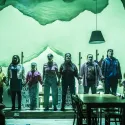
Olga Braga’s play, winner of Theatre503’s International Playwriting Award, is set on the cusp of that shocking escalation in a town on the Donbas frontline in which ethnic Ukrainians and ethnic Russians who once played together in the streets, now shoot across them. It’s an urgent reminder that this war is not all drones in the night skies and photo opportunities outside political summits, but a conflict that traps real people scraping a living, surviving under fire, frightened and confused.
Sashko is the young hothead, the Ukrainian true-believer who is back from an internment in Russia and itching to get a gun rather than rocks into his hands to take the fight to Putin’s ragtag soldiers. His father, Serhiy, is more practical, acquiring a Russian passport to work in order to pay for food and insulin. He directs his anger, born of the frustration caused by such a double life with his double nationality, towards his son and his much younger Moldovan girlfriend, Marianca, who has a five-year old child left in Transnistria.
Ivan (Russian) and Vera (Ukrainian) are elderly now, sweetly in love, their sensibilities formed in a country/empire that no longer exists. Nadya, Vera’s granddaughter, is an elective mute, traumatised by war and her mother’s fleeing the conflict. All the while, two Russian snipers observe from a hideout ready to enforce the curfew at the end of a Kalashnikov.
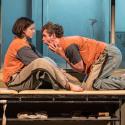
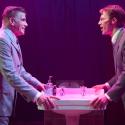
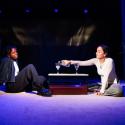
Eight characters require a fair bit of packing into a 100 minutes all-through play, but director, Anthony Simpson-Pike, keeps the pace high and the writing is vivid and performances sharp. On his stage debut, Jack Bandeira lends Sashko a Brandoesque sexy menace, putting down his pistol in favour of a pencil to sketch Marianca (Sasha Syzonenko, also very good), which has exactly the effect you would expect on a lost woman craving love and missing her son. Philippe Spall plays the cuckolded Serhiy more sad than vengeful, the fight beaten out of him by war, left solely with the cruel power to humiliate poor Marianca.
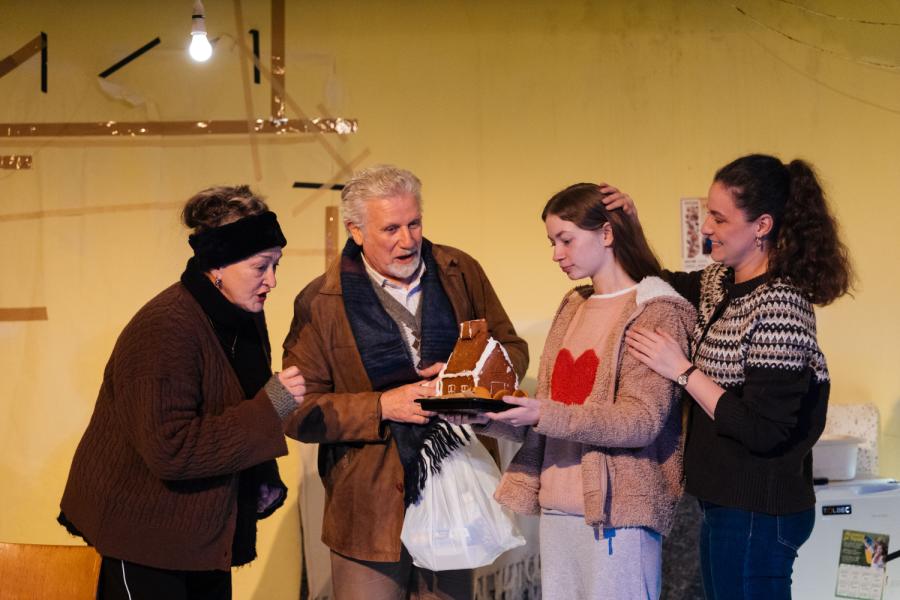
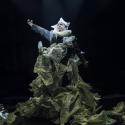
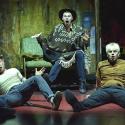
Liz Kettle and Steve Watts (pictured above with Sasha Syzonenko and Ksenia Devriendt) offer some comic relief as the older couple, Vera’s desire for a Claudia Schiffer blond mane her escape route from the trauma. Nadya (Ksenia Devriendt, ethereal) finds her voice as the spirit of an ancient Ukraine, embodying the bloodlines that have fought off enemies over centuries, almost a live action version of a Socialist Realist painting of a heroic young 1920s peasant.
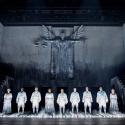
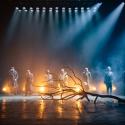
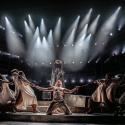
It doesn’t always work, balance the main issue. Cramming both history and contemporary politics into the narrative tilts some conversations into de facto rallying cries with fervent appeals to Ukrainian nationhood. Dream sequences are visually stunning (super costumes from Niall McKeever) but, like the history lessons, there’s at least one too many. Nadya stops sounding like a frightened but defiant teenager and starts sounding like a mouthpiece for propaganda. The cause is noble, the lines leaning into a mystical Eurasian Romanticism, but it takes us too far from the characters in which we’re invested.
That dreamscape takes up ground that could have been given over to the triangle between father, lover and son, the three struggling for the space between principle and pragmatism, duty and defiance, honesty and duplicity. Marianca, Syzonenko channeling a little of Thomasin McKenzie’s fear of discovery in Jojo Rabbit, is a compelling character, at 32 facing life-changing decisions, but somewhat underwritten, as her story is less about Ukraine and more about displacement. There’s a better, longer play inside this one that downplays the political and scales up the personal.
Despite that criticism, there is much that is good in this work and one can see why it rose to the top of the 1500+ entries to the competition. It wears its heart on its sleeve, commits fully to its unequivocal message and brings out fine performances from its cast.
Perhaps it just needs to trust its audience a little more – after all, very few will be in doubt about who are the goodies and who are the baddies in this ongoing tragedy.