

Contemporary London life in all its forbidding, faceless swirl makes for a visually busy evening at Boy, the Leo Butler play that finally isn't as fully arresting as one keeps wanting it to be. An admirably kaleidoscopic view of the capital as filtered through 17-year-old Liam (Frankie Fox), aka the "boy" of the title, Sacha Wares' production utilises a 26-strong cast to address the notion of aimlessness in our age of austerity – the sheer volume of actors in our midst constituting a welcome rebuke to the pinched economic landscape all its own.
But once you've clocked the populous landscape, and the snakelike travelator that defines Miriam Buether's characteristically venue-reshaping set, Boy in purely dramatic terms keeps walking in place. Indeed, I couldn't help but feel midway through that had less attention been given to recreating the visual templates of our sometimes-pitiless town, be they Sainsburys or Victoria Station, the more the narrative might have acquired its own pulse.
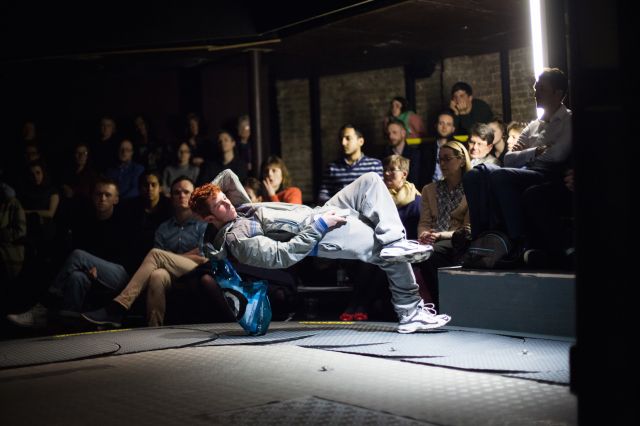 As it is, the play moment-by-moment constitutes a fascinating exercise in theatre-as-installation that nonetheless leaves us little the wiser about its central figure after 75 minutes than we were at the beginning: for all the immediately winning stage presence of the sweet-faced, physically supple newcomer that is Fox (pictured above), Liam remains a societal emblem, not a character.
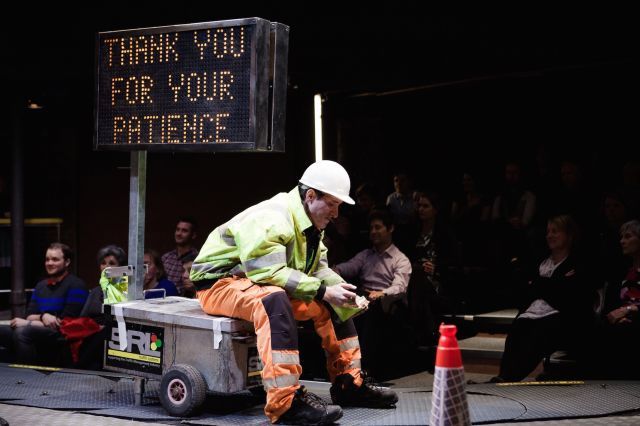
The Almeida certainly knows a thing or two about onstage bustle (Alecky Blythe's 2014 play Little Revolution had a chorus of 31 local volunteers), while Wares and Buether joined forces last year to make of Mike Bartlett's play Game a profoundly disturbing experience in which the writing seemed inseparable from the creative team's bold delivery of it. This time around, and with the audience on all sides of the ever-moving walkway, one can never quite ignore the continual work required to position into place the various doorways, bus shelters or whatever that make up Liam's urban picaresque: he's a modern-day Candide of sorts, but with Oyster card barriers in place of an auto-da-fe. (Oh, and workmen, too, as pictured below.)
It's no surprise that 'Boy' ends with a questionHis story amounts to so much butting up against the daily cacophony that defines the citiscape, Buether's travelator itself acting as a metaphor for the mechanised, impersonal society that confronts Liam at every turn: one could imagine an intriguing repertory pairing of Boy alongside the comparably-themed Sophie Treadwell classic, Machinal. Inarticulate to a fault, he is first seen at a sexual health clinic getting checked out for STDs, his wanderings leading to one or another lippy encounter or brush-off, alongside the occasional gesture of support when least expected – "he's just a kid," says a well-spoken fellow who volunteers to pay his fare, the implication soon evident that Liam constitutes the human equivalent of the "unexplained item in the bagging area" that we recognise from many an automated pronouncement.
 Liam, of course, is a person, not an automaton, and Butler is right to remind us of the primacy of the individual at a time when more than ever people are reduced in the lingo of realpolitik to vaguely generic collectives. As a result, one becomes doubly aware of how unindividuated he actually is: we get a passing reference to (unseen) parents working "zero hours" jobs, but it's part of the play's tricky strategy that Liam be a notably invisible protagonist. He's the antithesis to the thrusting, bravura image of Jamie Bell as Billy Elliot that at one point descends into view, the musical's fable-like quality in telling contrast to the unstarry existence that most people lead.
As an exercise in crowd control, Wares's staging represents no minor achievement, and some of the vignettes are sparkily funny amid the implicit sadness that prevails overall: a "really fucked" poshette attests to being scared of Liam but "in a good way", while a trio of schoolgirls early on suggests a play all their own with their rapid-fire hashtags for any and all occasions. Liam, meanwhile, lends such conversation as he possesses to talk of being "busy", but one wonders to what end. It's no surprise, in context, that Boy ends with a question about Liam's future that goes unanswered. It may or may not be the fate of the Liams of the world to disappear from view even as the prospects of the young actor playing him on this evidence are in every way assured.












Add comment