

Stories about slavery tend to be simplistic: white perpetrators are bad, black victims good. One of the more striking features of Winsome Pinnock’s new play, The Authenticator, is her insistence that reality is always more complicated. Staged in the Dorfman space of the National Theatre, this production signals the playwright’s return here after her success with Rockets and Blue Lights in 2021, and reunites her with its director Miranda Cromwell. But does the complexity of real life undermine the inherent drama of this fictional tale?
Well, the situation is simple: Fenella Harford is an eccentric white punk artist well into middle age. When she unexpectedly inherits Harford House, her family’s stately home, she discovers a collection of diaries and other archives. These were written by a distant ancestor who ran a Jamaican farm between 1756 and 1762. Fen asks historians Dr Marva Harford, a young research assistant, and her older mentor Dr Abi Adeyemi, to confirm their historical authenticity, choosing them because Marva has the same surname as her and because the academics specialize in the history of slavery. But does Marva really have a connection to this posh English landed family, and what secrets can this archival material reveal?
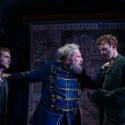
Pinnock certainly does introduce some complex plotting, with Marva having a grandfather, Melvin, who was a local amateur historian, and both Abi and Fen sharing a background of being students at Oxford University. So when the authenticators stay at Harford House, with its chilly bedrooms and dungeon-like cellars, it’s partly a rip-roaring gothic comedy, with unexpected haunted-house sounds for tourists, armour that turns out to be not very medieval and, more disturbingly, a “blackamoor” statue of a boy. Gradually, the six dusty volumes of Harford diaries begin to yield up their secrets. As you’d expect, they include inventories of slaves, but there is also evidence of the birth of a child from the not uncommon sexual violence of master against female slave.
The introduction of a historical figure named Black Sarah, and of Melvin’s belief, passed down by word of mouth, that he was descended from the Harfords, adds further complexity, as well as opening out a debate about the validity of oral historical evidence as against the written evidence of documentary archives. As these two different aspects of historical fact-checking are weighed up, Abi and Marva discover the imprint of a missing page which powerfully argues for a direct link between past and present. Like Tom Stoppard’s Arcadia, this play examines, sometimes seriously, sometimes playfully, the historical evidence, asking how can we know if an archival message is a true fact – or just a doodle?
When Abi and Fen get drunk, Pinnock articulates a debate about the history of slavery by showing that although the white woman had slave-owning ancestors, so did the black woman: her African “forebears facilitated the European trade in slaves”, or, rather, “enslaved people”. While Abi argues that these two situations are not exactly comparable, she does also say “if we identify ourselves too closely with trauma we risk perpetuating our own mental enslavement”. If both these women are relatively entitled, from Nigerian royalty and English aristocracy, Marva grew up in humbler circumstances and is descended from enslaved Ghanaians who worked on Jamaican plantations.
So while Pinnock makes the powerful point that Black Britons are not all the same, with differences of class and heritage, she also raises the question of who should be telling their stories. She likewise has some kooky fun with the idea that some white people want to appropriate elements of Africa heritage, and there are some good jokes in the play. At the start, there’s a band called Phallus-E (pronounced Fallacy) shooting a grime video at the country house, and Pinnock also shows that both Abi and Fen are able to perform identities that hide their privileged upbringing. But the main theme is that archives can contain explosive information that radically recasts our present-day sense of self.
As the action, a heady mix of farce and serious discussion, develops, Fen gets to sing an aggressive cockney “See You Next Tuesday” song and Abi a more literary Franz Fanon rap. There’s an oblique reference to Bridgerton, some satire about aristocratic family portraits and much lively banter. Old wines are drunk, and the house begins to groan and creak as if it’s a living thing. Through all this Pinnock keeps returning both to the post-colonial question of who’s responsible for past bad stuff, and to the fact that chance often plays a big part in deciding which archival evidence survives – and which is lost.
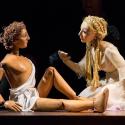
Cromwell’s production has an affectionate energy which, however, cannot disguise the fact that 90 minutes is, once again, not enough time to develop the themes of this show, many of which are introduced with little subtlety. Still, Jon Bausor’s traverse set has some suitably gothic features, and the actors clearly enjoy themselves: Sylvestra Le Touzel gives Fen a nice plummy scattiness, Rakie Ayola’s Abi is a blend of seriousness and archness, and Cherrelle Skeete’s Marva is vigorously impactful. A longer show would have helped make their characters deeper, and their discussions meatier, but nevertheless this is an entertaining play which revisits current debates about Britain’s imperial heritage.










Add comment