Though there are few starry, starry nights in Stockwell these days, nor flaming flowers that brightly blaze, you can find ragged men in ragged clothes outside the Tube station. One hundred and fifty years ago, when a fiery redheaded lad pitched up in SW9 asking for a room, something happened and, if we don’t know exactly what, we can have fun wondering can’t we?
It wasn’t just Don McLean who was drawn to the legend of Vincent van Gogh. In 2002, Nicholas Wright used a fragment of fact and a whole lot of imagination to spin a play out of the youthful Dutch master’s brief sojourn in South London as a failing print dealer and barely budding artist, but with hormones to burn. That National Theatre production, directed by Richard Eyre, marked an early public appearance of Emily Blunt - whatever happened to her?
We open on a domestic scene, a Victorian kitchen through which we must pass to get to our seats, me slightly fearful of being caught in the midst of a Miss Julie production and unable to escape. It turns out that the stuff all works, Charlotte Henery providing a hot oven and a hob on which actual food is actually cooked and a butler sink in the corner with plumbed-in taps. For 30 minutes or so, I could barely concentrate on the speeches, half-terrified, half-marvelling at the dexterity of the actors’ truly courageous prop work. I usually only reach those heart rates in a theatre when Chekhov’s gun makes its second appearance!
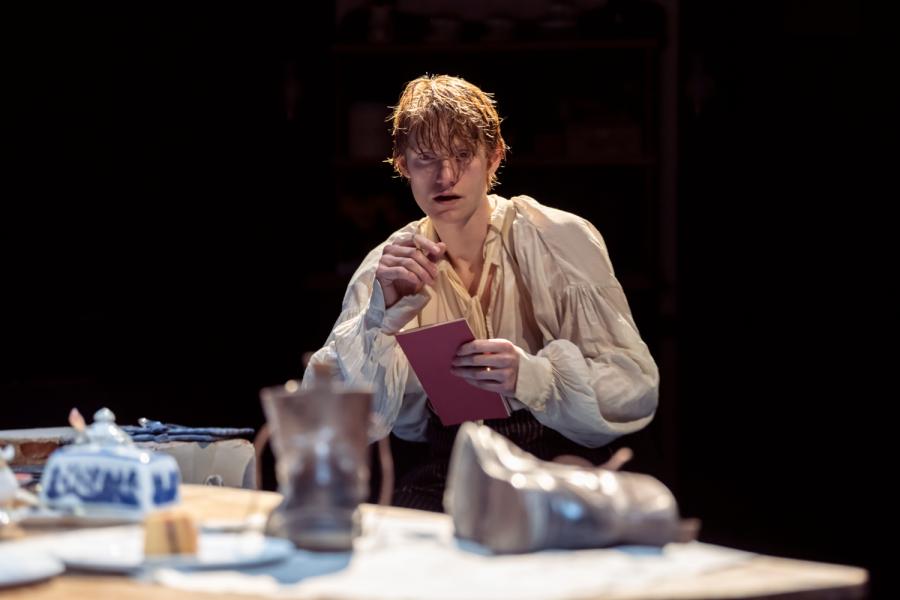
Jeroen Frank Kales (pictured above), making a splendid debut, is instantly recognisable as the young protagonist, the mop of strawberry blond hair a dead giveaway. Adding an accent seemed a bit superfluous, but it actually worked well, as it underlined this manchild’s strange otherness. He’s puppyishly enthusiastic/irritating, brimming with energy and very "no-filter" as the young people of today would say. The intelligent charm is unmissable, and he's very funny too.
His counterpoint is the present lodger at the address where Vincent is seeking a room, the cool-tempered, aspirant radical artist, Sam Plowman (a wryly observant Rawaed Asde). He wants to tear up the Academicians’ orthodoxy and paint the poor people with whom he mixes in the streets. He explains this while Vincent - who has barely put a pen in hand at this stage of his life, still less a brush - is peeling potatoes, natch, the first of many opportunities for those ITK to suck on a thoughtful tooth.
The real tension between them is caused by Eugenie (Ayesha Ostler, with, initially at least, a coquettish look for both). Vincent is smitten of course, as any passably pretty girl would smite a man like him at that age, but he’s so naive that he cannot see that she and Sam are an item. If anyone is honest and recalls being 19 or so, they’ll recognise that feeling, but, hopefully, not Vincent’s compulsion to say the quiet bit out loud.
So far, so so, but the play lights up when the landlady, Mrs Loyer, a widow, allows herself to see her strange new lodger as more than an eccentric, well-educated and overly sensitive young man. They bond initially over a shared interest in literature and a fluency in French (she runs a little prep school). They grow close when Vincent, showing that fiercely perceptive eye he would use years later in portraits, recognises that it is not just a widow’s grief that ails her, but the Black Dog’s barking that sends her so low. He understands because, as everyone in the theatre knows, he suffers too. There’s quite the age difference and Vincent has demonstrated that he is a vulnerable person, but there’s, probably, nothing predatory in the older woman's actions. Though if this were a Mr Loyer and Mary Cassatt, it would be a very different play.
In an inexperienced but technically skilled cast (Amber van der Brugge also makes a fine debut as Anna, Vincent’s sister, who’s just as mad as he is), Niamh Cusack holds the centre. She goes from angry to fascinated to uplifted to crushed in her dealings with her lodger, Vincent, as their affair blossoms and is then abruptly truncated when he is posted to Paris. Cusack catches exactly that sense of knowing it would all end in tears, but that proves to be of little compensation when they come. As with all acting in this most intimate of houses, there’s no margin for error if charged with carrying the emotional weight of the drama across two hours plus, and Cusack doesn’t need it. In her mid-sixties now, she is as handsome as ever, with a face that would captivate any artist.
Georgia Green performs miracles directing her cast around and through this busy kitchen, somehow avoiding them spilling tea or sprouts in the front row’s laps, and creates the animating tension beautifully. We’re never left in any doubt that Vincent, for all his problems, is on his way up (all that foreshadowing of the post-impressionist hits to come, unrewarded though they were) and that Mrs Loyer will be tortured by depression for the rest of her life.
But that window of joy when she was bedded by an adoring young man, the transgressive love as thrilling as ever for both of them, gave her something beyond the grind of teaching, cooking and grieving. For a short time, she was a character in her own French novel, which may be a dangerous place to spend time, but everyone deserves to feel a rush like that at least once in their lives.