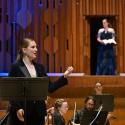
There’s something slightly odd about listening to Bluebeard’s Castle, Bartók’s great opera of darkness, on a sunlit spring afternoon. However, the sun streaming through the windows of Glasgow’s City Halls was the only thing wrong with this corker of a concert performance from the BBC Scottish Symphony Orchestra and Elim Chan. And indeed, conductor Chan was the not-so-secret weapon in this concert’s success.
Pacing is everything in this opera. The tension needs to heighten and steadily tighten as the successive doors are opened, becoming unbearable with the last one; yet the conductor needs also to find the love and affection in the score, avoiding it turning merely into a Hammer House of Horror. Chan nailed this balance perfectly, allowing the score to reveal its secrets step by step, never pushing the drama excessively, but also broadening out majestically for the more meditative moments, not just the high-point of the fifth door but also in the snatched moments of tenderness between Bluebeard and Judith, all the more precious for being so fleeting.

The orchestra colluded with her every step of the way, with chalky violas to represent the sighing castle, plangent wind solos that spoke of loss and of fathomless regret, trills and rattling tritones for the more macabre scenes, and yet a huge-hearted, wide-open climax for the glimpse of Bluebeard’s far-reaching kingdom.
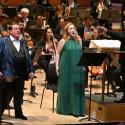
The two Hungarian singers rose to the challenge every bit as effectively. Dorottya Láng’s Judith (Lang pictured left) had a rich, flexible mezzo that inhabited the role’s middle register with poignancy and the suggestion of lost possibilities. Gábor Bretz never pushed his voice as Bluebeard, showing deep understanding of the role’s ebb and flow, finding the deepest sadness in his interactions with Judith but broadening out impressively for the fifth door. The tenderness between them was always more powerful than the darkness, meaning that the highlight of the opera, unusually, was the opening dialogue before the first door opens, so rich with suggestion and potential that only gained in power for being so cruelly thwarted.
Anything that shares a billing with Bluebeard is almost certainly going to take second place, and so it proved with the other theatrical excerpts, for all that they were well played. Shostakovich’s incidental music for Hamlet sounded brash, exciting and raw, a reminder that he was composing it concurrently with the brasher, rawer Lady Macbeth of Mtsensk. Britten’s Four Sea Interludes from Peter Grimes suffered a little from lack of coordination in the Sunday morning scene, but there was air around the violins, tremendous swell in the Moonlight music, and a punchy sense of theatricality to the storm.
- Recorded for future broadcast on BBC Radio 3 and BBC iPlayer
- More classical reviews on theartsdesk