

When the joyful energy at the final curtain - love briefly triumphant in the power-dominated world of Wagner's Ring - is as insanely high as it was at the end of a dizzying first act, that killer of a forging scene, you know this is a winner. Andreas Schager is a battle-hardened Siegfried, knowing no fear at full pelt but having to work harder on softer tones now, and his still-boyish enthusiasm learns all the febrile, physical lessons director Barrie Kosky asks of him in the third instalment of his challenging new Royal Opera Ring. It's a combustible meeting.
We also witness Kosky developing the intense imagination which powered his Rheingold and Walküre. That his wise, compassionate ancient Erda would be with us throughout was a given, but not how he'd engage her. Illona Linthwaite, last night's earth-mother, has a rich, readable range of facial expressions as vital to this Ring as the other characterisations (it's a pity the Royal Opera picture selection shies away from her nakedness).
Her happiness at the possibilities in young Siegfried is palpable; just as she celebrated nature with flowers in Die Walküre as Siegmund and Sieglinde welcomed the spring, she is seen by Siegfried, at one with nature, as the Woodbird in Act Two (Sarah Dufresne gives us the first high tones of the opera from the wings). And she is the gardener in the paradisial summer meadow on the mountaintop where Brünnhilde lies waiting an awakening with a kiss - evocative, perhaps, of the Edenic vision at the top of Dante's Purgatorio, though the spirit guide here is no calm Beatrice.
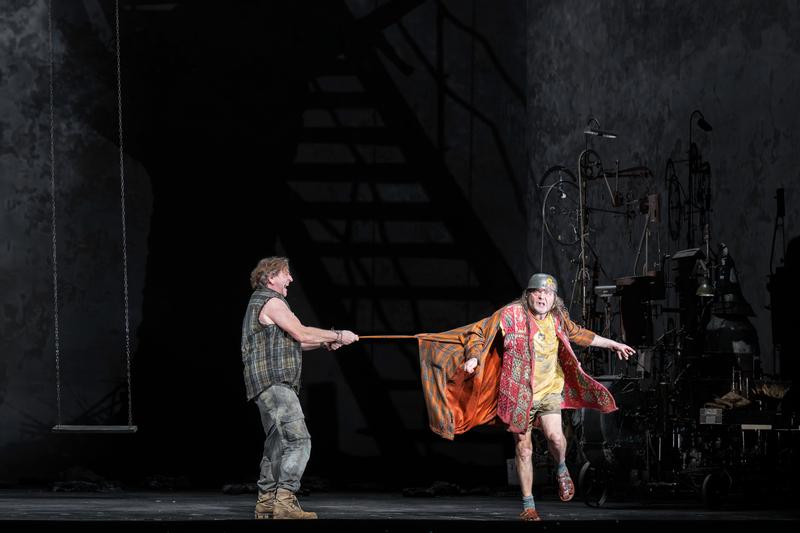
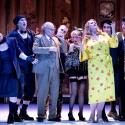
Anyone coming to Wagner for the first time and catching this first act - not always easy to bring off - would surely be hooked for life. The relationship between young Siegfried and Mime, the scheming foster father who's brought him up in the forest after the death of his mother Sieglinde in childbirth, is a rich one as sung and acted out by Schager and Peter Hoare (both pictured above).
The lighter tenor at first tells us how difficult this role is in the lower register, and it takes a bit of time for the voice to hit its stride, but none for the physicality to kick in, from tree-house chucking of sword fragments and tapping Nibelung rhythms on his tin hat - Siegfried has a good crack at that too later - to sparring and sniping with his adopted son. The campery of the flask swinging as, thanks to tasting the dragon's blood, Siegfried can hear his murderous thoughts, is vintage comedy, abruptly terminated by the lad's second murder, the one which brings the curse of the ring upon him.
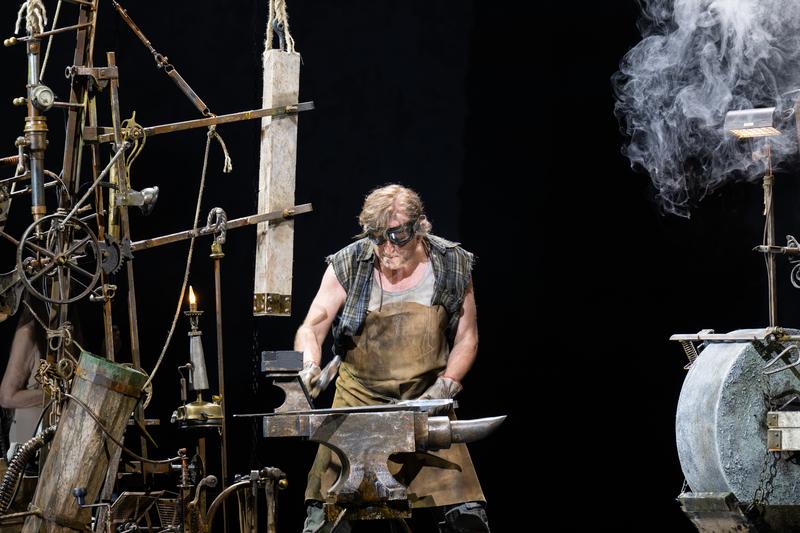
The adolescent can sometimes come across as a mere bully, but his excess vitality here is mingled with a rough kind of affection - pouring saucepan slop over Mime's head one moment, wiping it tenderly away from his face the next. As if the acting weren't fine enough, Schager makes light of the ludicrous number of high notes in the first scene, and the minute he strikes up his first song while forging the sword with clarion "Notung"s, we're knocked for six (pictured above). The Heath Robinson contraptions help, and sparks literally fly. You come out of the first act thinking "did I really hear that?" It combines, of course, with the comedy of Mime's poison-brewing and the brilliantly articulate playing of the Royal Opera Orchestra under Antonio Pappano. You hear every colour in the score, especially the chuntering clarinets and bassoons, and at a pace of wonderful vitality.
There are one or two points where the stage picture doesn't reflect the music: Pappano is very imposing with the lower-register darkness at the start, but Erda on a swing isn't quite the corresponding image. Nor is a weary Wotan moving ever so slowly in front of the black drop-curtain while Siegfried supposedly braves the flames in the blazing orchestral ascent of the mountain. But otherwise the images, so imaginatively designed by Rufus Didwiszus and above all so variously lit by Alessandro Carletti that we don't notice how we got, say, to the shadowing of the central tree of Act One or the increasing light on the flower-meadow in Act Three, are potent if unexpected.
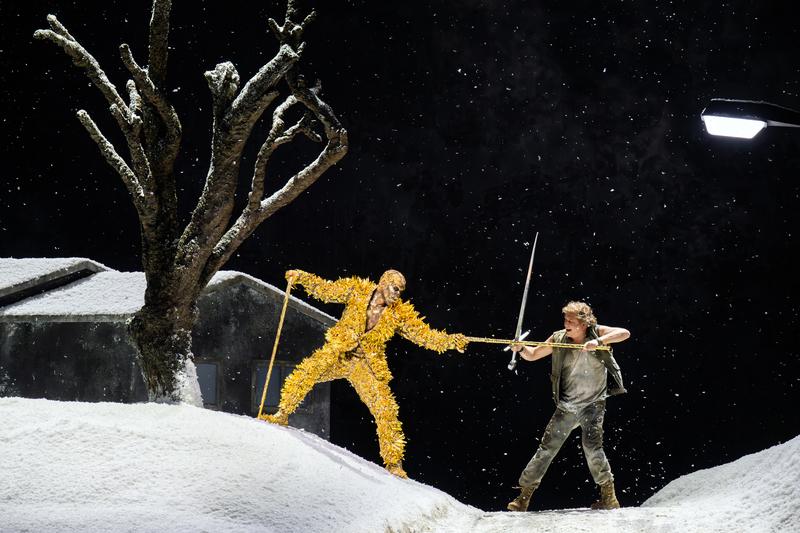
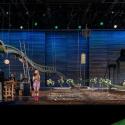
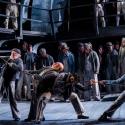
Who else but Kosky would have asked for a snowy landscape around Fafner's lair in Act Two, contradicting perhaps the leafy rustles of Wagner's forest murmurs, but unforgettably composed (bench front of stage, a street light to mirror those in Act Two of Die Walküre, another withered tree, two huts). Soloman Howard is a resonant golden Yeti (pictured above with Schager), but as in Act One, other vocal battles can be uneven: as Hoare has trouble with the lower register, Christopher Purves as Alberich no longer has much of a top, but like Hoare his supreme acting skills overcome that.
Christopher Maltman never has any problem projecting as Wotan, though you sometimes wish his power were mitigated by noble Wanderer tones, and to have him look like Bill Bailey, "Part Troll", sheds a different light on what is here a shabby "Light-Alberich" god. Love the packet of crisps he offers to share with his dark counterpart. Against Erda and Siegfried, though, he seems merely petulant - here's the real bully of the evening - and incipient tenderness towards the grandson he hopes will save him gets lost.
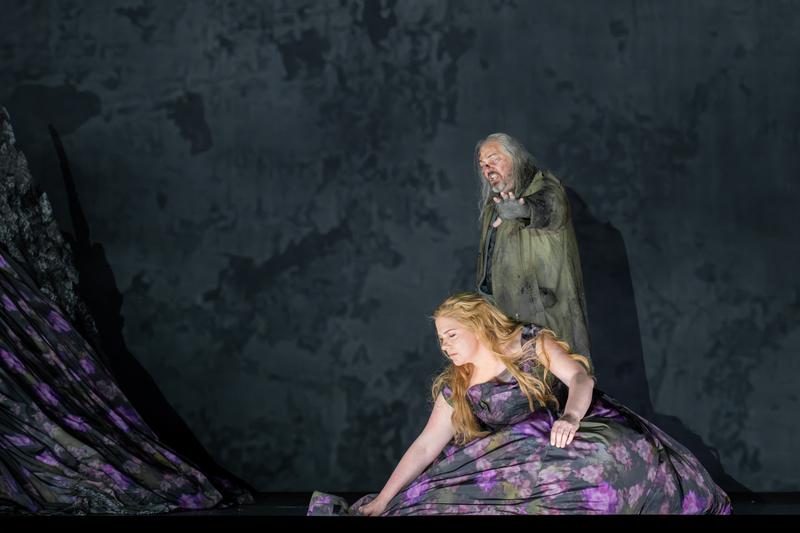
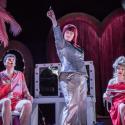
Wiebke Lehmkuhl, crawling out from under old Erda's dress, was, we were told, unwell last night, but you wouldn't have known it, and it seemed essential that she should be a younger version to tussle with her arrogant summoner (Lehmkuhl and Maltman pictured above). If Pappano has any weakness, it's in the lack of cosmic breadth here - and surprisingly, he allows the orchestra to let rip at all times, so Wagner's thicker, more elaborate scoring after the holiday from the Ring in which he composed Tristan und Isolde and Die Meistersinger, can overwhelm.
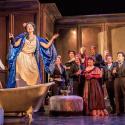
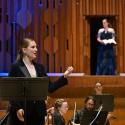
But then, finally, there's the sleeping princess. At least in the stalls, we can't see Brünnhilde lying there among the flowers - a friend looking down from above tells me she was a Pre-Raphaelite vision - but her awakening is radiant. Elisabet Strid (pictured below) is the warmer, more feminine kind of Brünnhilde, but never has any trouble with the cannonade of top note Wagner asks of her in this opera.
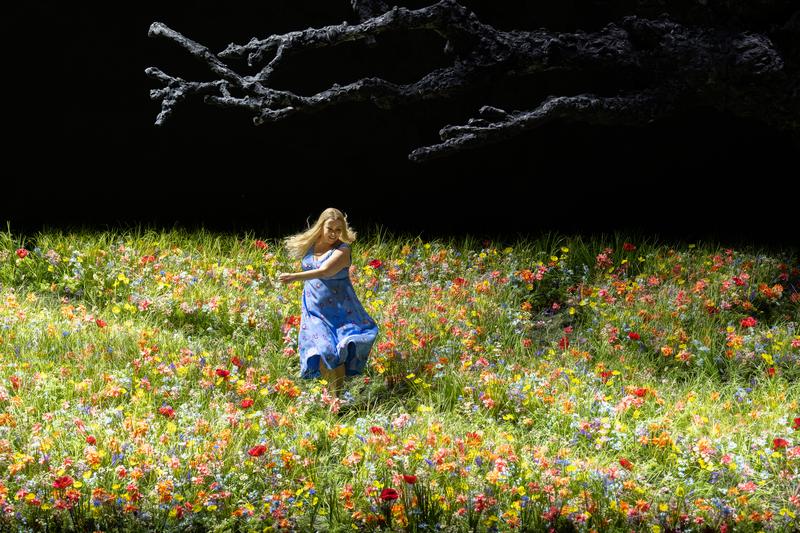
Pappano powers what's finally a blazing love duet after the doubts and fears of his two virgins to an exultant end. From the jubilant curtain calls, it seems as if Schager's Siegfried could have danced and sung all night, and for many of us it's been difficult to sleep. That's the power of a great Wagner night at the opera.

Comments
RBO Seigfried
A Great Siegfried
Siegfried
Siegfried - staging
Mesmerizing Siegfried at Covent Garden
Seigfreid streaming tonight
Siegfried
I watched this live streamed…