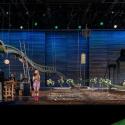
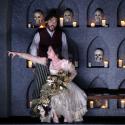
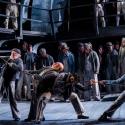
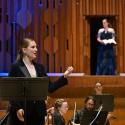
Harry Fehr’s directorial take on The Cunning Little Vixen is a sound one: keep it simple. Together with set and costume designer Nicky Shaw (with whom he worked on a memorable Buxton International Festival production of La Sonnambula in 2023), lighting designer Mark Jonathan and movement director Ewan Jones, he brings Janáček’s everyday story of country life to the stage with a clarity and innocence that reflect the story’s origins as a newspaper cartoon strip.
Of course, as with all good strips, the implications are what really counts: the animals, in the tale of a half-domesticated vixen who escapes to the wild, meets her dog-fox mate and brings up a family, (contrasted with the Forester, who has a soft spot for her, and his village pub friends), are high-minded beings with romantic hearts. The humans, less so.
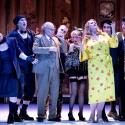
The Vixen is not merely a pure soul, but a socialist (or at least, an agitator prepared to appeal to gullible hens in the name of equality and socialism) and a clever survivor. The humans are a miserable lot: the Forester’s marriage has lost its spark; his drinking pal the schoolmaster cherishes longings for a beautiful girl but can’t get up the courage to woo her; the village parson is over-fond of the booze anyway.
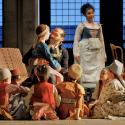
Later we meet the poacher Harašta, who’s the one who eventually kills the Vixen – but life goes on, and one of her daughters will pick up where she left off. In Fehr’s vision the blurring of difference between animal and human characteristics is amplified: the woodland folks have their own bar, as the humans have their inn; the Badger’s sett, occupied by stealth on the part of the Vixen and later by her spouse and brood, is a comfortable abode with books and a sofa – more commodious, we begin to think, than the Forester’s house.
It’s a bit like a parallel to The Wind in the Willows. But, while the costuming is more than half human, with little more than wigs and headdresses to indicate the animal and insect characters’ species, he’s able to present them in movement more realistically than many directors of this charming opera, as the young performers of the RNCM are capable of dashing about on all fours, crouching and performing rolls with some athleticism.
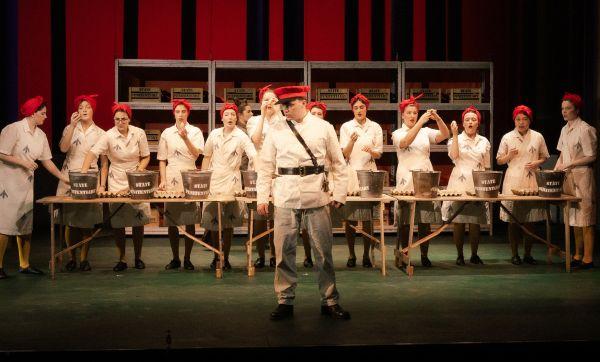
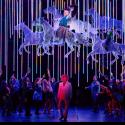
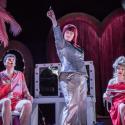
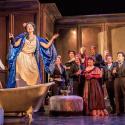
He presents several episodes of the story as dreams in the Forester’s slumbers – particularly the Act One scene for the hens and their cockerel, where we see them parcelling eggs as inmates of a “State Penitentiary” and the cockerel as their uniformed guard (pictured above), and the love scene and marriage of Vixen Sharpears and her Goldenmane, where all the denizens of the forest appear to celebrate their nuptials with confetti and rejoicing to end Act One.
The major part of the set is direct and evocative, just columns to represent the trees of the forest, striking lighting to show the seasons and the time of day, and the other location features, detailed and realistic as they are, flown in efficiently (occasionally covered by a full drop curtain) so that the fast-moving sequence of scenes flows beautifully.
There is excellent pacing, too, as in that love scene where Vixen Sharpears’ “Yes” to Goldenmane’s declaration of love seems like a plighting of troth, and the wedding scene, with the large RNCM Opera Chorus gathering round, is a visual feast.
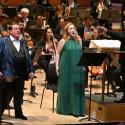
The opera is sung in English, in David Pountney’s clever translation, and uses a reduced orchestration by Jonathan Lyness, which, while exposing some of the lines to unavoidable prominence, making some demands on individual players, ensures that the singers never have to struggle to be heard. With conductor Martin Pickard’s experience, the principal singers have a sure hand to support them, and the chorus are reliable as ever under Kevin Thraves’ tutelage.
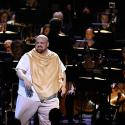
The opera is double-cast in some roles, and I have seen only those who appeared in the opening performance, but I can commend those who sang The Forester (Charlie Barker), Goldenmane (Esther Shea), the Schoolmaster (Jay Broadhurst), the Forester’s Wife (Jemima Gray), Badger (Benjamin Finnie), Parson (Christina Loizou), and Harašta (Khaled Issa) in it, alongside those who take roles in all performances such as Katrina Mackenzie as the young Sharpears, Sam Rose as the Cockerel, and Grant Haddow as the publican.
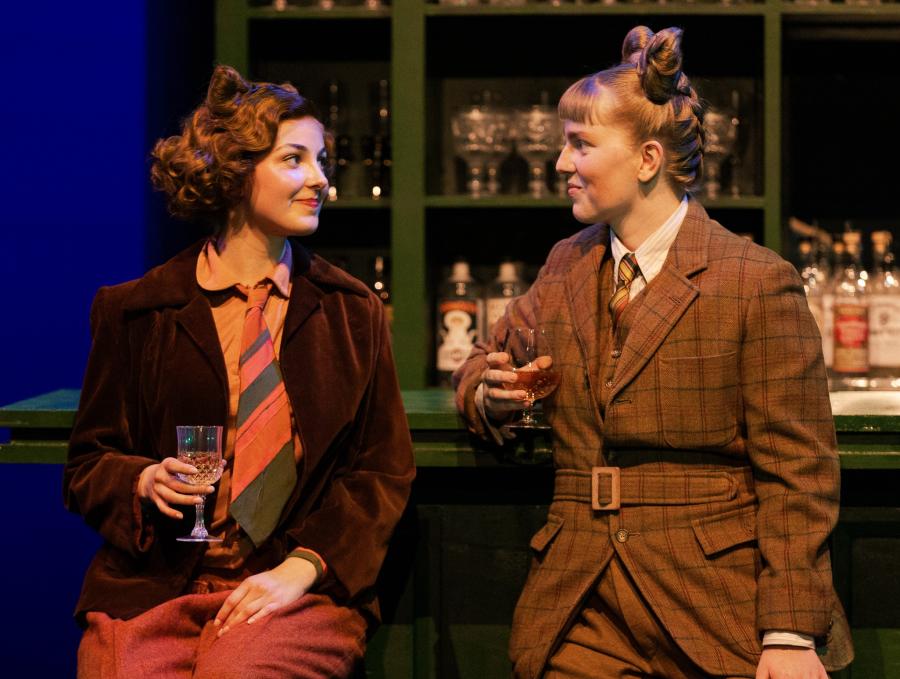
The key role in this opera, however, is the Vixen herself, and Clementine Thompson (who took it in this cast and will in one other performance, pictured above, with Esther Shea) was outstanding both vocally and in her stagecraft and movement. Without that it could have been considerably less enchanting – and Hannah Andrusier will I’m sure be a worthy exponent as she assumes the role.
Further performances on 24, 26 and 28 March