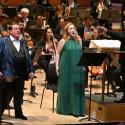
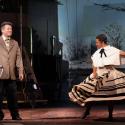
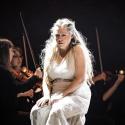
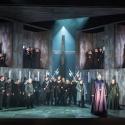
Most concerts of operatic excerpts serve up an after dinner mint. This one offered - to follow up Menotti's image of light versus serious in art - the very bread of life, albeit framed by familiar women's duets from Mozart's The Marriage of Figaro and Delibes' Lakmé. Jennifer Davis, about to make her role debut as Dvořák's Rusalka with Irish National Opera, may have been the initial draw, but mezzo Sarah Richmond was a revelation new to me in major roles, and pianist Aoife O'Sullivan knew no bounds in dramatic torrents, as well as setting up so poetically a perfect Rusalka Song to the Moon.
Davis also gave us significant scenes for heroines with whom she's already created a sensation in a series of debuts around the world. Most lacerating was the awakening from drugged sleep of Janáček's Jenůfa (a role she's sung for English National Opera), whose stepmother has just taken her week-old baby out to drown him beneath the ice. Characterising disorientation, shouted distress and an urgent plea to the Virgin to the harrowing hilt, Davis used the space between the piano and the audience to take us straight to this extraordinary opera's dark heart. The technique is free and easy, secure from top to bottom, letting her do what she so passionately needs unhampered.
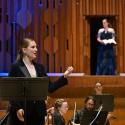
The equivalent to this for Richmond (pictured below) was Charlotte's almost bipolar reaction to Werther's letter announcing his intention to kill himself in Massenet's Goethe adaptation: equally full, rich and wounding. To judge from her biography it's not a role she's sung on stage, but this was as fully lived, Davis was quite genuinely stunned by it, as she showed when she returned to her next slot.
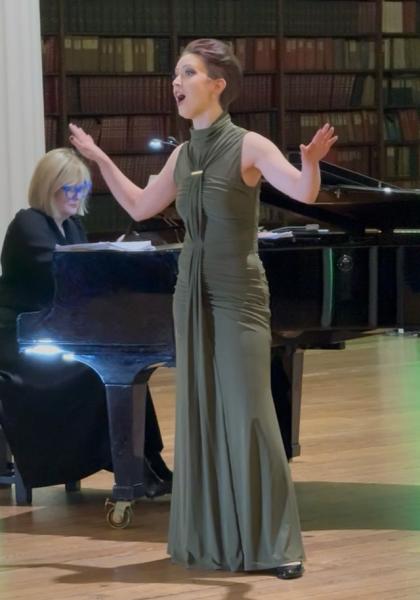
Richmond also gave us a perfect Purcell Dido's Lament, setting it up beautifully to explain the revolving piano bass-as fate, adorning the line tastefully but also holding nothing back in the "Remember me!"s. The relatively light relief came in Carmen's Habanera, stylishly phrased, and the charm of Tatyana's sister Olga - light sentiments, deep contralto register perfectly applied at the end - in Tchaikovsky's Eugene Onegin. Rumour has it that INO will be giving us the full opera next season; I can't comment on the casting, but it looks ideal.
There were further treats from Davis (pictured below) backed up by role debuts in which she's triumphed: Wagner's Elisabeth in a Geneva Tannhäuser (her Royal Opera Elsa in Lohengrin is already legendary) and Strauss's Arabella in Berlin. Both had radiant ecstasy, but Arabella's serious dilemma over wanting none of the four suitors she's being pressured to marry by her impecunious parents brings troubled thoughts before she can turn to the prospect of the coming Vienna Cabbies' Ball. O'Sullivan dealt masterfully with the piano transcription of Strauss's complicated writing, and waltzed us to the end of the scene.
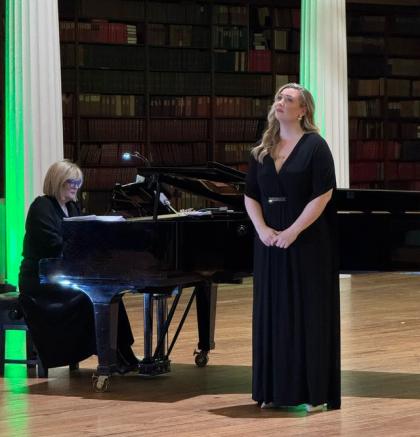
"Dich, teure Halle", Elisabeth's greeting to a place that will be lit up again by her beloved Tannhäuser after his long absence, was electrifying, reminding one of what it must have been like to hear the great Linda Esther Gray at the start of her career (too short, but if the name doesn't resonate, listen to her Isolde for Reginald Goodall).
To add to rich and varied textures, Davis gave us a riotous encore, the only piece on the programme with which I wasn't familiar: the so-called "Tiara Aria" from Jonathan Dove's The Enchanted Pig, in which a bride throws a tantrum at wedding expectations not coming up to standard. Here, too, our soprano spared us nothing of the full works, so it was both genuinely funny and thrilling. Even so, the three ladies all deserved equal accolades at the end of a rich hour, and got them.
As if that wasn't enough, INO Music Director Fergus Sheil told us that this was the last event in a Rusalka weekend, in collaboration with the hosting Royal Dublin Society, preceded by a Saturday in which amateur players worked on the score, and a Sunday daytime event for choral singers. If you live in London or elsewhere in the UK, think of flying over - or taking the train and the boat, if you have the time - to Dublin for the Rusalka, directed by Netia Jones, as six of the students with whom I spent five Monday Zoom afternoons on this masterpiece are doing.