

Marketed as “City Noir” to begin with, this programme title was switched to “Beethoven Piano Concerto no. 4” closer to the off, perhaps because the more familiar of the two main items in it would ring more bells with potential attenders. Unsurprisingly, it proved a thing of two halves, with Beethoven in the first, and John Adams’ self-described symphony inspired by Los Angeles, from 2009, in the second.
The concerto was imaginatively preludised by another American composer’s evocative thoughts – Charles Ives’s The Unanswered Question, in John Storgårds’ first Bridgewater Hall programme with the BBC Philharmonic of 2026. Given the thesis-antithesis nature of the concerto’s first movement and the ambivalent dialogue between soloist and orchestra (like a soft answer repeatedly turning away wrath) of its second, the concept of Ives’s short piece seemed very apposite.
In his case the existential question posed by a solo trumpet (as if calling out “What are we doing here?”) is demeaned, distorted and finally ignored, despite the gloriously tender and ethereal cushion of string sound against which its would-be dialogue is heard. It was played with extraordinary subtlety and gentleness by the strings led by Emily Davis, with the flute quartet suitably grinding out their unsympathetic response. The only real problem was the Bridgewater Hall Coughers’ Collective were also present in fine voice, something you probably can’t entirely avoid on a damp winter’s night in Manchester. It will be interesting to find out whether the BBC’s technicians have been able to soften their impact by the time the concert is broadcast.
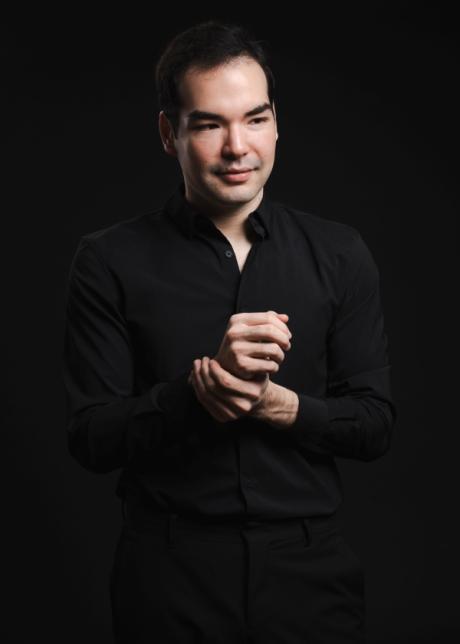
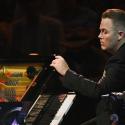
Anyway – to the concerto, which demonstrated the gifts of Alim Beisembayev (pictured) – Paul Lewis being unable to appear. Winner of the Leeds International Piano Competition in 2021, he is a performer of extraordinary skill, with a touch at once lithe and fluid and tones often tinklingly clear and crystalline. Between him and John Storgårds, the concerto’s first two movements became an examination as much of the spaces between the notes as the notes themselves: every texture, pianistic and orchestral, was articulated with precision – you could hear some of the detached string chords bouncing as echoes off the wall opposite from where I was sitting – and at the same time allowing time and space for rumination as the music proceeded.
The second movement’s piano statements, sometimes compared to Orpheus taming the wild beasts, sounded like a passionate plea for restraint and kindness, agonizingly heart-felt. The finale, as it should, was fast and furious, and the concerto’s two cadenzas, in the opening and final movements, were show-stoppers in themselves.
The Adams piece made an interesting contrast with the examples from past and present offered in the Hallé’s recent festival of his work. He must have investigated quite a number of differing ways of writing for orchestra in his time: this is not the most recent, nor immediately the most approachable, despite its avowed intention to use jazz idioms and be “cinematic”.
I went to a late-night jazz club in LA once: it didn’t sound much like this. Adams wrote for a very large orchestra (and the Philharmonic strings were brought up to 60 for it), and jazz elements paled by comparison with the riches of the full orchestral palette, and the edginess which I think Adams was trying to get was muted under sheer weight of sound. At least one member of the orchestra had his hand over his ear because of the volume emerging from the efforts of his colleagues.
After the first movement seamlessly merged into the middle one (“The Song is for You”, Adams calls it), with a slow-down that came as some relief, we heard a brief taste of blue-note melody with a solo in Ellingtonian style, but a series of fortissimo chords from the orchestra soon wiped that out. It’s as if he’s unable to let melody have too prominent a role in his writing, repeatedly allowing it to be overcome by explosions or busyness (or at least that’s how it sounded on this occasion). Adams says it’s meant to be violent: he writes comprehensive programme notes for his own music, so it must have been intentional.
The final movement (“Boulevard Night” – presumably the Hollywood or Sunset) begins quietly and atmospherically, but not for long. After a short general pause he seems to want to evoke The Rite of Spring, and the alto saxophone solo that might have been a reminder of subtler things was almost drowned. After another pause he goes for broke again, with more familiarly Adamsian motoric rhythms and ostinati. It’s all rather too complicated to be suitable for actual filmscore use, but very, very clever. No complaints as to the virtuosity of the BBC Philharmonic in performing it, or as to John Storgårds’ skills in directing them, but I wonder whether the music has the qualities to live completely up to its aspirations.


Add comment