

The Proms listings are full of concerts a bit like the one last night that seem to offer up, on paper, little of real burning interest: no big names, no star foreign orchestras, no intriguing rarities, no new works, nothing beyond one hard-working BBC orchestra and a few staple classics (a Strauss family waltz-medley and some Schumann) that could be rattled off by any professional orchestra blindfold. Be warned: these are the concerts that are most likely to transfigure your evening, stir your soul and leave you reeling.
At least one element of the concert line up was destined to do all these things anyway: Christian Zacharias - one of my Proms recommendations. Zacharias is one of the most intelligent and characterful pianists alive today and a hugely underrated figure in this country. Above all, he is a great original at the piano, a great refashioner of phrases, a great chiseler, chipping away at old chintzy bad habits. The Schumann Piano Concerto came out from this surgery almost unrecognisably new, fresh, intense and lustrous.
The opening hovered between a stilled dream state and a hesitant, rushed, rushing reality. Melodic statements were fleet, never lingered over indulgently but harried down into the bass. The coda was a transforming experience as both Zacharias and conductor Sinaisky crouched down into their instruments for the devil-dotted pianissimo dance. Zacharias tiptoed and then sailed hazily through the soft weeping willow branches of the Intermezzo into the Allegro vivace.
The Allegro vivace entrance was a marvel in itself. The door to this movement is opened by way of a descent of several suspended chords that fall on us like moonlight. Zacharias couldn't help but make it a moment of wonder. And there was a rethinking and recolouring through to the very end: rhythms re-examined, accentation re-balanced, much of this pedal-led. Zacharias must be one of the world's great pedal virtuosi. Notes were bled and then dried with mesmerising fluency and unorthodoxy. This was quite simply a fabulous performance.
But then so was the programming. I never think of Schumann as a great dancer. But actually, while there are few conventional dances in the concerto or the Overture, Scherzo and Finale that opened the night, there's a lot of air-borne activity and plenty of sweetness and light. So it was but a dotted hop to the waltzes of the second half.
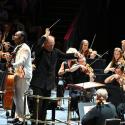
The real surprise of the night was the transformation of the BBC Philharmonic and their conductor Vassily Sinaisky from two nights ago. Sinaisky was a new man: sure-footed, responsive, deft, full of charisma and cleverness. In this company, the genius of the Strauss family and some of their most famous crowd-pleasing waltzes - and one polka - was able to be fully grasped. Elasticity and firmness - a balancing of the two - is what maketh the waltz and what madeth this performance, Sinaisky holding back and pushing forward, judging every tempi shift and scene change, from the heart-rending Austrian paean of the Emperor Waltz, to the rambunctious city sounds of the Radetzy March (by Johann Strauss père) to the ravishing languor of the Die Fledermaus overture, to perfection. Every section played their part. Not to be outdone by the principal clarinet on Friday, second clarinet, Colin Pownall, delivered a melancholic cameo of true delight in the overture.
And the man who should have been at the podium, Sir Charles Mackerras, who died last week, was almost certainly making one last fleeting appearance somehow, somewhere, during the Slavonic Dance in E minor, Op 72, No 2, by Dvořák, which had been programmed in his honour. One felt his presence hovering above us. I imagined him indulging in one final Czech kick of the heels during the triangled little dance that bursts out with quiet joy through the tender sadness of this little work. RIP, Sir Charles.



Add comment