

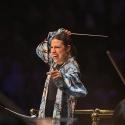
There are enough historical reasons for differing approaches to Handel’s Messiah to allow every conductor to produce, effectively, their own edition. American conductor Jeannette Sorrell gave the Hallé audience a streamlined, power-driven one that had them on their feet at the end as well as during the Hallelujah Chorus.
The main reasons for that were undoubtedly the precision attack and dynamic strength of the Hallé Choir’s singing – most of them doing it without the book (and choral director Matthew Hamilton got one of the biggest cheers as he took his bow) – and the exciting and characterful contributions of the tenor and bass soloists, Thomas Elwin and Henry Waddington – all four off-book, too.
It was promoted as a “theatrical” reading. Now, if you want “theatrical” in your Messiah, you could go back to Barbirolli’s way, with insistence that the “Glory to God” chorus should begin sotto voce (following Handel’s note that it should be “from a distance and quite soft” and so framing the angels’ appearance with an sonic zoom effect) – and later having the last allegro “Hallelujah!” shouted, at the tops of their voices, as well as employing all available instrumental resources. (The first time I heard that I thought they’d all gone berserk).
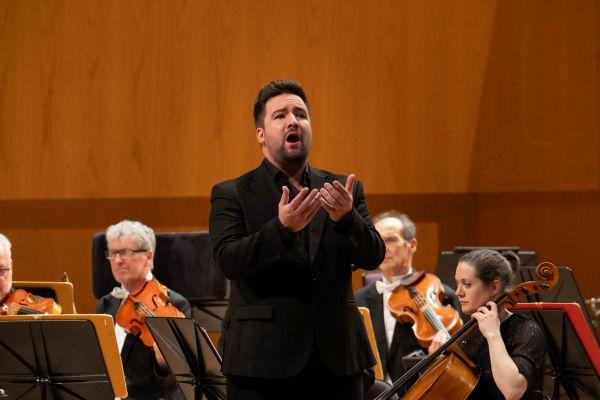
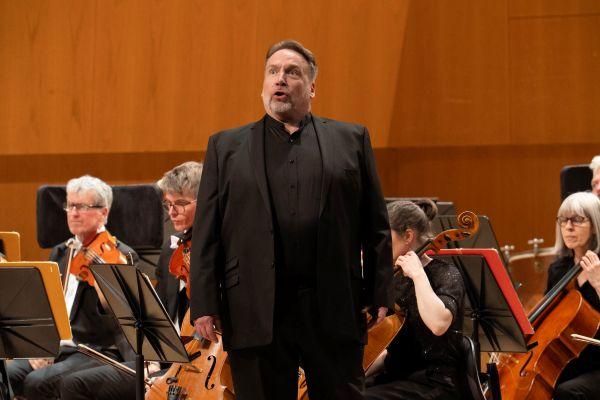
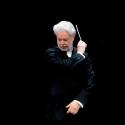
But neither of those devices played a part this time. Baroque operatic style certainly did, with some of the recitatives bounced along at speaking pace and some, albeit intermittent, exercises in period gesture technique. From the raised hand of Thomas Elwin (pictured above), as the prophet Isaiah proclaiming “Comfort ye!”, through his evangelist-style telling of the Passion narrative, and to a lesser extent in “He was despised” from Beth Moxon and “I know that my Redeemer liveth” from Sonya Headlam, these were effective in adding vitality and drama to their singing. Henry Waddington (pictured below), on the other hand, hardly needed to do any, as his presence and voice were enough on their own: he was still compelling throughout.
What was something of a surprise – and I’m not sure explicable purely on grounds of dramatic effect – was that “Then shall the eyes of the blind be opened” and “He shall feed his flock”, “Behold the Lamb of God” and “Lift up your heads, O ye gates” were all left out, as well as the more conventional omissions in Parts Two and Three; and the early Passion numbers were shuffled a bit, so that “He was despised” was later than normal. It was all over in two hours 20 minutes (including interval), which was going some, and maybe that appealed to people anxious to be home early, after a 6pm start.
There was no lack of bodies in the hall (almost sold out), so the timing was clearly not a problem, and no lack of appreciation in the hall at the close, so you could say no one minded the cuts, and the impression I have is that Jeannette Sorrell’s approach to articulation gave us clear, spiky counterpoint in the livelier choruses (“… the Prince – of – Peace”, “All we – like – sheep”, “He trusted in God”, and “… even so in Christ shall all be made alive” spat out, almost staccato), contrasting with smooth, layered textures in the fugal “And with His stripes we are healed” and the awe-struck “… and the Lord hath laid on him the iniquity of us all”. “Let us break their bonds asunder” had vivid changes of dynamic, and the “Amen” chorus was spectacularly developed from a gentle, meditative beginning through a beautifully-shaped fugue to an apotheosis of affirmation at its end.
Was it an “authentic” Messiah, in the sense of reproducing the sounds Handel might have expected to hear when it was first performed? Not if you follow the advice of the learned writer who suggested that, to do that, you should start by fielding the smallest orchestra you dare and then make sure that they outnumber the choir. There is still a tradition when it comes to Messiah, and we like to hear a big choir giving it some welly. Manchester has a track record going back before Hallé on this, and he did Christmas performances from the very start (although in the series marketed by his Manchester Choral Society to begin with, in 1858, which was so successful it was repeated shortly afterwards in the otherwise orchestral-only weekly concerts).
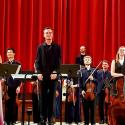
Today’s orchestra, led by Emily Davis, was modest by contrast with the old days, but had oboes and a bassoon plus a chamber organ and made a solid sound (which wasn’t noticeably different whether Handel’s ripieno – full complement – was included or not), and the continuo line came out with double bass trundling along as well as cello at some points.
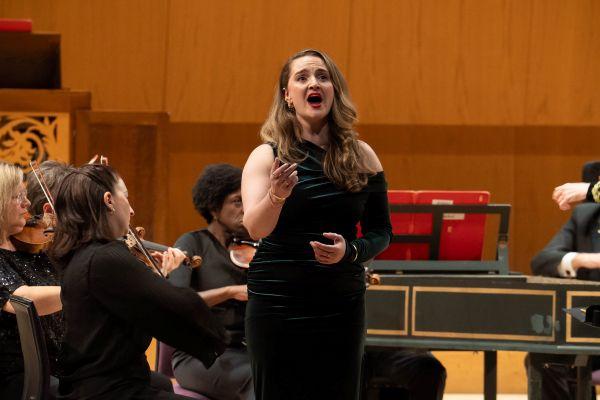
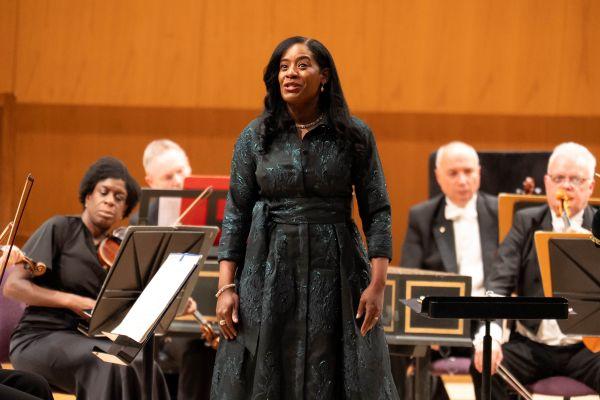
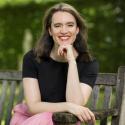
There was a bit of stagecraft in positioning the trumpets up on high with the choir for “Glory to God”, and later bringing some of the singers down to encircle the story-telling soloist in “He trusted in God” Most effective, though, was the use of voices, both choral and solo. I’ve mentioned the outstanding contributions of Thomas Elwin and Henry Waddington; both the lady soloists were not those originally advertised but were imaginatively refreshing in their approach, too. Beth Moxon (pictured above) switched seamlessly from chest to head voice as the pitch and sense of the words required to provide a fiery account of “But who may abide” (there may be an Amneris in her one of these days) and in “O thou that tellest” and movingly in “He was despised”; and Sonya Headlam (pictured below) shone in “Rejoice greatly”, decorating the final cadence, though coming over perhaps a little warbly and over-careful in “I know that my Redeemer liveth”.
Hamilton Harty told Isobel Baillie that the important thing was that you should believe it, not just sing it, and that is part of the enduring appeal of Messiah, whenever and however it’s performed. Hearing it is almost like a pilgrimage, and it was a happy band of pilgrims who departed that hall on Saturday.




Add comment