The Philharmonic’s chief conductor John Storgårds was enjoying the taste of his pure, northern native air in Saturday’s concert: Sibelius at the heart of it, with the Violin Concerto played by a brilliant fellow-Finn, plus Rautavaara and Nielsen.
Simone Lamsma gave an outstanding account of what is surely one of the most attractive violin concertos for any listeners: her performance was characterized by panache, lyricism and fearless virtuosity – in fact everything the concerto encapsulates and requires.
The concert’s beginning was intriguing. It’s not often, in that randomised period before the oboe gives the A, that you hear the sound of the celesta engaging in furious high-pitched tinkling, ready for the fray to come – but that all made sense once Rautavaara’s Cantus arcticus was under way. It’s a three-movement instrumental work in which the recorded real sounds of birds, DJ’d by their own exponent of the decks, are woven into orchestral textures that at times seem like Sibelius himself (chords like cushions and big, slow melodies), but with extra interpretation provided by extensive instrumental variations on them – tinkling celesta among their many features.
“Concerto for birds and orchestra” is one nickname it’s been given, and in the first section, the woodwind traced lines of flight and trilled together, and principal cello Peter Dixon’s solo line sang through the texture, and (as often in the piece) there were warm chords from lower-registers in the orchestra as horns, harp and celesta formed another concertante group of their own. The central movement (“Melancholy”) begins with slow, high violin string chords (so Swan of Tuonela!), but by its close has formed a brass crescendo that ultimately drowns the recorded birdsong, and the final one, featuring the cries of migrating whooper swans, comes to another huge climax of orchestral, avian and environment sound before a sudden end to the fieldwork and an orchestral fade-out. At times it seemed as if we were listening to the soundtrack of an Attenborough documentary, but without the Attenborough voice-over: it was cinematic in effect and immensely attractive.
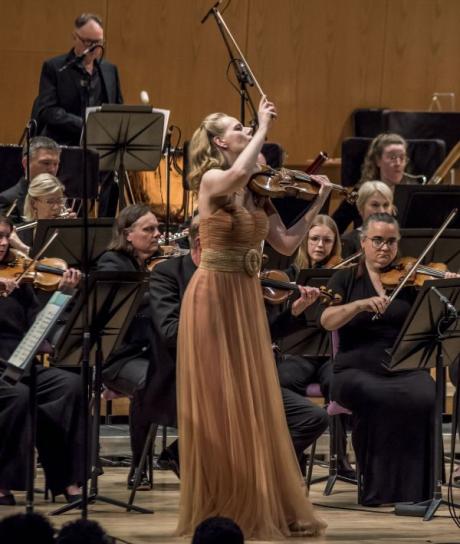
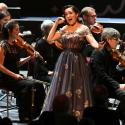
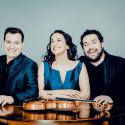
Those high violin chords are at the opening of Sibelius’ Violin Concerto, too – and the Storgårds-Lamsma team were its ideal exponents. He made the brass entry that signals the early solo fireworks both dramatic and haunting: she (pictured) made the solo double-stopped theme both beautiful and mysterious. There’s a lot of two-part playing for the soloist in this concerto, and rarely can those passages have been played with such technical and expressive intensity, their individual lines singing like independent voices (and we heard a masterclass in legato double-stop playing in Simone Lamsma’s encore after it). The slow movement, its opening melody taken to the heights with the unique quality of the violin’s lowest string throughout, had a sweet sorrow to it that was the product of long-breathed phrases, wonderfully shaped, and an unerring sense of the inevitable as it reached its high point of intensity.
The finale, almost always a show-stopper, posed a question: Sibelius marks it as “allegro – but not too much”. But what could that be? Can you have too much of a good thing? It was a wild ride, from the first big orchestral intervention, through the delicacy of the soloist’s second theme (mirrored in the front-desks team of the orchestral strings), and through to the stunning conclusion. It always was a concerto for passion and virtuosity – rarely has it been realized with such drama.
Nielsen’s Fifth Symphony is a popular one: perhaps the epitome of what “musical argument” can be, as conflicting ideas are set against each other in eager, if not fierce, competition. The two movements contrast, too: the first beginning gently and ending with a mellow clarinet solo; the second beginning with full-on conflicted ideas and ending with a positivity which is that bit too hysterical to be convincing as a happy ending. Between, in each case, come ideas which appear to lead in contradictory directions, with more questions asked than answered.
Known – possibly notorious – for the point where the side-drum player seems to go on a crazy excursion of his own (testing to destruction what appears to be just a rather picturesque entry by a marching band on a peaceful scene), the first movement can be presented as a fight which he wins outright. That was not John Storgårds’ way. True, the mad drummer’s interruption subverted all the lyricism and tenderness of the preceding music, but in this battle the rest of the orchestra undoubtedly won, with a magnificent brass chorale before John Bradley’s lovely clarinet solo.
The second movement’s full-on clashes of ideas were finely controlled, and the deceleration that brings that argument to a close was expertly presented. The jig tune that follows was magnificently realized with grim fury, and followed by tender string playing under the guest leadership of Róisín Verity, and an exceptional injection of energy and determination to create the ambiguous ending. At the close Storgårds looked a happy man, and he had every right to be. There may still be a blockbuster finale to his season here, in the shape of Mahler’s Symphony No. 2, but this was as convincing a demonstration of his rapport with this orchestra as could have been demonstrated.