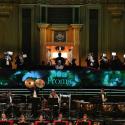
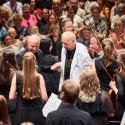
Honegger's gaudy 1935 meditation on the life of Joan of Arc - which we witnessed in concert last night at the Barbican - is an untidy flea market of meretricious musical ideas. The work's only value lies in it being able to make one understand why the likes of Pierre Boulez felt forced to make their postwar musical revolutions so sweeping and so violent. The sort of musical slime that the interwar French Neo-Classicists like Honegger left behind - one of the worst examples of which is his Jeanne d'Arc au bûcher (Joan of Arc at the Stake) - required an industrial-strength response.
This was as fine an outing as Honegger's tawdry oratorio would ever get
Qualitatively, the music and libretto of Jeanne walk hand in hand. Paul Claudel's words mostly stumble around in a pompous poetic fog. Every now and again they snatch at something solid and tacky, to which Honegger never fails to respond with bitty, foursquare trash of deadening literalness. The drama lurches between the banal and the pretentious. The first 10 minutes are given over to establishing Joan's name. The next 10 sink into a sleep-inducing philosophical ponderousness. And to think of the detail, the emotions, the hardheaded political and historical truths that Carl Theodor Dreyer conjures up with the same subject matter a decade earlier, using the most basic film techniques.
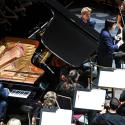
Yet this was no dud performance. This was as fine an outing as Honegger's tawdry oratorio would ever get. Nicolas Dorian (who, rather excitingly, represented Belgium in the 2011 Eurovision Song Contest) and sparring partner Mark Antoine (a French TV presenter) messed around with great theatrical panache in their various minor comic roles, most of which were simple caricatures of Joan's enemies. Was this perhaps a pre-emptive propagandistic strike by a patriot against France's tub-thumping neighbours? Before one could even begin to care, another tinselly, syncopated, ondes Martenot-capped wave swept over us.
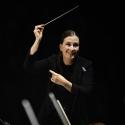
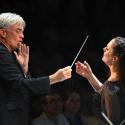
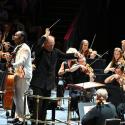
The women (Katherine Broderick, Kelley O'Connor and Klara Ek) - representing various saints and angels - were all very fine. Paul Nilon delivered his fast patter with brilliance. Jonathan Lemalu offered plenty of musicality and conviction. Amira Casar's Jeanne d'Arc was suitably mystical and pigheaded - reminiscent of those feisty, fey females that one often saw running around Godard's Paris. Conductor Marin Alsop elicited a clean and clear performance from the London Symphony Orchestra. The London Symphony Chorus might have given it more oo-la-la. But it would have changed little. Death at the stake would have remained preferable to any more Honegger.
- Check out the rest of the London Symphony Orchestra 2011/12 season