

There was a common factor in the superficially disparate elements of this Hallé concert, and it wasn’t just the fact that both soloist and conductor were female. It was an experience of the colours of the music and a sense of enjoyment of what orchestral music offers.
The conductor was Kristiina Poska, chief conductor of the Flanders Symphony Orchestra and herself Estonian, with a firm track record in concert hall and opera house. She has a reputation for her interpretations of Sibelius and brought her reading of his First Symphony to this podium, but first she offered us Brits something quintessentially British – the Four Sea Interludes from Britten’s Peter Grimes.
It was interesting to hear bird noises of every kind emanating from the platform as the orchestra’s wind players warmed up before the concert began: that stood them in good stead for the piece itself, and Poska seemed to relish the richness of the sounds they made. The Hallé brass were warm and rounded as ever in the opening “Dawn”, and it became clear that this conductor was interested in more than mere sound effects, with a clear focus on the shape of the musical paragraphs and on melody. The final “Storm” was enthusiastic and rhythmically buoyant.
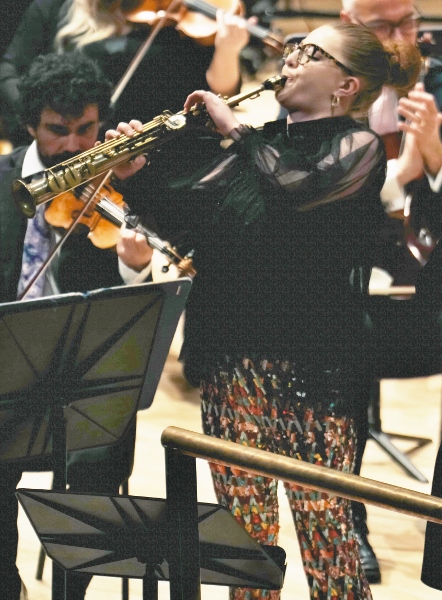 The soloist was Jess Gillam (pictured), who has done wonders for the saxophone and its repertoire. For this she brought a work written for her – John Harle’s Briggflatts. This three-movement concerto proved a showcase for Jess Gillam’s virtuosity and infectious charm. There were some similarities, in a way, with the Britten just heard before it: particularly in the use of instrumental colour (and definitely more ostinati rhythms … a lot more). The first section, “Flare”, gives her a big, soulful tune, which was eloquently played, and has the added surprise of a passage for the soloist accompanied, at first solely, by unison (or more or less unison) hand claps from the orchestra. The central “Garsdale” was not a million miles away from Britten’s “Sunday morning” movement, ambling at a pleasantly steady tempo, and the final “Rant!”, after its wistful and atmospheric opening solo, was a helter-skelter of tunes played with laid-back mastery. There were cheers at the end, which you don’t often get with the Hallé’s afternoon audience.
The meat of the programme, though, was the Sibelius symphony. As with the Britten, Kristiina Poska’s approach (with the orchestra led by Hannah Perowne) yielded phrasing sensitively shaped and a sense of melody leading the music. Sergio Castelló López’s opening clarinet solo was subtle and gentle, leading to an almost shocking contrast with the string tune that follows, and the first movement’s second main theme (marked piano ma marcato) was pointed and telling. Climaxes were warm, rather than colossal, and in the Andante (in reality anything but a conventional slow movement) the strings’ contribution heartfelt and the horns’ chorus well blended.
The Scherzo’s hammering, energetic rhythmic figures were taken fast but precise and still dance-like, with clean articulation from strings and woodwind. Only in the opening of the slow interlude was there a moment of uncertainty in the brass chorus, but that was well redeemed by the thrilling stretto ending. The finale had all the best of the preceding movements: energy, clean articulation, passionate string playing, and a peroration that was both powerful and beautiful.
- Repeated tonight and on Sunday 24 March
- More classical and opera reviews on theartsdesk




Add comment