The master pianist and pedagogue Heinrich Neuhaus impressed upon Elisabeth Leonskaja the maxim "don't look for yourself in the music, but find the music in you", something she says she reflects upon daily. Which is how she seems to channel the essence, shedding ego but retaining personality. More recently she's given us one-composer marathons - Beethoven's and Schubert's last three sonatas above all - so to be reminded of what genius there is in her more diverse programming was a special pleasure in last night's recital of Beethoven, Schoenberg, Chopin, Webern, Schubert and Mozart. The authority and the magic were as peerless as ever.
The parallel themes were fantasy in the first half, the concept giving Beethoven in a work we rarely hear and Chopin in his Polonaise-Fantasie the opportunity for some futuristic sounds, and rigour in the second, the Schubert sonata in question offering his most concentrated exploration of a single, stark idea in the first movement and variations that made more sense than Webern's (in serialism, surely, anything can be related to anything). The first notes were startling: Beethoven's Fantasia in G minor, Op. 77, a work I didn't know, starts with scalic upper register cascades, answered by a variety of noble ideas: Ariel flying in to listen to Prospero was the immediate impression, for me, at any rate. At one point Caliban joins the dialogues. Descending the stairs at the interval, I heard a voice behind me saying "If that were all Beethoven left us, we wouldn't bother". Stuff and nonsense: the pioneering originality of the genius is apparent throughout.
Schoenberg's Six Little Pieces reduced the fantasy to aphorisms and maybe gave Leonskaja a break; she only used music on the piano for this and the Webern, the phenomenal memory at 80 serving everything else. Then there was clarity and space in the welter of notes in Chopin's fiendish Scherzo No. 1 in B minor, the tremendous bass resonance of the Russian schooling coming into play for the first movement of a quasi-sonata, followed by the rapt Nocturne No. 8 in D flat as a noble, never sentimental serenade which only at the end turned ethereal. All the more reason, then, to sustain that with the magical opening ascents, pauses for transcendental thought, before the Polonaise-fantasie took off as phenomenal finale.
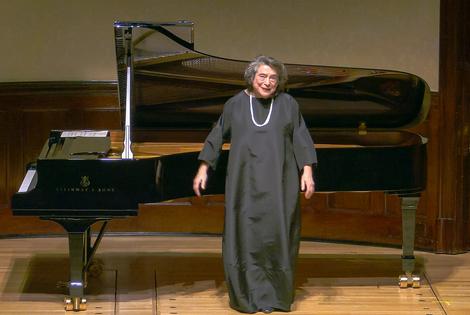
Bafflement over Webern's last published composition, the so-called Variations of 1935-6 - I'm not the only one to scratch my head, since David Owen Norris suggested the same in his excellent notes - was offset by Leonskaja's precisely etched placement of seemingly random notes. Then, as if what we'd already heard wasn't a taxing programme for a pianist of any age, the big work at the end crowned the evening. Schubert starts his A minor Sonata, D845, with a lonely theme that, especially if heard in its original form four times as the exposition repeat Leonskaja always gives, serves as a figure of fate. Nowhere else that I can think of does the composer exploit a single idea so ruthlessly - dramatic in the development, originally tailored as we find ourselves in an unusual recap.
The Leonskaja thunder linked it to the second movement's variations by virtue of the excursion into C minor. Throughout, right to the very imposing end, her perfect partnership with Schubert gave us a masterly balance between simplicity and originality, darkness and light. The light and the simplicity won out at the very end of the evening in the Andante from Mozart's K545 Sonata. To think that years ago Leonskaja played them all "without really appreciating at the time how difficult they were and what it all meant". Now we have her complete Mozart sonatas on Warner Classics, an indispensible set like her complete Schubert, to prove that the difficulty is overcome with supreme wisdom.