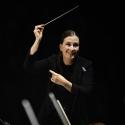
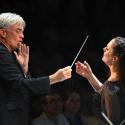
Kahchun Wong ended his second season as the Hallé’s principal conductor with a blockbuster – and one from what may be seen as his personal zone of expertise: Mahler’s Sixth Symphony.
Blockbuster in the sense that it’s a huge undertaking logistically, with a very large orchestra required, and that it’s a very big work. Blockbuster also almost literally – the finale requires an enormous Thor-like hammer to be wielded, at least twice, to create a thud akin to that of an axe at the base of a tree.
Should it be three thumps, or just two? Mahler changed his mind about that, and editors and commentators have disagreed about what his final intentions were, or would have been if he’d wanted them known. This time there were two – contrasting, but not quite as might have been expected (more of that anon).
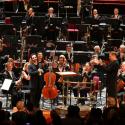
The sound world created by Kahchun Wong was much akin to that obtained by Sir Mark Elder when he conducted the work with the Hallé in 2015 (it doesn’t come round very often, and you can guess why when you see the number of players involved): there were four harps again, as well as the two timpanists specified in the score, the cowbells to be heard both “in the distance” and present in the hall, and the off-stage tubular bells. It all adds up to a luxurious sonic experience, and, with an orchestra of the Hallé’s quality, that applied to the tonal beauties of its strings, its woodwind soloists and its brass (the eight-part horn section outstanding). The “distant” cowbells were, as 11 years ago, decidedly distant, as were the tubular bells – all to the good, as they are surely supposed to evoke memories and associations rather than supply bucolic sound effects, and that applies really to the ones played in the main auditorium, too.
There is a choice to be made, in the light of Mahler’s second and possibly third thoughts, in the order of the inner movements of the symphony, also. It has four in total, in accord with standard classical precedent (though all of them are very long, and the first specifies an exposition repeat, duly observed, which took the overall playing time to close on 100 minutes). Elder went for the slow movement followed by the scherzo: Wong had the scherzo, then the slow movement. You can make musical arguments in favour of each: perhaps it’s a question of whether that slow movement, so different in style from the rest of the symphony, can be considered as a temporary excursion into dreamland or a necessary contrast, the more to emphasize the grim reality that is to come in the extended final movement.
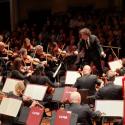
Such known unknowns aside, it was clear that Kahchun Wong sees the symphony as a seamless whole, but holding within it near-infinite variety. Contrasts and clear melodic leading were the keys to unlock an incredibly complex score.
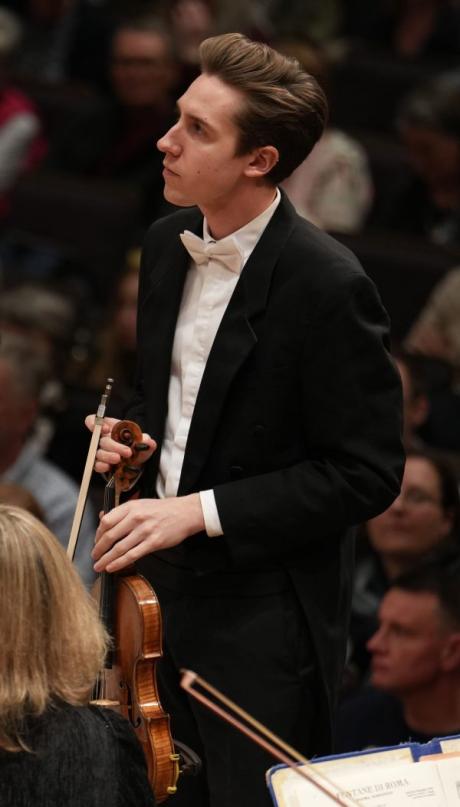
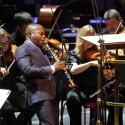
The opening movement’s strange, chromatic chorale-like theme, to follow its gritty march tune, made the first of many tellingly vivid internal mood-switches, and after it the “Alma” theme (inspired, it’s believed, by Mahler’s love for his then wife) sang gloriously through the orchestra, led by Roberto Ruisi (pictured), with soulful echoes of its melody each time it died away. Ruisi’s solos, and those of principal horn Laurence Rogers, were a glory of the whole performance. And in the recapitulation the second violins created powerful counterbalances to the firsts, as indeed they did later in the work. Kahchun Wong took Mahler’s “Don’t hurry” marking to mean “a bit slower”, with signal effect as a sense of anguish in the sweeping away of the Alma theme by the march was palpable – and then a return to tempo carried away the forebodings of gloom to make a traditional first-movement climax.
The Scherzo had a perfect tempo, solid but not dragging, just as it says in the book, bringing out the caricature side of Mahler’s writing otherwise rare in this work, and the “grandfatherly” tune was made so by a pronounced initial hesitation and some quite big changes of pace – a Teutonic kind of humour, but followed by brisk interpretations of “don’t hurry” and “don’t drag”. At its close the solos of principal flute Claire Wickes and principal clarinet Rosa Campos-Fernandez were eloquent.
The slow movement, an essay in the kind of sentimental Romanticism made familiar by composers of Mahler’s own youth, began tenderly and quietly intense, with the oboe solo beautifully played by Stéphane Rancourt (and the cor anglais one by Matt Jones), and textures overall were gorgeously balanced, with a rich tutti. Of course, it needs to be too beautiful to last …
The finale began strongly but also smoothly before getting properly into its stride: and became a thing of grim determination after the first hammer blow. That was, surprisingly, not as loud as its successor, but the extra power (for which Graham Johns, the exponent of the monster mallet, received the loudest cheer of any individual at the close of the symphony) seemed right in that it brings a kind of orchestral consternation in its wake. Under Wong, the pace did not flag, with a resolute energy remarkable after an hour-plus of playing time, and when the musical collapse came (without benefit of thump number three), the power that had seemed sustained simply evaporated away – a telling ending.
The Sixth has been labelled Mahler’s “Tragic” symphony in the past. There’s much, much more to it than that – pushing the four-movement framework to, and beyond, its limits for one thing, but in this reading it ended, rather than with a bang, but both tragically and movingly, with a whimper.
- To be broadcast on Radio 3 on 10 June (and on BBC Sounds)
- More classical reviews on theartsdesk