Avril Coleridge-Taylor: Piano Concerto & Orchestral Works BBC Philharmonic Orchestra/John Andrews, Samantha Ege (piano) (Resonus)
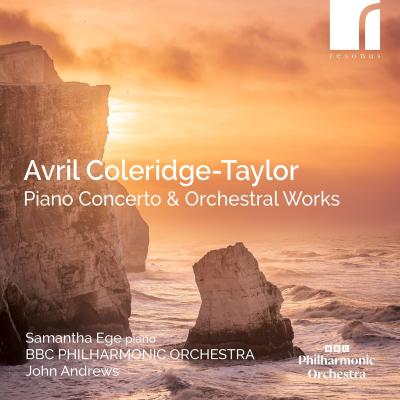
The rediscovery of the music of Samuel Coleridge-Taylor (1875-1912) in recent years has always been marred by the disappointing fact that the music isn’t as good as everyone (myself included) would like it to be. But this first album dedicated to the music of his daughter Avril (1903-1998) suggests that her work may have more chance of enduring in the present day. Although neglected in her lifetime (unlike her father, who was much fêted) her time may be coming, thanks to the advocacy of conductor John Andrews, the BBC Philharmonic and pianist Samantha Ege, who does so much to promote the music of unsung composers.
Ege features on the first, and weightiest, piece on the disc, the Piano Concerto of 1936 (subsequently revised twice), premiered in 1943. It is quite Rachmaninov-like in its lush outer movements (including a near-quotation of his Second Piano Concerto at one point), and has echoes of the film music of the time, but shows subtlety as well as bombast. The heroism of the outer movement is well handled by the orchestra, the piano alternating between carrying the thematic material and accompanying, Ege clearly revelling in the music. The slow movement is the highlight, dedicated to the recently-deceased Elgar (her father’s champion) and played with reverent stillness and a beautifully projected line in the piano. I certainly hope this recording leads to more performances of a piece that I really enjoyed.
Of the rest, it’s all premiere recordings, with only Sussex Landscape previously recorded. This is a dark and bleak wartime tone poem, a million miles away from the Piano Concerto in tone, but very finely orchestrated and convincing in its shaping. In complete contrast is the light-music Valse Caprice and different again is her Comet Prelude, depicting Avril’s air flight to, of all places, South Africa, where she was initially welcomed when work dried up in the UK – till the apartheid government discovered her Black heritage and instantly cancelled all her work. It makes the soaring optimism of the music written at the beginning of her trip all the more poignant. Also poignant are In Memoriam: To the RAF, in tribute to the flying colleagues of her partner Bruce Charlton, and the latest composed piece on the programme, her 1967 In Memoriam to both her brother and father, whose song provides the piece’s theme. It is brief and heartfelt, and all the more impactful for that, and played with understated dignity by the BBC Philharmonic.
Leah Broad’s typically fascinating liner note covers Coleridge-Taylor’s bumpy life story with clarity and sympathy, and casts light on, among other things, how to pronounce the composer’s name. Born Gwendolen (which was getting off lightly: her brother was called Hiawatha) she switched to her middle name only in the late 1920s, when she started afresh after abandoning her husband and young child. Avril, I now know, was “pronounced ‘Avrille’ (as in the French for ‘April’)”. This album makes a persuasive case in favour of the music, whose mid-century accents make it more likely for acceptance into the repertoire than the heavy Victoriana of her father’s, and the Piano Concerto in particular is a fine piece, and takes its place alongside other Resonus issues celebrating neglected 20th century female British composers. Bernard Hughes
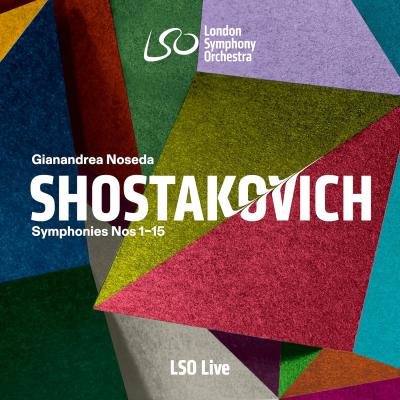
Shostakovich: Symphonies 1-15 London Symphony Orchestra/Gianandrea Noseda (LSO Live)
Here’s a noteworthy late arrival to the Shostakovich 50th anniversary party, nicely packaged, well documented and very reasonably priced. Gianandrea Noseda’s London Symphony Orchestra cycle of the 15 symphonies was recorded live at the Barbican between 2016 and 2025 and this venue’s dryish acoustic suits the repertoire well, the sound full of punch and detail. The LSO’s most notable Shostakovich recordings were made in the analogue era with André Previn, whose first versions of Symphonies 5 and 8 still sound marvellous. Best to avoid a more recent cycle split between the LSO and Washington’s National Symphony Orchestra, conducted by Mstislav Rostropovich and marred by slack tempi and sloppy playing. Noseda’s performances are in a different league: they’re generally taut, cogent and exciting. Try the motoric central scherzo from No. 8, the strings brilliantly incisive, matched by a suitably brash trumpet solo from David Elton. Shostakovich’s huge opening movement doesn’t drag and the grinding shift to C major at the end of the “Largo” is sensitively handled.
The LSO principal winds are outstanding in a witty but brittle take on Symphony No. 1, Noseda finding real pathos in the Mahlerian slow movement. I still can’t get my head round this work’s two successors, though the London Symphony Chorus provide full-throated vocal support. Symphony No. 4 is raw and sharp-edged, the massed brass terrifying in the finale’s garish peroration, followed by one of the spookiest codas in the orchestral repertoire. No. 5 is sober but imposing, while No. 6 moves from stygian gloom to big top craziness, Noseda mapping the journey with real skill. Symphony No.7’s louder passages are ear-splitting in a good way and the introspective inner movements are well characterised, Christine Pendrill’s cor anglais solo in the “Moderato” a highlight.
Symphonies 9, 10 and 11 are exceptional, shrewdly placed and superbly played. No. 10’s closing minutes are unequivocally triumphant, close in spirit to a zippy performance of the Festive Overture. I like No. 11 more and more with each hearing, the violent outburst in “The 9th of January” shattering here. There isn’t a bad performance in this set: Nos 13 and 14 have excellent vocal soloists and Noseda nails No. 15’s haunting close. Andris Nelsons’ recent Boston Symphony Orchestra Shostakovich set includes the six concertos plus Lady Macbeth, but the interpretations are uneven. Noseda’s package is cheaper and more consistently satisfying. LSO Live’s thick booklet contains detailed notes on each symphony plus full texts and translations. The cover art is appealing. A real bargain.
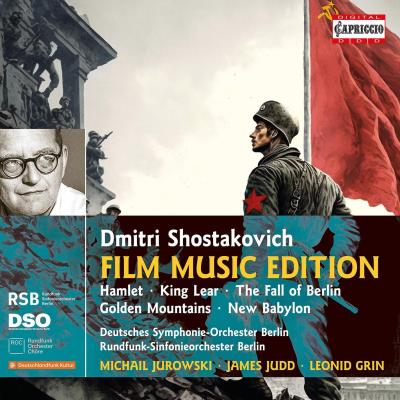
Shostakovich: Film Music Edition (Capriccio)
Shostakovich: Music for Film (Naxos)
There’s more, in the shape of two seven-disc compilations of Shostakovich film scores. Film music was a genre which Shostakovich worked in for his entire career, the works collected here spanning the years 1929 to 1970. It’s interesting to learn that 1929’s silent epic New Babylon was co-directed by Grigori Kozintsev, with whom Shostakovich was planning to collaborate with on a film based on Gogol in the final years of his life. That project was aborted when the director died in 1973. Both boxes include versions of New Babylon’s score, the film a historical drama about the 1871 Paris Commune. Not that you’d necessarily guess that if you listened blind, the music self-consciously un-epic, full of lean textures, quotations and dark humour – that opening trumpet tune is one of Shostakovich’s catchiest and silliest tunes. This is a huge score, lasting almost 90 minutes. Capriccio’s version has James Judd conducting the Deutsche Symphony-Orchester Berlin, Naxos the Basel Sinfonietta under Mark Fitz-Gerald. Both are excellent; Fitz-Gerald’s smaller forces giving his account a little bit more edge.
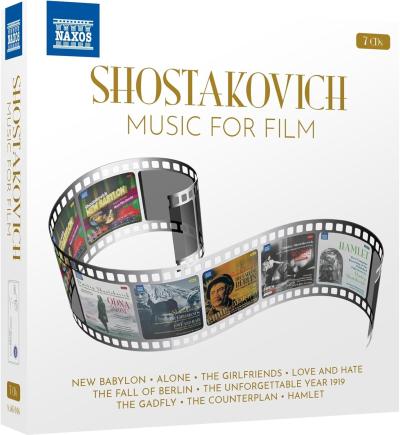
We get competing accounts of the follow-up, 1931’s Alone (both excellent). Plus, a suite drawn from the Maxim Trilogy, scored between 1935 and 1939. Naxos’s set includes the complete published score for Kozintsev’s 1964 Hamlet, brilliantly played by the Russian Philharmonic Orchestra under Dmitri Yablonsky, while Capriccio give us the shorter eight-movement suite arranged by Levon Atovmyan. This is a masterpiece, brilliantly orchestrated with some effective writing for harpsichord and a duel scene recalling the 11th Symphony’s finale. The Capriccio box includes the cues for Kozintsev’s 1970 Hamlet, the director specified that “there should be no stylisation of antiquity… it should be the language of contemporary art”, Shostakovich responding with some thrillingly raw music.
Capriccio has Atovmyan’s suite from 1955’s The Gadfly, including the gloriously cheesy “Romance”; Naxos include Fitz-Gerald’s reconstruction of the entire score. There are many passages when Shostakovich sounds as if he’s writing on autopilot, though they’re offset by the quirkier moments. The composer’s own suite from 1931’s Golden Mountains contains a dense, oppressive fugue for solo organ, and Alone features possibly the earliest use of a theremin in a film score. And while the Capriccio box includes Golden Mountains, The Fall of Berlin and Five Days-Five Nights, Naxos give us Love and Hate, The Girlfriends and The Counterplan. All are worth hearing. Each release contains detailed notes and persuasive performances. Save up and buy both boxes.
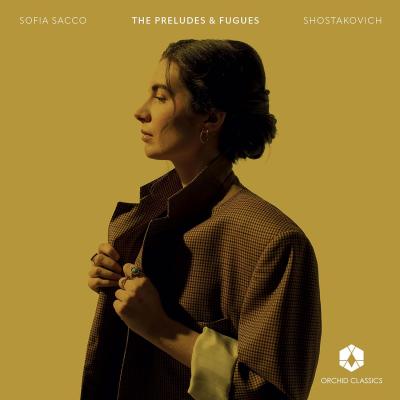
Shostakovich: 24 Preludes and Fugues Sofia Sacco (piano) (Orchid Classics)
Shostakovich’s 24 Preludes and Fugues were composed in the wake of politician Andrei Zhdanov’s harsh condemnation of "formalism" in Soviet music. Criticised for writing music deemed too pessimistic and unheroic for general consumption, Shostakovich lost his teaching position and his works were effectively banned. Film scores (see above) allowed him to keep composing, and several important works, among them his Violin Concerto No. 1, were consigned to a desk drawer in the hope that the mood would change. A trip to Leipzig in 1950 for a festival celebrating the 200th anniversary of Bach’s death was where Shostakovich heard Tatiana Nikolayeva performing excerpts from Bach’s Well-Tempered Clavier; inspired by her playing, he began composing his own set. Though the Union of Composers weren’t impressed when Shostakovich played through the work in 1951, Nikolayeva was a staunch advocate of the cycle and gave the first public performance in 1952. She taped it several times, her Russian recordings better than her award-winning early 1990s set on Hyperion, marred by an over-resonant acoustic and stodgy tempi.
Shostakovich never specified that the complete work should be consumed in a single sitting and only recorded extracts, but Italian pianist Sofia Sacco makes a persuasive case for listening to the individual numbers in sequence. The opening C major prelude is hushed and expectant, the ensuing fugue’s restrained final cadence in sharp contrast to the dizzying A minor prelude, Sacco’s lightness of touch dazzling. Individual moments stand out – the unexpected major chord at the end of the E minor fugue, and a luminous account of the radiant A major counterpart, a piece which never fails to cheer me up. Sacco’s B major prelude is a spiky delight.
You can sense the clouds descending in the cycle’s second half, the E flat minor prelude particularly chilling, and Sacco brilliantly differentiates the schizoid D flat major pair – its prelude sharp and witty, the demonic fugue terrifying. Sacco’s description of this movement as “hideous and irresistible at the same time” nails it. The B flat major prelude’s brightness offers some relief, and the moody G minor prelude feels improvised. All great, then, capped by an emotionally charged reading of Shostakovich’s magisterial D minor fugue. It’s quite a journey. This could be my new favourite recording of this marvellous music, fond as I am of versions by Peter Donohoe, Igor Levitt and Roger Woodward. Sacco’s notes are excellent, and she’s wonderfully recorded. Catch her playing extracts from the cycle at the Wigmore Hall next month if you’re curious.