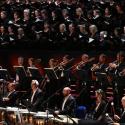
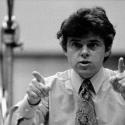
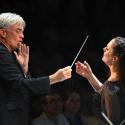
There was I, up to that point, very grateful to be hearing so fresh an approach to a heavyweight, admiring the way the crack Bavarian players sang and danced in every line that so often stays numb until the mechanics of horror let rip, but wondering what the many younger listeners in the audience might be taking from the masterclass. They would sense the shape and urgency of Shostakovich's symphonic argument, but would they feel what the likes of Rostropovich and Svetlanov always told us about the infinite suffering of the late Stalin years, followed by the ambiguous transcendence of 1953, when the symphony was completed? Jansons not only dared to beam as he urged on the players in his energetic guidance; he even seemed to be having fun with the unstoppable machine of the whirlwind scherzo. For once, the ghost of Stalin didn't have to rear his ugly head; this was symphonic rhetoric pure and powerful.
You couldn't fault the muscle and the inner fire of adaptable strings, the sense of physical freedom which has come late to these German orchestras - I only first saw it in the Berliners when Rattle arrived on the scene - and which was so superbly embodied in the youthful woodwind section: first flute reaching to very unusual alto colours in his low register, clarinets on creepy tiptoe in pairs, later the most vocal and expressive oboe solo I've ever heard in the finale's introductory yearning for release.
But everything changed at that point two-thirds of the way through the symphony when Shostakovich, having yanked his personal signature of four notes into marionette mode and rictus smiles, opens a window on a stifling room with the first horn. It doesn't matter whether his emancipating call is another musical acronym, this time of a student love-object, or the opening of Mahler's Song of the Earth - though that seemed even more likely to me in a performance like this, where artificiality suddenly came smack up against open skies. Jansons held the tension, and could have gone on to the further battles of the finale without a break, so intriguingly did the unresolved conflict between horn and woodwind hang in the air . He didn't, but having placed that crucial change of light so unerringly, the argument could afford to relax towards a genuinely exuberant last dance.
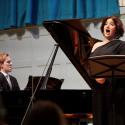
It was, of course, Mahler who paved the way for Shostakovich's bigger symphonic canvases, and so it made sense last night to plunge first into the regrets of his early Wayfarer songs which sowed so many seeds in his own symphonies. Given once-easy baritone Bo Skovhus's disconcertingly hardened, bony sound, all the warmth, sensuousness and sympathy had to come from the orchestra. And it did, Jansons pinpointing like few Mahler interpreters every fleck of psychological detail from the hard metal of the wedding triangle which rings so bitterly in the jilted lover's ears to the little group of first violins leaning on the funeral trudge of the wayfarer's farewell to his village. Skovhus was certainly attentive to what his orchestral conscience was telling him, and cut like the knife of the third song; but brief euphoria and the few moments of spiritual ease could not hope to scythe through his physically tense delivery.
Ease, marshalled with paradoxical care, was the lovely keynote of the first, perfect encore: the gentle spirit of Tchaikovsky's Lilac Fairy hovering in the wings to dissolve Shostakovich's high drama with the Panorama from The Sleeping Beauty, albeit at a daringly slow speed and with a slightly arch but incontestably dewy pianissimo reprise that would have startled the composer. As would the kick up the fairy's backside administered by the drunken Shabby Peasant of Shostakovich's Lady Macbeth of Mtsensk, a final riot that might have had a little more threat behind it than an encore should but which nevertheless set a lucky, very happy audience roaring again.